
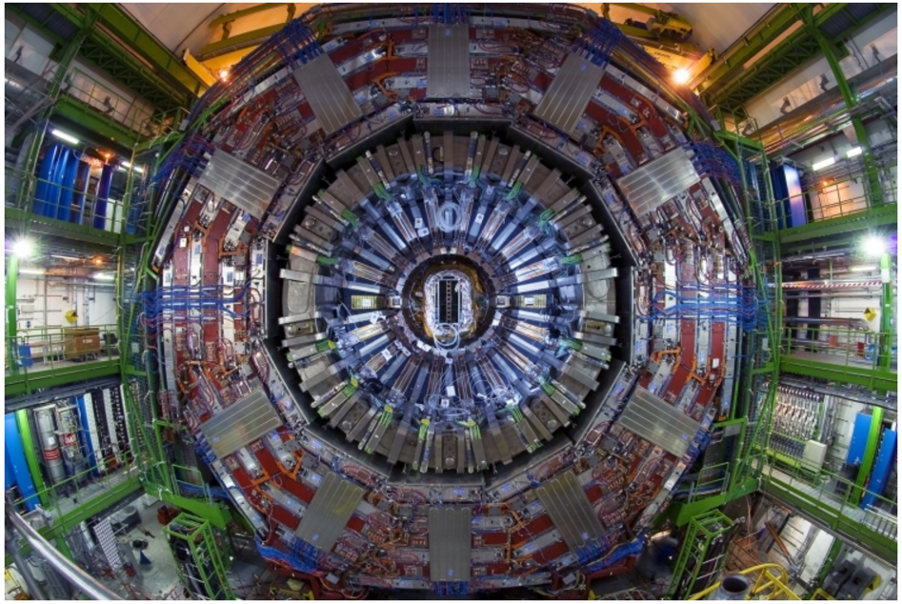
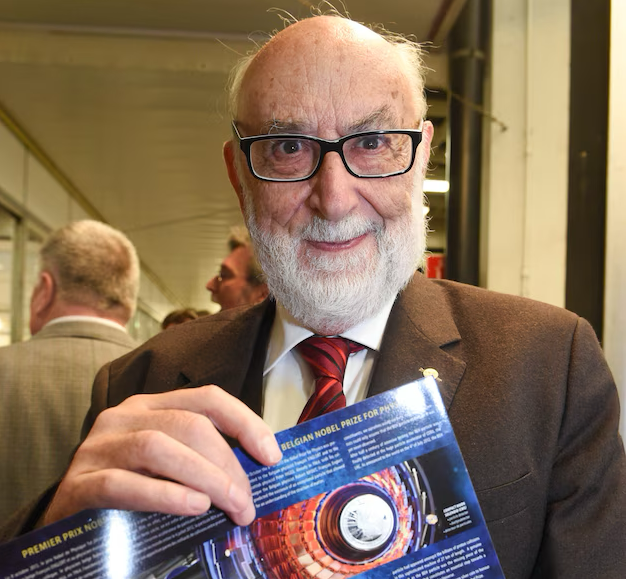
The worldwide CMS Collaboration is deeply saddened by the passing of Belgian theoretical physicist François Englert at the age of 93. Together with his colleague Robert Brout, and independently of British physicist Peter Higgs, Englert’s pioneering work led to an understanding of the mechanism that explains how elementary particles acquire mass. The hunt for proof of the existence of the “Brout-Englert-Higgs field” (see Englert himself describe this in this video) and the associated “Higgs boson” was one of the driving factors for the development of the LHC and CMS.
Although their theory was nearly 50 years old at the time of the startup of CMS, it only took 2 years for CMS and ATLAS to acquire and analyse sufficient evidence for the existence of the Higgs boson, announced to the world on 4th July 2012. Both Englert and Higgs attended the announcement at CERN and witnessed CMS Spokesperson (SP) at the time Joe Incandela show the CMS proof of the Higgs boson existence, seen in five different ways. A year later the Nobel Prize in physics was awarded to Englert and Higgs and, in the same year, he visited the CMS experiment with the CMS management and senior representatives of the Belgian community of CMS. In 2014 Englert visited CERN again to give a seminar on the BEH mechanism and its scalar bosons – a reference for young physicists joining CMS. And he took the opportunity to visit CMS again, this time with His Majesty Philippe, King of the Belgians!

In the 16 years since CMS started taking data the search for the Higgs boson and the understanding of its properties, and that of the BEH field, have been the focus of more than a thousand physicists and students, resulting in the publication of more than 200 peer-reviewed scientific papers on these topics and around 20 more in the pipeline. But several thousand more CMS physicists, engineers and technicians have been involved in detector design, construction, operation and maintenance, as well as calibrating it, developing advanced techniques for analysing the data and reconstructing “what happened” from the trillions of collisions produced by the LHC. A single high-precision measurement can represent many years of work by a large and dedicated team.

The passing of François Englert marks the loss of one of the great physicists whose ideas fundamentally shaped our understanding of the Universe.
The theoretical framework he helped develop, confirmed decades later through the discovery of the Higgs boson at CERN, marked a historic moment for particle physics: the experimental validation of an elegant idea that became a cornerstone of the Standard Model and our description of fundamental interactions.
That discovery did more than complete the Standard Model; it set the course for generations of research and continues to drive our search for a deeper understanding of the fundamental principles governing our Universe.
I had the privilege of meeting François, and what stayed with me most, beyond his extraordinary intellect, was the person he was: genuine, direct, deeply honest, and remarkably humble.
- Anadi Canepa, Current CMS Spokesperon 2026-2028
The measurements performed so far have, in particular, searched for any deviations from predictions made by the Standard Model. This is extremely important, as any deviations may point to as-yet undiscovered massive particles that interact with the BEH field. Indeed the BEH mechanism is far from being a closed chapter: 2012 was really the beginning of a new field of physics research and, indeed, the ongoing long shutdown of LHC is to modify both the accelerator complex and the major detectors (CMS and ATLAS) to continue this exploration into the 2040s.
Englert’s legacy for CMS physicists is enormous. In his Nobel Prize acceptance speech he emphasized “what interests me is not so much the application of things but the way they really function” – a sentiment that continues to inspire our experimental work towards a deeper understanding of the Universe.
