
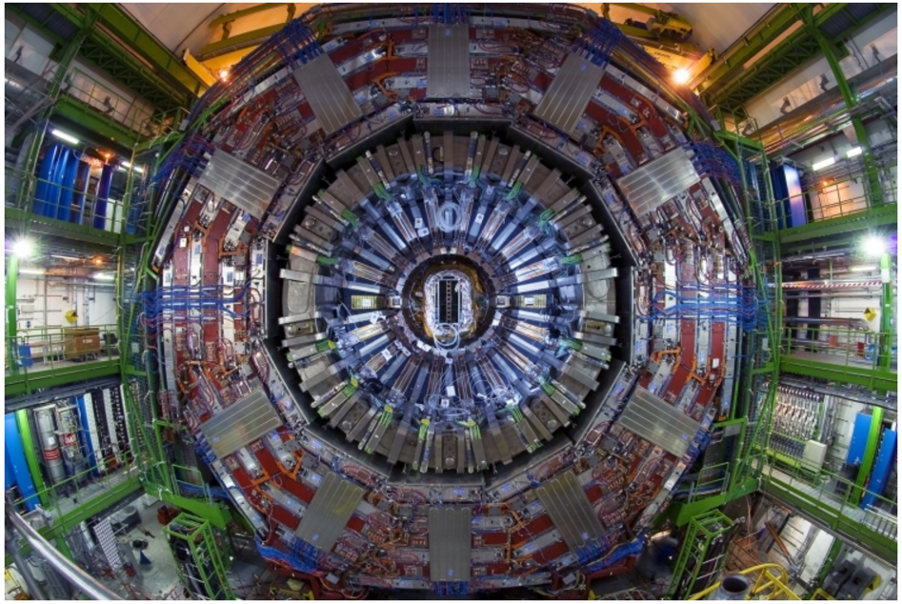
The CMS experiment presents a novel search for new physics by studying collisions that produce three W or Z bosons.
The quest for new physics has taken scientists to the rarest corners of the Standard Model (SM) of Particle Physics. In a new result, the CMS Collaboration reports the first search for new physics using collision events with three highly-energetic W or Z bosons produced at LHC. These "triboson" events, where three bosons are produced in a single proton-proton collision, are exceptionally rare, and were first observed by the CMS Collaboration in 2020.
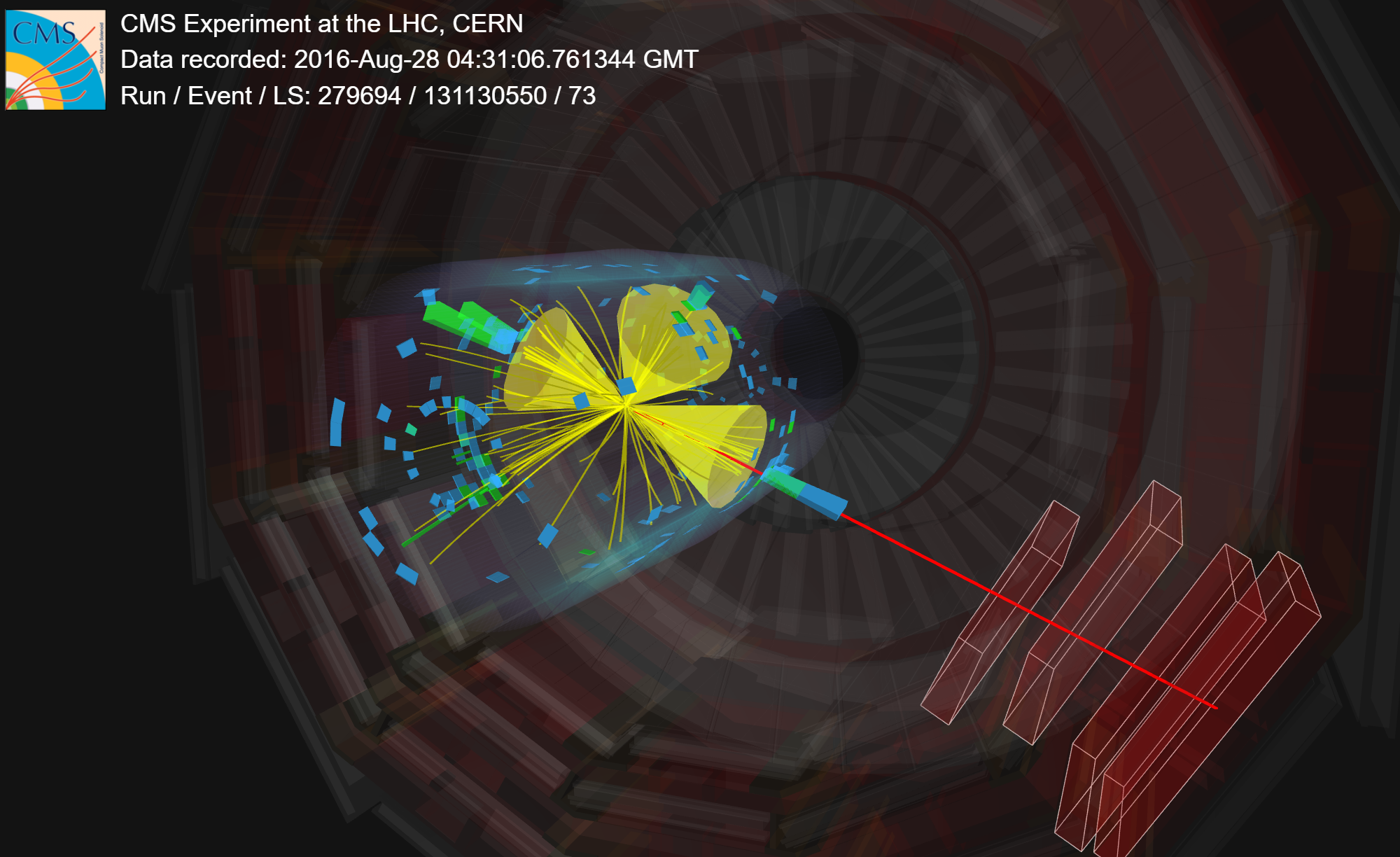
The W and Z bosons are unstable particles that decay to a pair of leptons (electron, muon, or tau particles, and the corresponding neutrinos) or quarks resulting in a wide array of final state particles that can be detected with the CMS detector. Such events are highly distinctive and produce striking detector signatures. One such event is shown in the image above, where all three bosons decay into pairs of highly-energetic quarks that subsequently form three high-momentum jets (collimated sprays of particles), shown as the yellow cones.
A ten-pronged search strategy
The study searches for signs of new physics across ten distinct final states, which are broadly classified by the numbers of leptons and jets. A schematic diagram of the final states is provided in the figure below, which sketches the various decay modes of the three bosons. For each final state, the analysis employs a discriminating variable sensitive to potential new physics effects. This variable is typically related to the total energy in the event, as new physics effects are expected to appear as deviations in the high-energy "tail" of this variable's distribution. In the challenging, tau-lepton specific final states, a machine learning algorithm known as a boosted decision tree (BDT) is used to separate signal from background processes. “This analysis is really expansive and we undertook a comprehensive approach in targeting final states arising from the decay of tribosons”, says Yulun Miao who was a graduate student at Northwestern University at the time.
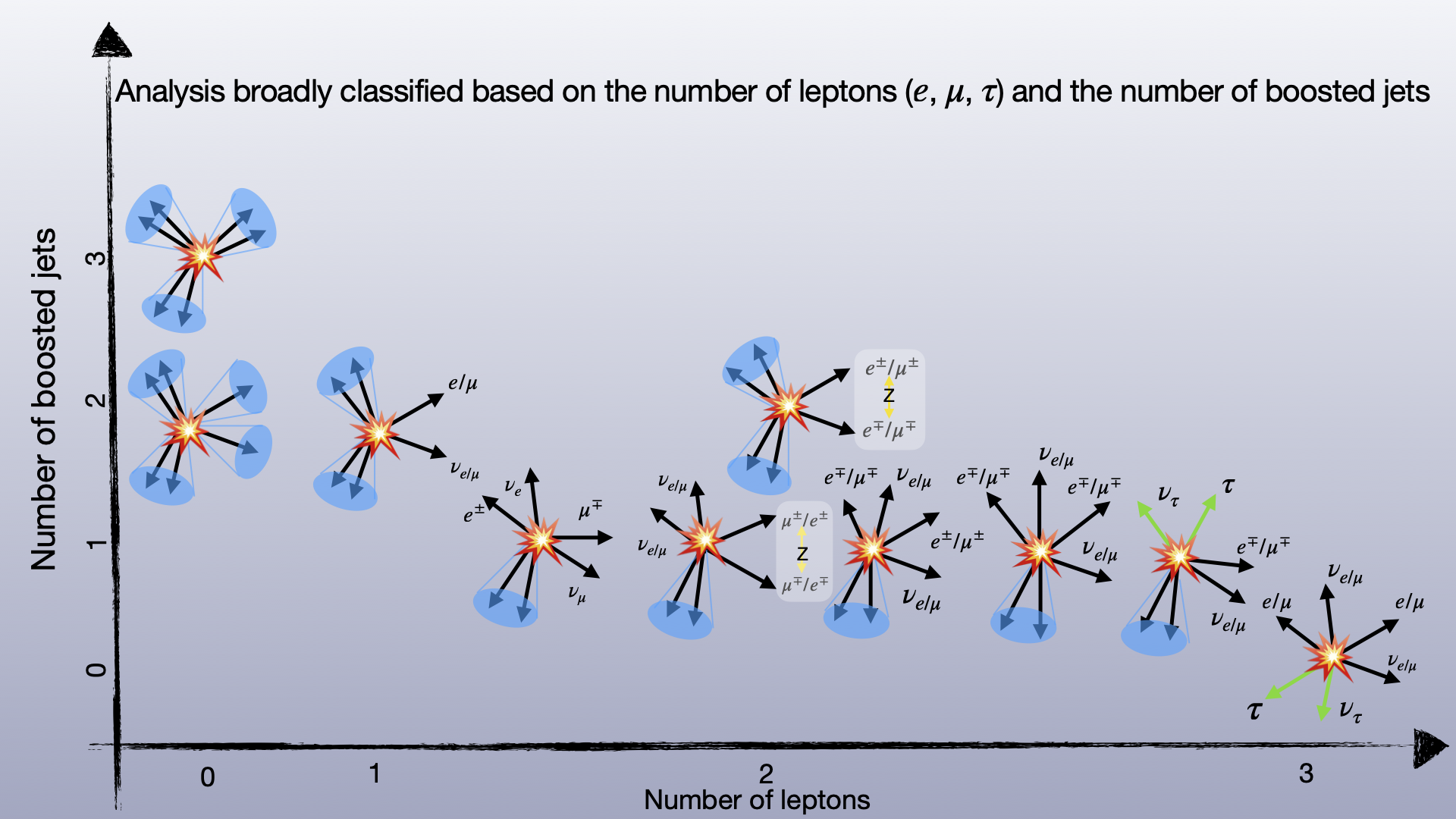
Above: A schematic diagram illustrating the different decay modes of tribosons, which are used to classify the analysis. The black arrows are representative of decay products which can be either leptons or jets. For bosons with high momenta, the decay products collimate, forming a single reconstructed jet represented by a blue cone.
Results are interpreted within the framework of an effective field theory (EFT), which extends the mathematical structure of the SM by inserting new physics interactions. The EFT approach enables the study of indirect effects from physics beyond the direct energy reach of the LHC, enabling us to trace footprints of heavy new physics that might exist at higher energy scales. The search reports constraints on the strength of these interactions across 32 different new physics scenarios, greatly expanding the scope of previous searches involving triboson processes. “To uncover hints of new physics at the extreme edges of the Standard Model, we had to build an intricate analysis!" says Saptaparna Bhattacharya who led the analysis as a Humboldt Fellow at DESY.
The figure below shows the observed data and predicted background yields for every bin – 37 bins in total – of the discriminating variable across all final states. In the lower panel, the constraining power of each final state is indicated, along with the ultimate constraint obtained from combining all final states.
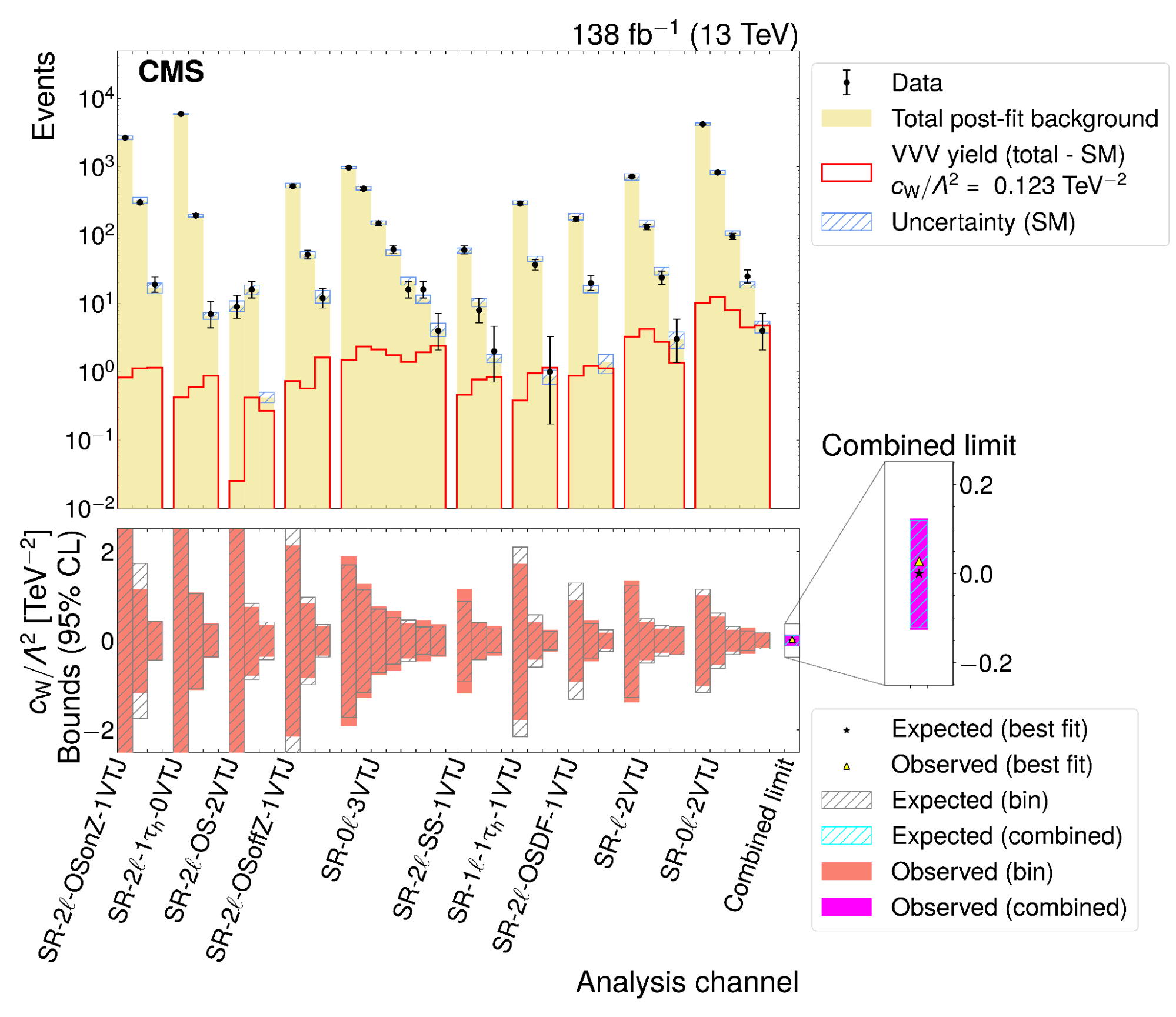
Above: The distribution of the number of events for all 37 bins across all final states. The shorthand used as labels for the x-axis includes information of the final states (SR stands for signal region) specifying the number of leptons and their specific properties, and number of jets identified to originate from W or Z bosons.
“One of the biggest challenges was coordinating ten distinct final states and combining them into a single statistical framework that incorporates the 32 different new-physics scenarios. I'm particularly proud of the exhaustiveness of our search – we placed bounds on all EFT coefficients that modify triboson production, which has not been done before.” says Cole Kampa, who was a graduate student at Northwestern University at the time. The data yields are in agreement with expectations from the SM. A total of 52 events lie in bins that contain the most energetic events. Although these events remain compatible with SM expectations, they are particularly interesting because they probe the theory in extreme regions of phase space.
Paving the path to the future
Tribosons are ultra-rare processes that provide a unique glimpse into the SM. We are only now able to study them because of the large dataset that the CMS experiment has amassed. “By mapping these complex collisions, we aim to uncover hints of new physics through the subtle signatures of heavy, undiscovered phenomena”, says Saptaparna. The ongoing Run 3 of the LHC, where an even larger dataset has been accumulated at a higher center of mass energy, will enable future searches where tribosons are used as probes of new physics.
Written by: Saptaparna Bhattacharya, for the CMS Collaboration
Edited by: Muhammad Ansar Iqbal
Read more about these results:
-
CMS Physics Analysis Summary (SMP-24-017): "Search for new physics in triple boson production in proton-proton collisions at √s = 13 TeV using the effective field theory approach"
-
@CMSExperiment on social media: Bluesky - Facebook - Instagram - LinkedIn - TikTok - Twitter/X - YouTube