
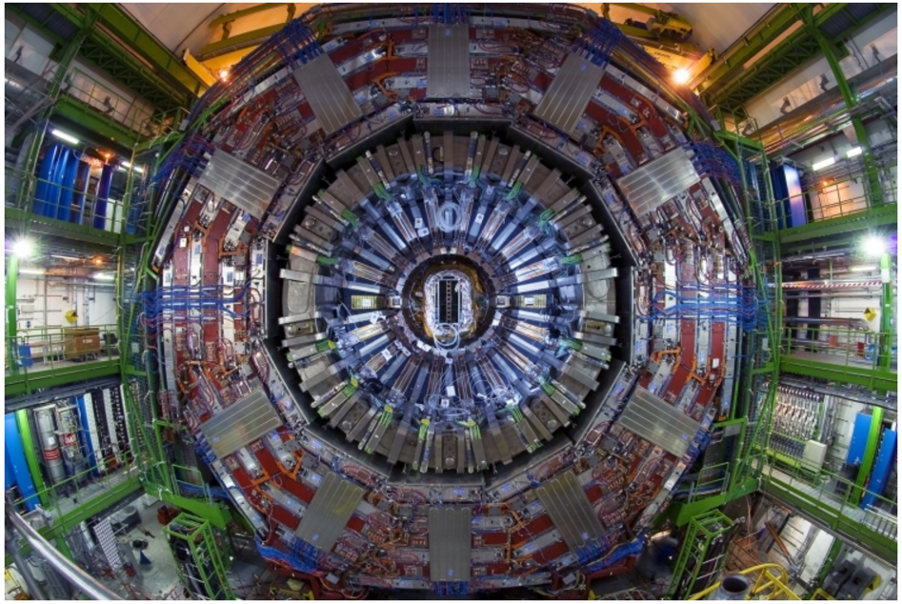
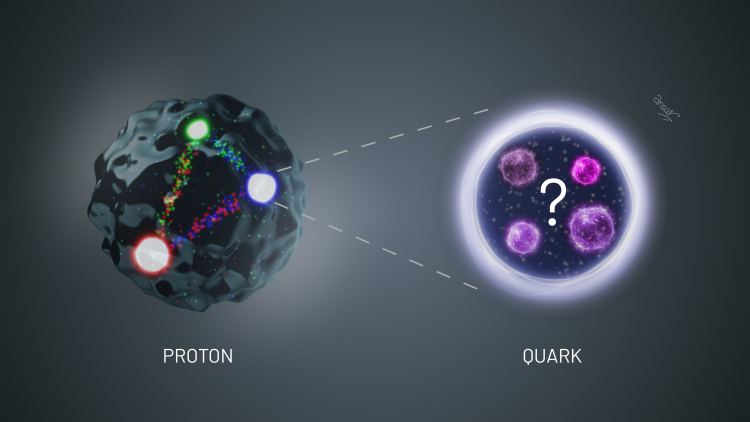
CMS probes the inside of quarks down to distances of 10–20 m – smaller than ever before – searching for potential more fundamental building blocks within them.
In our current understanding of nature, visible matter is made of quarks. Quarks are considered to be point-like particles bound together with the strong nuclear force, one of four fundamental forces in the standard model of particle physics. However, one may wonder: Are quarks really the smallest building blocks of nature?
History has often shown that structures once considered fundamental can reveal deeper layers. Matter was found to consist of molecules that are made of atoms. Atoms consist of a dense nucleus surrounded by a cloud of electrons, and the nucleus is made of protons and neutrons, which were shown in 1968 to consist of quarks. Today, experiments at the LHC continue this quest, colliding particles at extremely high energies to probe a potential inner structure of quarks.
The experimental principle follows the idea of Rutherford, who discovered the nucleus by scattering a beam of helium nuclei (alpha particles) on a target made of atoms (gold foil) and measuring the distribution of scattering angles. By studying their scattering, he was able to deduce that atoms had an inner structure and contained a point-like nucleus at the centre. This was possible because the beam in the experimental setup had enough energy to probe the inside of the atoms.
At the LHC, we collide two extremely dense and energetic beams of protons, which break apart into their constituent quarks in the collisions, effectively allowing us to study the scattering of quarks. The outgoing quarks turn into two jets (collimated sprays of particles) that we can detect with the CMS experiment, as shown in the event display below. From the two measured jets (dijets), we then reconstruct the scattering angle between the original quarks.
Above: An event recorded by the CMS detector with two outgoing jets in the final state. The display is interactive and can also be viewed on a full, interactive page here.
Comparing the distribution of a measure of the dijet scattering angle with the prediction of scattering of point-like quarks via the strong force in the standard model we do not see significant disagreement. We can exclude structures with sizes of order 10–20 m related to the energy scale of a potential beyond the standard model force binding constituents within quarks.
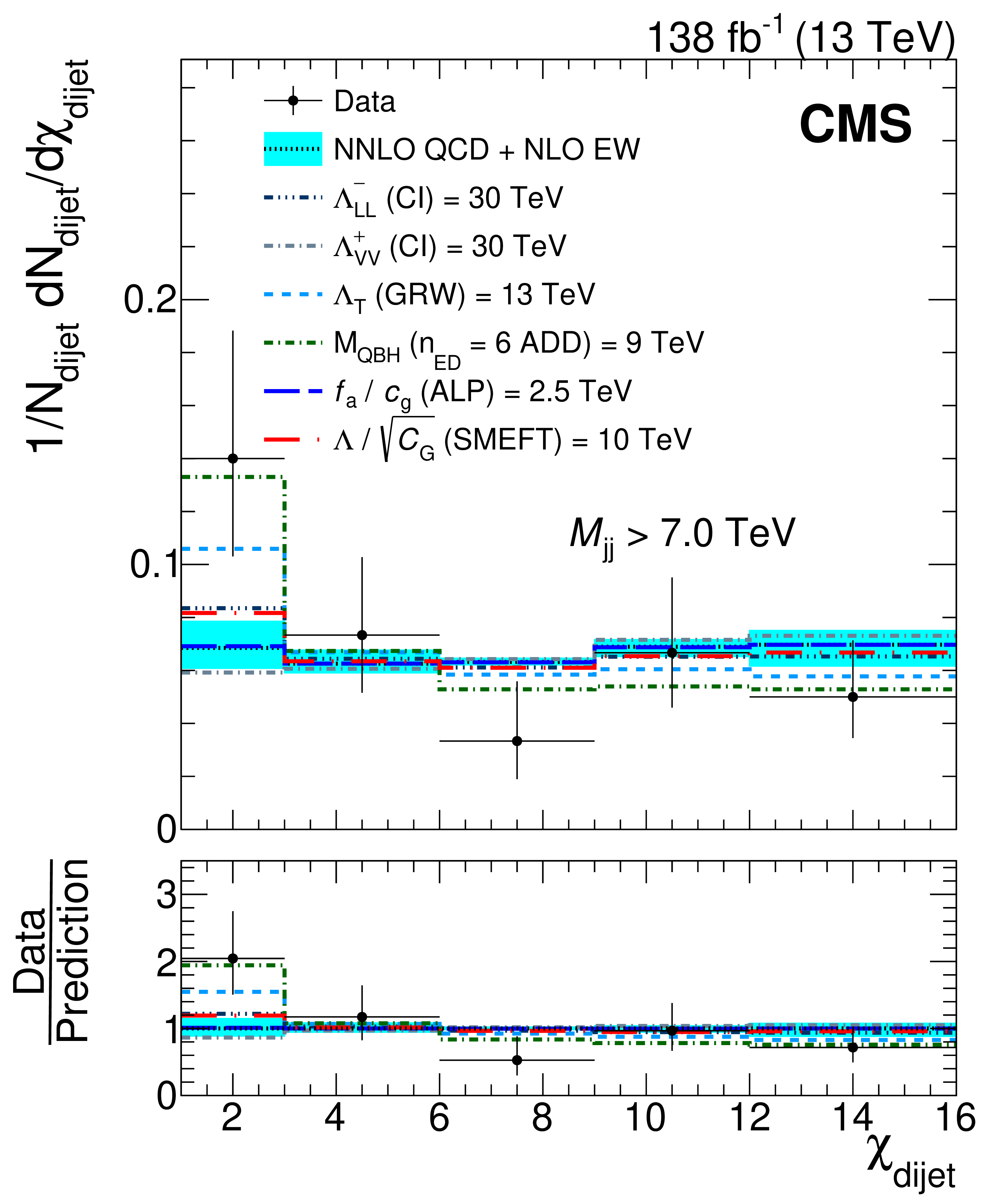
Above: Distribution of a measure of the dijet scattering angle (black markers) compared to predictions from the standard model (turquoise band) and in several scenarios beyond the standard model (colored lines).
The results are also interpreted in terms of more beyond-standard-model scenarios including extra dimensions of space, quantum black holes, dark matter particles, and more.
Now, is this the deepest we can ever look? No. With the Run 3 data taking period and upcoming High-Luminosity LHC, a measurement of the scattering angle with significantly reduced uncertainties will allow us to resolve even smaller structures and continue the quest for the smallest building blocks of matter.
Written by: Andreas Hinzmann, for the CMS Collaboration
Edited by: Muhammad Ansar Iqbal
Read more about these results:
-
CMS Publication (EXO-24-011): "Measurement of dijet angular distributions and search for beyond the standard model physics in proton-proton collisions at √s = 13 TeV"
-
Display of collision events: CERN CDS
-
@CMSExperiment on social media: Bluesky - Facebook - Instagram - LinkedIn - TikTok - Twitter/X - YouTube