
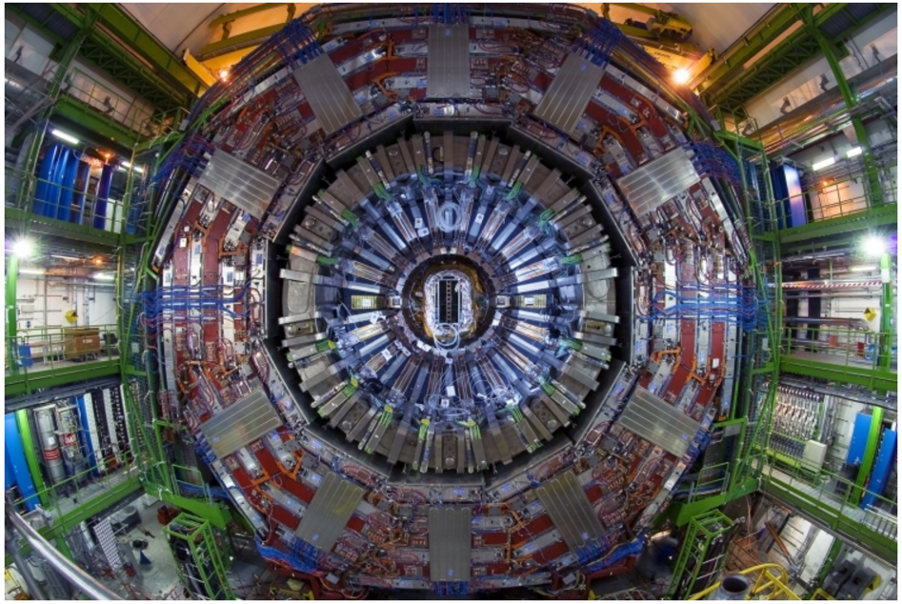
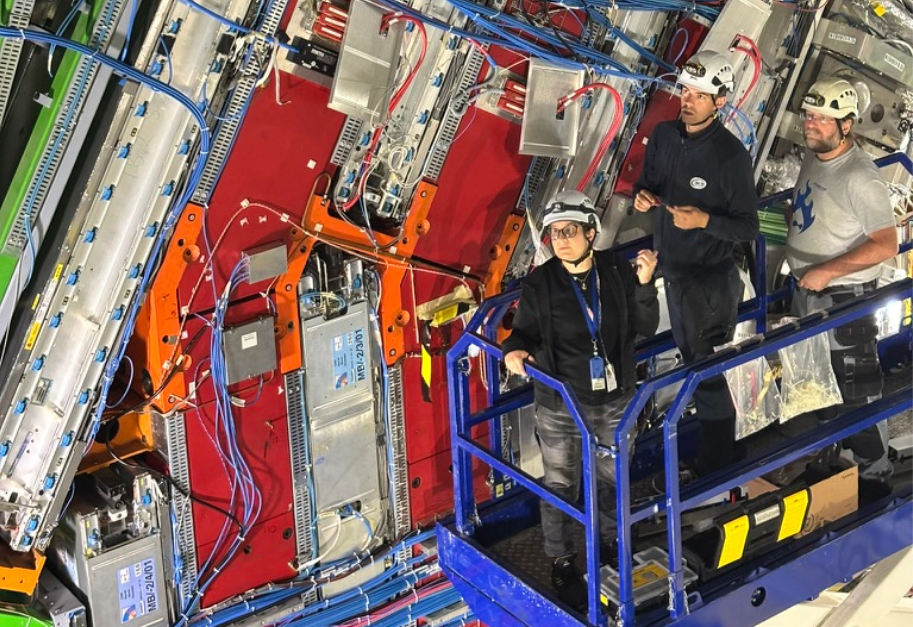
After years of effort to imagine, design, develop, build, and coordinate, a new chapter for the CMS Drift Tubes has finally begun!
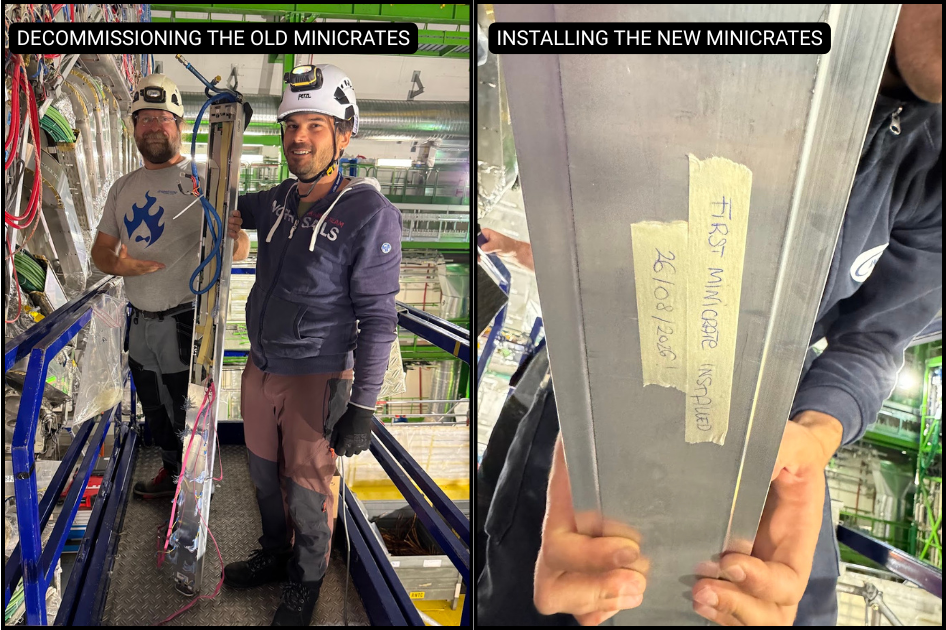
Commissioning of the CMS DT system for the High-Luminosity LHC upgrade is officially underway. The DTs are gas-filled detectors that trace the paths of muons making up a key part of the CMS barrel muon detection system. The first new DT minicrates have been installed, and the first cosmic-ray events have been recorded with the new electronics! The installation campaign will continue through to 2028.
This installation marks a crucial milestone for the CMS muon system upgrade. The CMS detector contains 250 Drift Tube chambers, and every single one of them will now be equipped with a new ‘minicrate’ housing the electronics needed to read out and control the detector.
But this upgrade is about much more than replacing electronics.
A DT trigger primitive is a locally reconstructed muon-track segment, obtained by combining hits from multiple detector layers and characterised by its position, direction, timing and reconstruction quality.
In the original system, trigger primitives, which are muon-track segments obtained by combining hits from multiple DT layers, were reconstructed directly by the on-detector electronics and then sent to the Level-1 trigger. For the Hi-Lumi phase of the CMS detector, the On-Board electronics for Drift Tubes (OBDTs) will digitise signals from muons passing through them with nanosecond-level precision and transmit complete hit information via high-speed optical links to the backend electronics.
There, new algorithms will use the full information from each chamber to reconstruct more precise trigger primitives for the Level-1 trigger. This new architecture will enable more flexible and powerful triggering strategies while improving performance, maintainability and resilience against detector ageing.
One of the main tests to verify everything is mounted properly is whether the newly fitted-out DTs can detect muons produced by cosmic rays that hit Earth’s atmosphere. Recording these muons is much more than a successful test: it is the first real signal from the future DT system of CMS.

This achievement is the result of the extraordinary dedication of the physicists, engineers and technicians who began working on this ambitious project nearly ten years ago.
Each minicrate is thoroughly tested at the CERN Prevessin site using a dedicated front-end mock-up that replicates the connections to a DT chamber. After validation, the minicrates are shipped to the CMS detector experimental cavern, 100m underground at the LHC Point 5, and installed directly on the DT chambers.
At the heart of each minicrate are two types of On-Board electronics for Drift Tubes: OBDT-Phi boards read out the phi superlayers, which track how muons bend in CMS’s magnetic field to estimate their momentum, while OBDT-Theta boards read out the theta superlayer, locating the muons with respect to the direction of the LHC beam.

The OBDT-Phi was designed by the INFN Padova electronics group, while the OBDT-Theta was
designed at CIEMAT in Madrid. The minicrates have been assembled across the participating DT institutes in Aachen, Madrid, Bologna, Padova, and Torino. A truly international effort!
250 chambers, 250 new minicrates, and a new generation of electronics are taking their first steps.
The journey has just begun!

Further Links: