
Under a new scheme funded by the CMS Collaboration's share of the 2025 Breakthrough Prize in Fundamental Physics, early-career researchers have been selected as the inaugural recipients of the CMS Breakthrough Prize PhD Awards. The awards provide dedicated research time at CERN to those who applied for this support, in recognition of their exceptional contributions and promise.
In April 2025, CMS shared the Breakthrough Prize in Fundamental Physics with ATLAS, ALICE and LHCb, in recognition of detailed measurements of Higgs boson properties, the study of rare processes and matter–antimatter asymmetry, and the exploration of nature at the shortest distances and most extreme conditions at the LHC. The collaboration chose to donate its $1 million share to the CERN & Society Foundation to fund doctoral students from CMS member institutes to carry out research at CERN.
As the first recipients of these awards, this cohort will also help shape the scheme, and their feedback will inform future calls. As with any application-based scheme, the inaugural cohort reflects those who applied: many more outstanding early-career researchers are contributing to the CMS experiment.
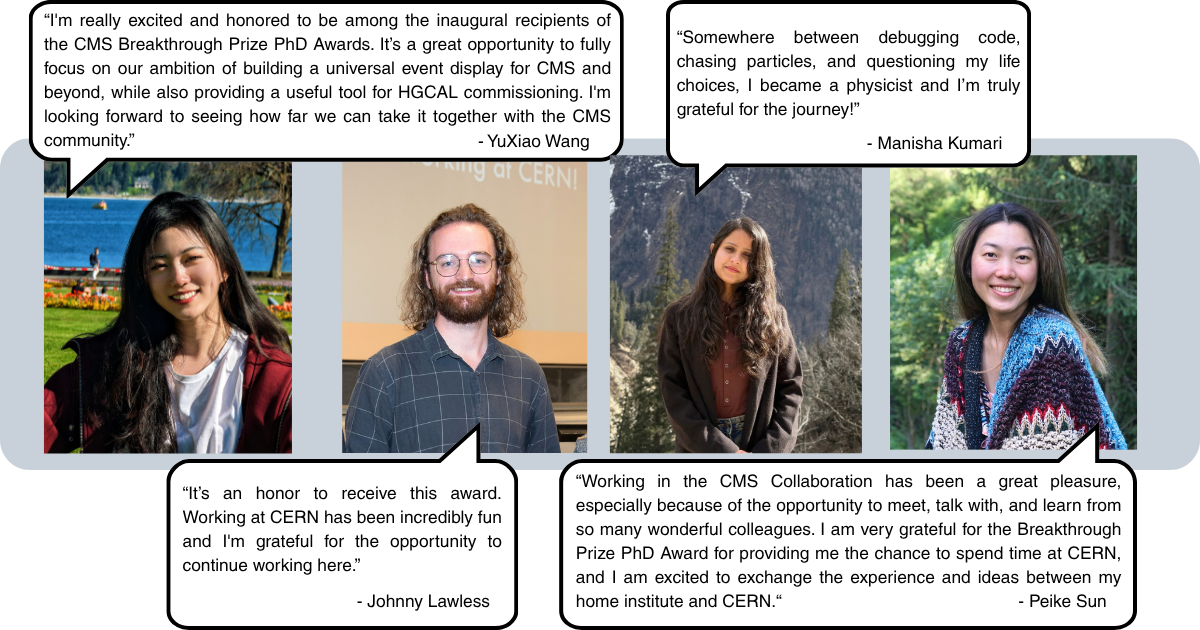
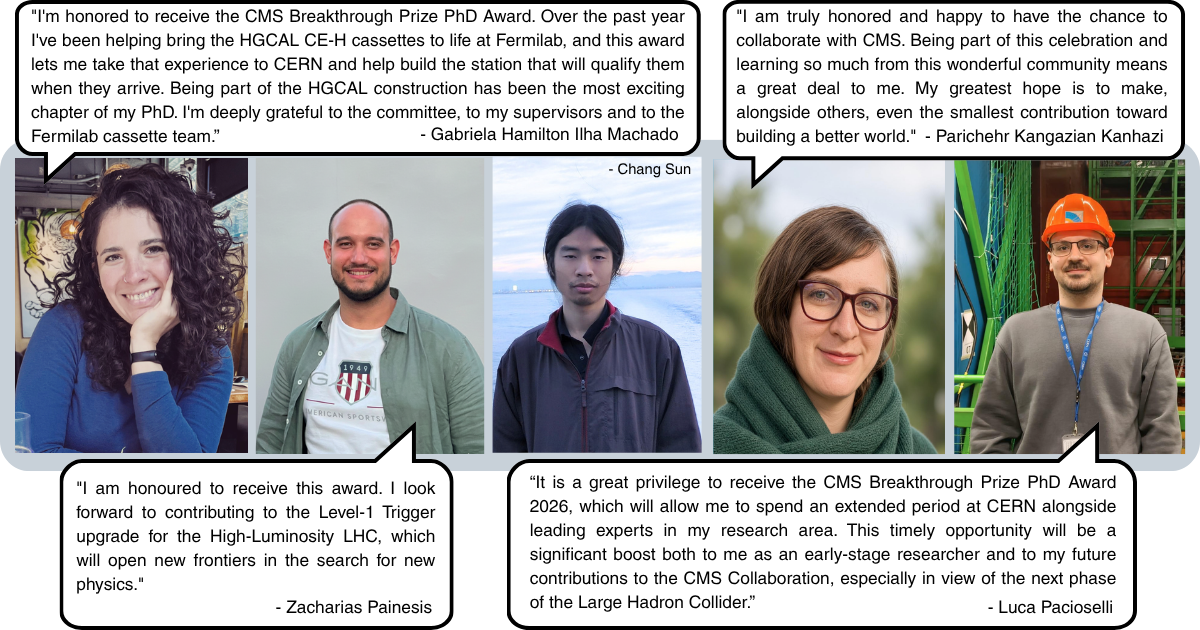
The recipients are (in alphabetical order):
Chang Sun - University of Caltech
Gabriela Hamilton Ilha Machado - University of Virginia
Johnny Lawless - University of Tennessee Knoxville
Luca Pacioselli - University of Perugia
Manisha Kumari - IIT Mandi
Parichehr Kangazian Kanhazi - Isfahan University of Technology
Peike Sun - Cornell University
Yuxiao Wang - Tsinghua University
Zacharias (Haris) Painesis - National and Kapodistrian University of Athens
Each award covers a research assignment at CERN, during which the recipient will work on a research topic of their choice. The recipients were selected from over 80 applications from countries worldwide.
The Breakthrough Prize recognised the work of thousands of CMS members. That collective achievement now gives us the opportunity to invest in the future, by supporting the next generation of CMS researchers and helping them develop the talent, expertise, and leadership that will carry CMS into the HL-LHC era.
- Anadi Canepa, CMS Spokesperson.
The heart of the CMS Collaboration is our people from different countries and institutions working as one. The time spent by the winning students, diving deep into technical challenges at the detector alongside experienced colleagues at CERN truly shapes their path. I am thrilled that this award empowers these students to come to CERN and develop as particle physicists, with a genuine passion for our science.
- Sridhara Dasu, Chair of the CMS Collaboration Board.
It has been a real pleasure to see the scientific quality, enthusiasm and strong motivation reflected in the many applications we received. The overall level was extremely high, with many very interesting projects, which made the selection both rewarding and particularly challenging. The recipients stood out across the wide range of important topics we work on in CMS. We warmly congratulate them, and thank every applicant.
- Lucia Silvestris, Chair of the Selection Committee and Chair of the CMS Engagement Office.
The CMS Collaboration thanks the CERN & Society Foundation for administering the awards and the Breakthrough Prize Foundation for appreciating our continued journey toward a deeper understanding of Nature.
You can find all the photos of the award ceremony here.