
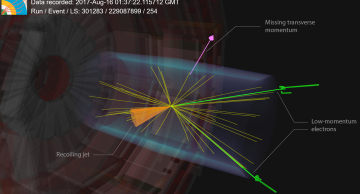
The CMS experiment performs the first collider search for “inelastic dark matter” in the case where dark-matter particles travel a measurable distance before decaying into a pair of low-momentum electrons.
Most of the matter in the universe…
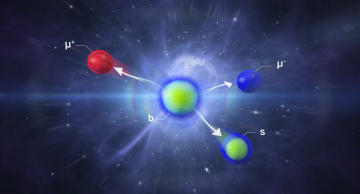
One of the unique features of the weak interaction is its ability to transform one quark flavor into another. However, not all flavor transitions are equally likely. Some occur relatively often, while others are extremely rare because the…
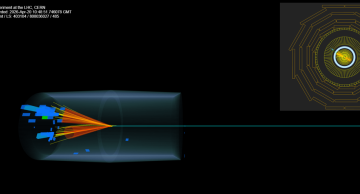
For the first time at the LHC, W and Z bosons and TeV-scale jets are seen alongside a proton that survived the collision intact, reopening a chapter of forward physics that high pileup had closed.
In exploring the strong interaction at the highest…
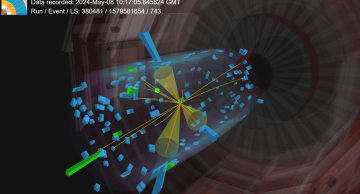
The CMS experiment utilises proton–proton collision data collected between 2016 and 2026 to search for rare decays of the W boson into three charged hadrons.
The W boson, which carries the weak nuclear force, was discovered at CERN in 1983 by…
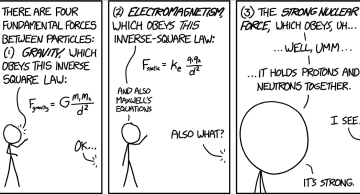
The strong nuclear force is the most mysterious of the four fundamental forces of nature. By studying four-way energy correlations between particles produced by the strong nuclear force, researchers at the CMS experiment have taken another step…
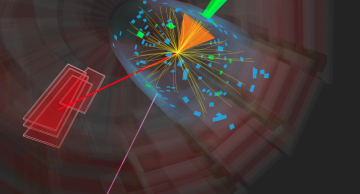
CMS sets the world’s most stringent constraints on anomalous interactions between the bosons that carry the electroweak force.
A key prediction of the Standard Model of particle physics is how the carriers of the weak force – the W and Z…
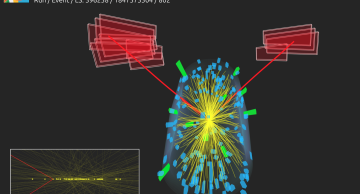
The CMS experiment uses data collected between 2016 and 2026 to observe, for the first time, leptons (electrons and muons) emitted from protons scattering off one another.
Since the first high-energy proton colliders began operating more than…
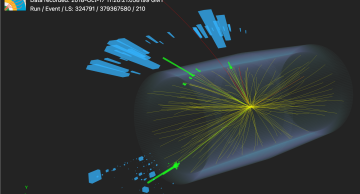
A new boosted jet technique, powered by machine learning, gives CMS its most sensitive search for Higgs bosons breaking apart into never-before-seen particles.
Some theories predict that new light particles associated with the Higgs boson…
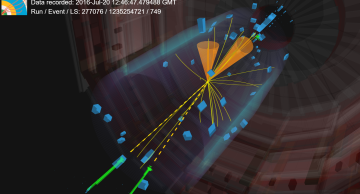
CMS has made the first search in the two-photon and two-bottom-quark final state for a heavy particle with masses from one to four trillion electronvolts.
In a first of its kind, CMS has carried out a search for a heavy particle, X, with masses…
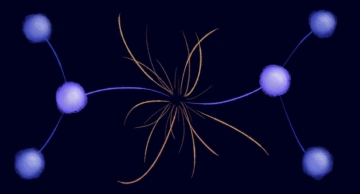
CMS advances the study of Higgs boson’s self-interaction by searching for Higgs boson pairs decaying into bottom quark–antiquark and tau lepton–antilepton pairs in collisions recorded between 2022 and 2024.
Is the Standard Model (SM) the…
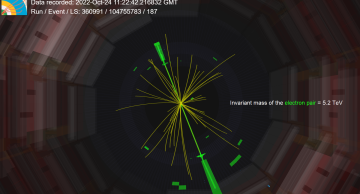
CMS probes the highest-energy lepton pairs ever recorded to search for hints pointing to a Higgs boson made of smaller constituents.
Is the Higgs boson truly an elementary particle, or could it be composed of more fundamental constituents? This…
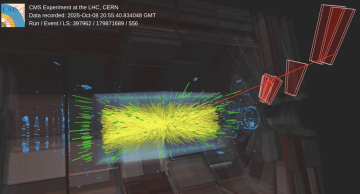
A special test run, with more than twice as many near-simultaneous collisions as usual, allowed CMS to test new methods of tracking and identifying particles, years before the upgraded High-Luminosity LHC comes online.
For a few days during…