
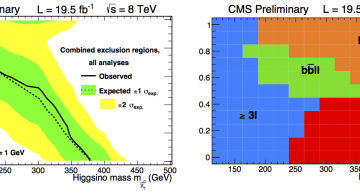
Among the leading candidates to describe physics beyond the standard model of particle physics is Supersymmetry, a new symmetry that posits the existence of a partner particle for each known particle in the standard model. Supersymmetry, or “SUSY”…
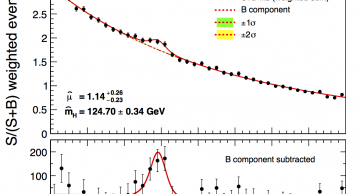
The data reveal that the particle discovered at CERN continues to behave just like the Standard Model predicts
Since the discovery of a Higgs boson by the CMS and ATLAS Collaborations in 2012, physicists at the LHC have been making intense efforts…
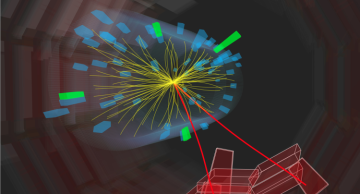
The CMS experiment reports the observation of a peaking structure in the Υ(1S)ϕ(1020) channel in proton-proton collisions at 13 TeV.
Using the Run 2 proton-proton collision dataset collected at the LHC between 2016 and 2018, the CMS Collaboration…
The CMS Collaboration announces several new results for LHCP 2026.
Among the highlights are four new results including 2025 data, and two comprehensive performance papers.
CMS presents a competitive measurement of time-dependent CP violation…
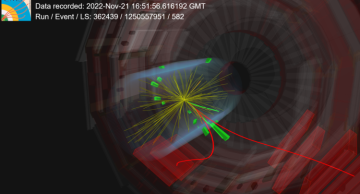
The CMS experiment reports the first observation of the rare decay of an eta meson to two muons and two electrons.
The CMS detector was originally built to discover the Higgs boson and search for heavy particles that could transform our…
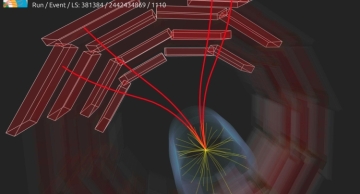
CMS sets the world’s most stringent limits on B⁰ and B⁰ₛ decays into four muons.
After examining the Run 3 dataset collected between 2022 and 2024, the CMS experiment has established the most stringent limits to date on the extremely rare decays of…
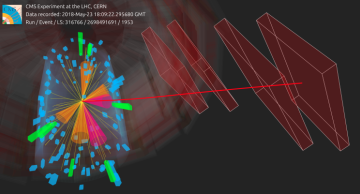
Could there be more particles like the Higgs boson? For the first time, the CMS experiment has searched for the decay of the Higgs boson into two more Higgs-boson-like particles with unequal masses.
Some theories suggest that the Higgs boson…
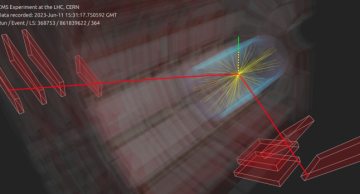
CMS pushes the sensitivity frontier towards a measurement of the rare Higgs boson decay into a Z boson and a photon
The 2012 discovery of the Higgs boson at CERN by CMS and ATLAS was a landmark achievement in the world of particle physics - but it…
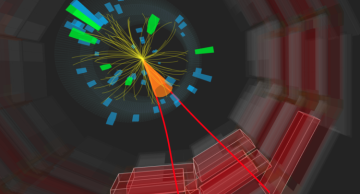
The CMS experiment presents a first study of the ϒ mesons (bound states of a bottom quark and antiquark) produced within jets. The results reveal significant discrepancies between the observed data and current theoretical predictions,…
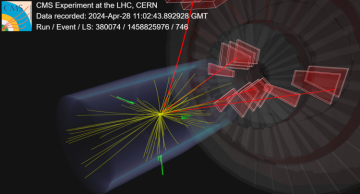
The CMS experiment uses data collected between 2022 and 2024 to perform a detailed study of Higgs boson production rates as a function of several variables. The measurements focus on the “golden channel”, characterized by four leptons (…
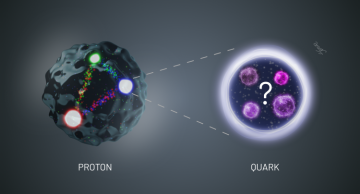
CMS probes the inside of quarks down to distances of 10–20 m – smaller than ever before – searching for potential more fundamental building blocks within them.
In our current understanding of nature, visible matter is made of quarks. Quarks…
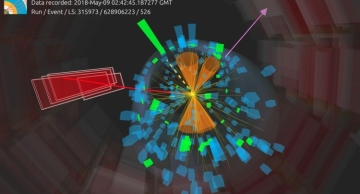
The CMS Collaboration has completed the most precise measurement to date of top-quark production in association with a photon
Using the full Run 2 dataset of the LHC and advanced machine learning techniques, the CMS Collaboration has delivered the…