
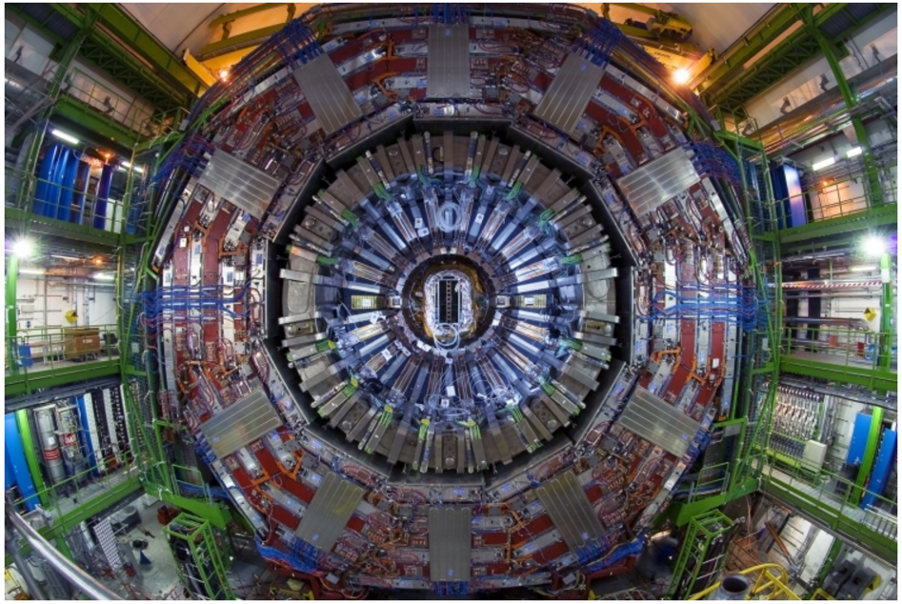
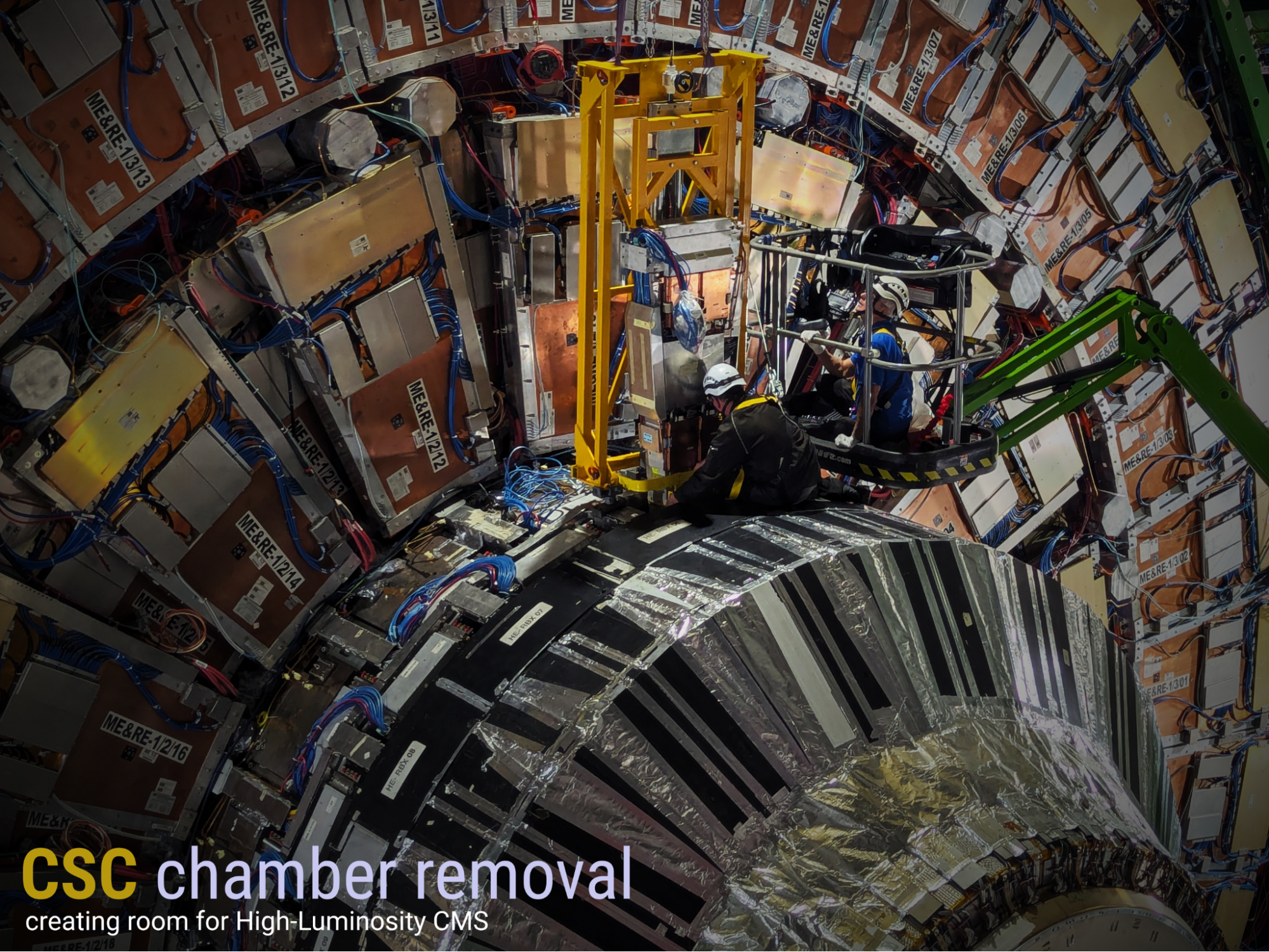
How do you install new, additional components in an already compact machine? CMS Cathode Strip Chamber (CSC) muon detectors are being removed to make way for major upgrades, before returning to their place in the experiment’s transformed configuration for the next era of the Large Hadron Collider.
Deep underground at CERN, work is under way to prepare the CMS experiment for the High-Luminosity Large Hadron Collider (HL-LHC). During the Long Shutdown 3 (LS3), a 3.5 year period when the LHC is stopped for major upgrades, teams are carefully removing 216 CSC detectors from the first endcap disks of CMS. This work marks an important step towards upgrading CMS to meet the demands of the HL-LHC and install entirely new components, including a high-granularity calorimeter and a new layer of muon detectors close to the colliding proton beams. The removed CSC detectors are being stored for reinstallation later, along with more than 30 kilometers of readout and power cables.
The CSCs are part of the CMS muon system, which is designed to detect muons, particles similar to electrons but much heavier. Unlike many other particles, muons can travel through substantial amounts of material, making them especially useful for identifying the products of high-energy collisions.
Preparing the CSC detectors for the tremendous number of collisions during the HL-LHC started years ago. With the electronics modules on the detectors already upgraded during the previous long shutdowns, the current extraction provides an opportunity to finalise the upgrades, and make room for the installation of the new detector-systems in CMS.
“Removing the CSCs and all the cables that connect to them is a complex operation that requires years of careful planning and coordination,” says David Morse, CSC Project Manager. “The detectors are installed within the massive CMS structure, 100 metres underground at the experiment’s site at P5 of the LHC. Access is limited and the surrounding equipment must be protected throughout the work.”
The first stage of this multistage procedure is to disconnect and remove the CSC chambers in the innermost ring, known as ME1/1, located inside the central “nose” of each CMS endcap. The extraction of these chambers began in the first week of September and is now nearing completion.
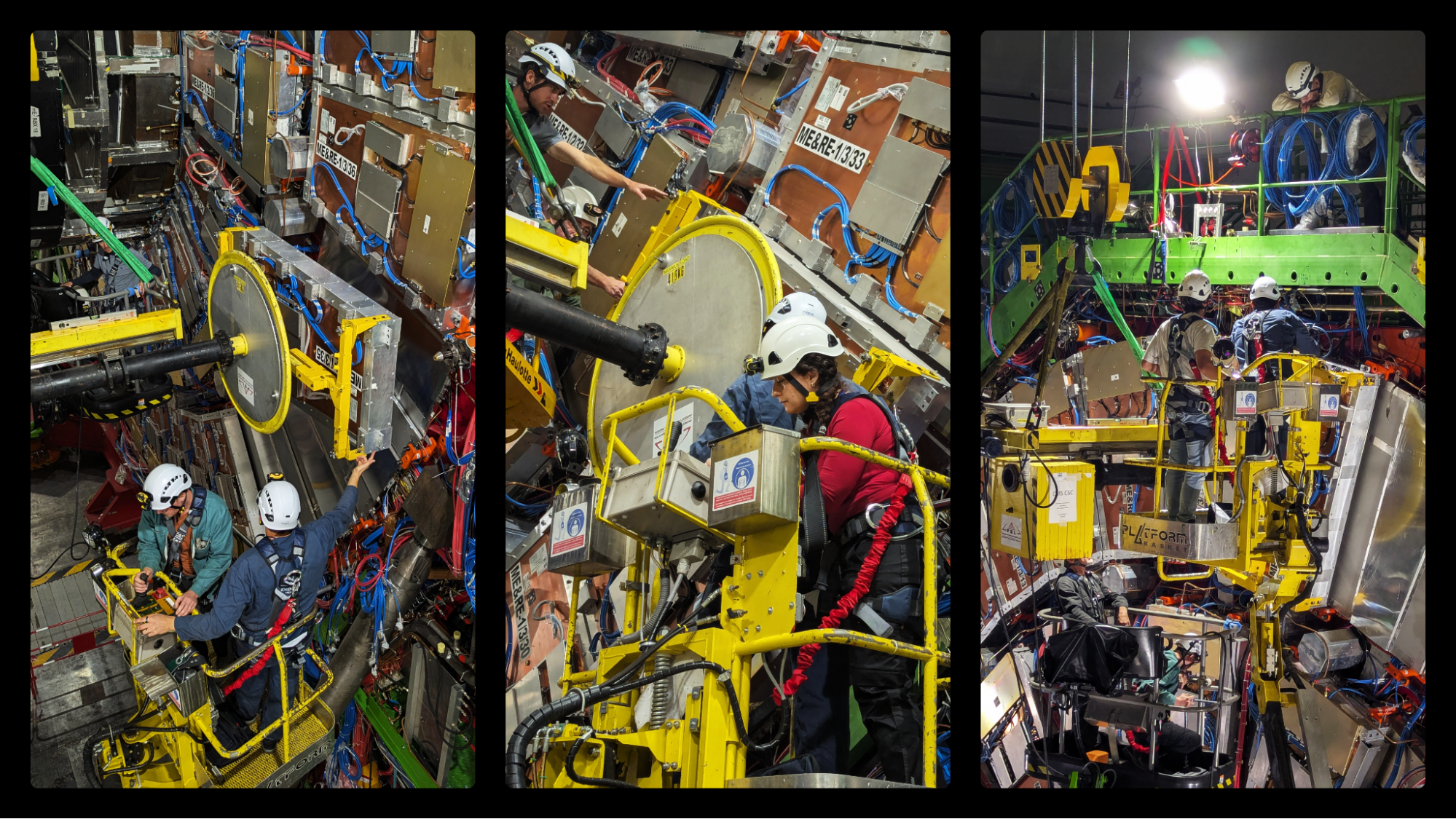 ABOVE: Removal of the inner-ring (ME1/1) chambers.
The next stage, which is underway, involves disconnecting and removing the chambers in the outer ring, known as ME1/3. “With each chamber weighing 160 kilograms, the extraction demands patience and technical prowess,” remarks Mikhail Ignatenko, CSC Technical Coordinator. “Once a chamber is removed, it must be carefully placed in a transporter and lifted 100 metres to the surface through the CMS large-equipment access shaft.”
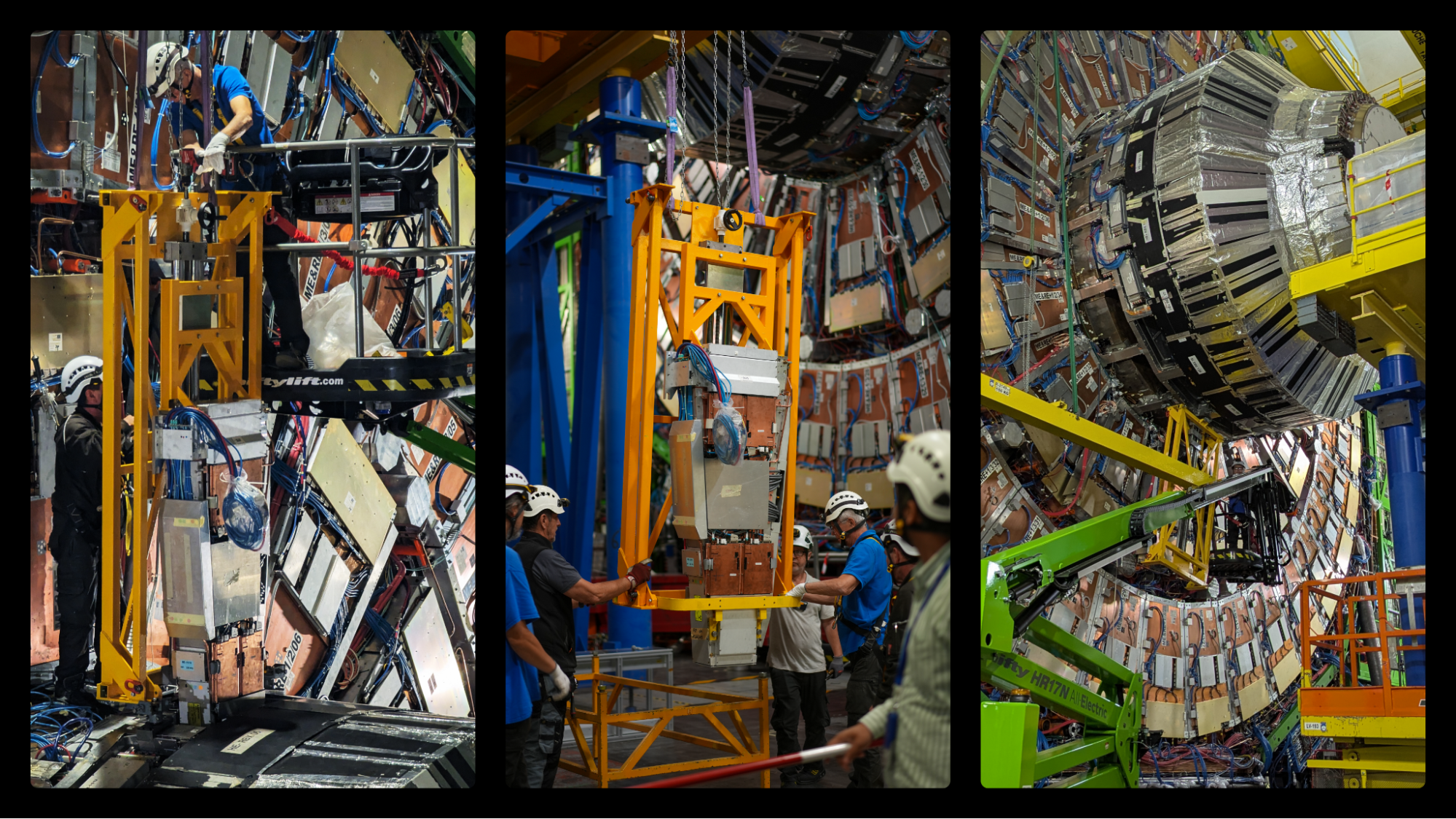
ABOVE: Removal of the outer-ring (ME1/3) chambers.
The removed chambers are being transported to a storage area at CERN’s Prevessin site, which will be their home until reinstallation in CMS in 2028. For the teams working underground, the removal is more than a dismantling operation. Each chamber must be removed safely and preserved for reinstallation, whilst space is made for the new technologies that will help CMS meet the challenges of the HL-LHC.
Further links:
Photos of the Inner Ring chamber extraction (ME1/1)
Photos of the Outer Ring chamber extraction (ME1/3)