
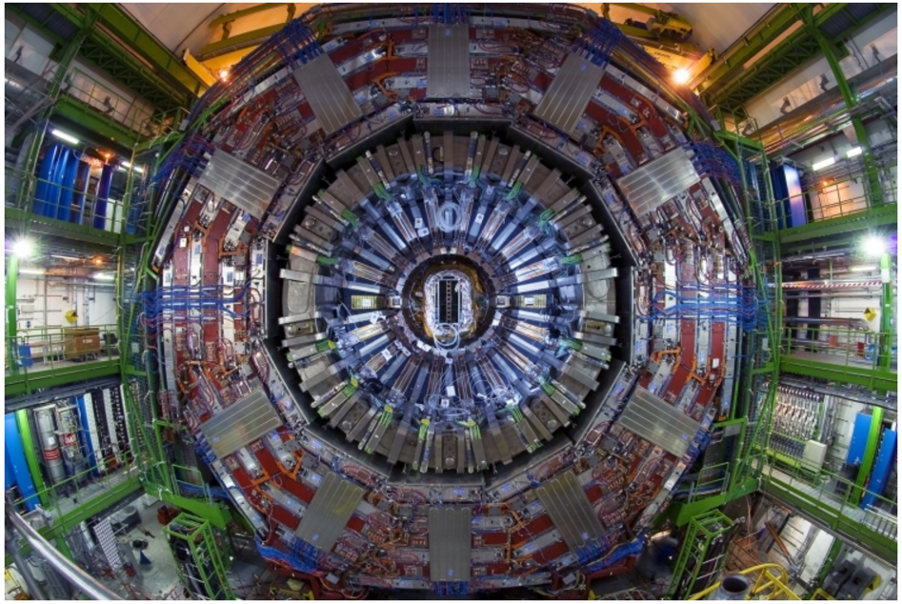
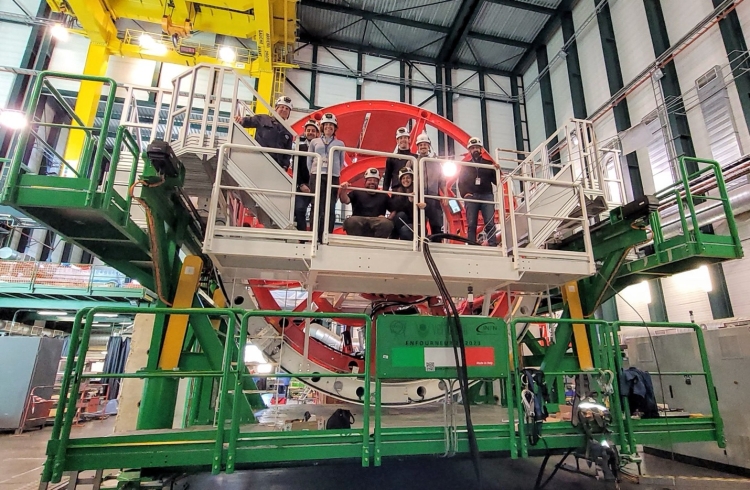
The Electromagnetic Calorimeter (ECAL) group has tested the second enfourneur (pictured above), a highly specialized instrument that allows the insertion and extraction of key components of the CMS detector at CERN, the ECAL ‘supermodules’.
Weighing in at 3 tonnes each and very fragile, the supermodules contain the ECAL scintillating crystals, devoted to precision measurement of electrons and photons in CMS. The crystals are very heavy and fragile. Therefore, they need to be handled with care and precision. Considering the limited space and the tight schedule, the enfourneurs are key elements for the success of the upgrade programme. These machines are large – about 20 tonnes each -, round, and brightly coloured, consisting of a central ‘cage’ that looks like a giant hamster wheel. Aside from their fun appearance, they have been specifically designed to handle these extremely delicate operations, and are essential in the upgrade of the ECAL subdetector.
ABOVE: The enfourneur during rotation tests at the CMS site.
The High Luminosity (Hi-Lumi) phase of the LHC and CMS will go into operation from 2030. This new phase of the LHC will see a massive increase in the data that can be captured by experiments like CMS. During Hi-Lumi, the new ECAL subdetector will feature much faster electronics, greatly improving its ability to measure particle energy and timing with greater precision and efficiency. To achieve this, all 36 supermodules will be extracted, and their electronics entirely replaced, and then carefully re-inserted into the CMS detector. This operation must be carried out within the allocated time frame, but carefully and efficiently.
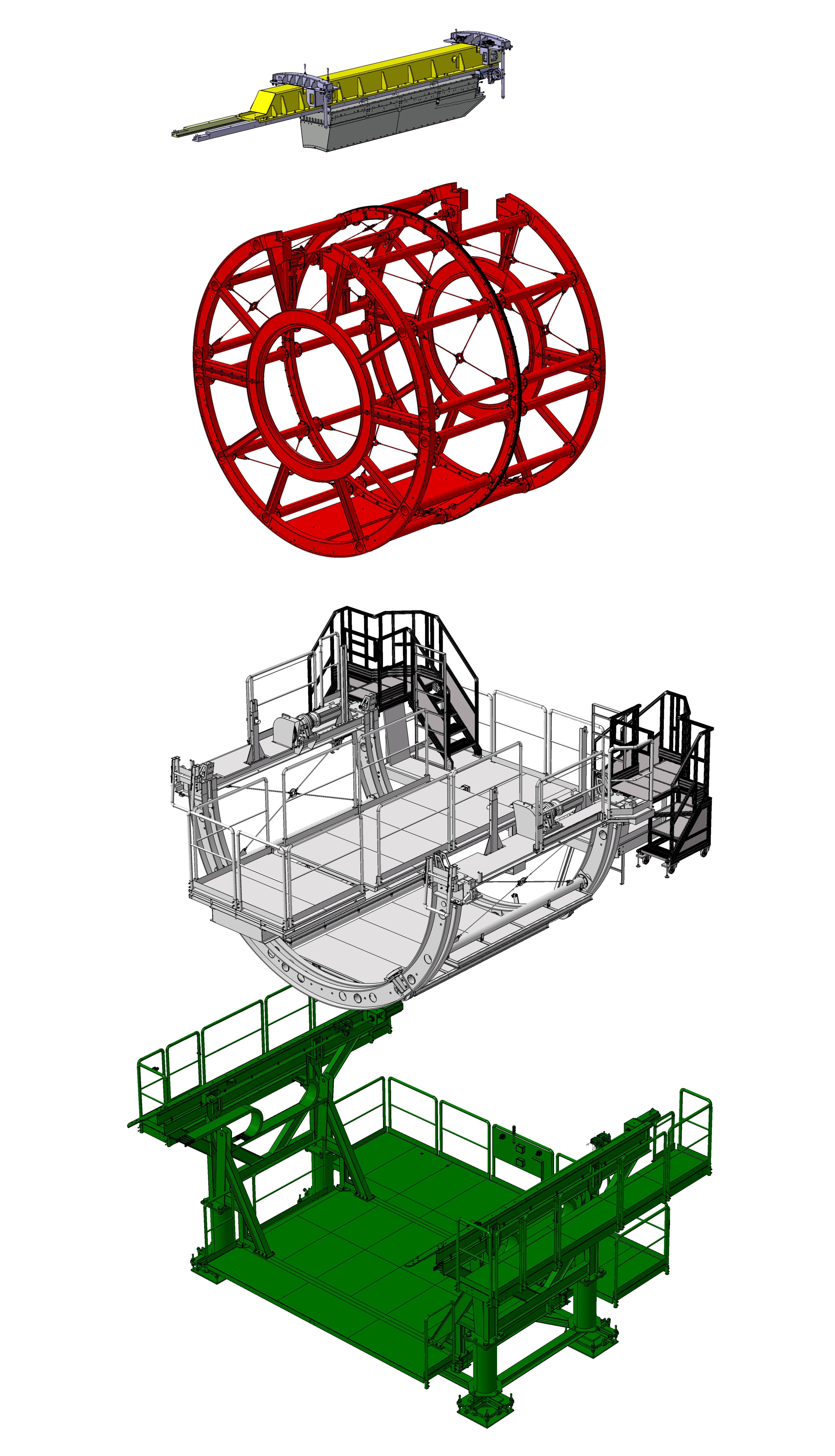
Above: Exploded view of an enfourneur.
Testing the enfourneurs is essential for Hi-Lumi. This is true not only for ensuring the equipment functions as needed, but also in creating an efficient teamwork plan to save time and reduce risks during the work. The tests carried out so far make it clear that not only in-depth knowledge of the machine and procedures, but also mutual knowledge among the members of the team working on it, is crucial to the success of the operation, especially considering the sustained concentration needed to make sure people and supermodules remain safe throughout the work.
The current ECAL barrel installed in the CMS detector has 61,200 scintillating lead tungstate crystals. These crystals look like glass to the naked eye but are much heavier. When electrons and photons pass through the ECAL, the crystals emit a light, or ‘scintillate’, in proportion to the energy of the particles that hit them. Specialized electronic sensors detect the light emitted by the crystals and convert it into electronic signals so that the data can be transmitted and studied.

Each of the 36 supermodules, located in some of the innermost sections of CMS, contain 1700 crystals and electronics. They have been an essential component of the CMS detector and notably were key in the observation of the Higgs boson through its decay to two photons.
CMS two enfourneurs will extract the supermodules from their current locations via rails fixed to the inner core on the HCAL subdetector. The enfourneurs have three distinct and - despite the large dimensions and masses involved – highly sensitive movements: translation of the cradle along the rails to approach CMS central detectors, rotation of the cage to move the supermodules into place, and pushing or pulling of the supermodules in or out of CMS. Through these, they can safely and smoothly handle the supermodules with a precision of better than 1mm!
The first enfourneur, E1, was designed by CEA-Saclay in 2005, and was already used for the initial installation of the ECAL barrel in 2007. Now, E1 has been improved and tested at CERN. The new enfourneur, E2, has been produced by INFN Roma and features an electric system instead of the E1’s hydraulic one. It has many sensors to monitor the movements with precision, an electronic control and safety system, and a touch pad to guide the machine movements.

The enfourneurs will work on the two sides of CMS during the LHC Long Shutdown 3 to prepare Hi-Lumi CMS ready for 2030.
Both enfourneurs were carefully tested with a dummy supermodule weight, simulating the insertion and extraction of the supermodules at the bottom of CMS (at 6 o’ clock) and at 9 o’ clock (the most difficult position from the point of view of the mechanical stress).
Now E2 has been transferred to a storage building to make space for the ECAL electronic integration zone preparation. A special super-heavy load truck has transported the whole machine fully assembled in the building. The other enfourneur will join it soon.
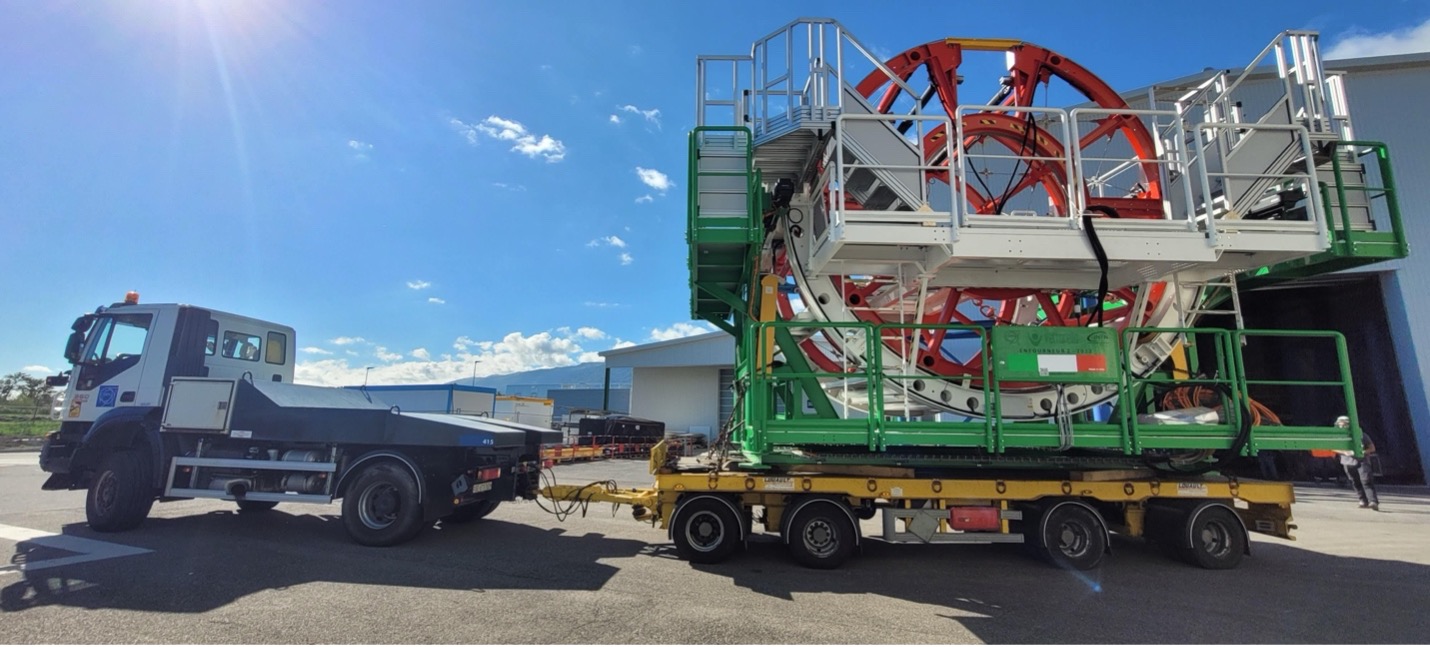
Above: E2 being transported to the storage facility after testing.
Beyond all the technical milestones, there is something special about the team behind the enfourneurs. After so many hours spent together testing the machines, the engineers and operators have found a beautiful rhythm. They’ve become more than just a crew; they’re a perfectly synced-up unit. They know each other’s moves so well that they often pass a tool before it's even been asked for. It’s that kind of quiet harmony that makes the most complex tasks look easy, and it’s what truly brings the machine to life.
In 2027, when the extraction of the ECAL supermodules will be done, one of the two enfourneurs can be lowered fully assembled in the CMS cavern from the main shaft to reach the southern side of CMS. While, to reach the northern side of CMS, the other enfourneur must be disassembled in smaller parts and pass through the smaller shaft that gives access to the other CMS side. This delicate operation of disassembly and reassembly of the whole machine has been recently successfully tested on E1, and engineers have studied the problem with the 3D model of the caverns and shafts to understand how to best transport the enfourneur parts underground.

In addition, both enfourneurs must be placed on a pedestal to raise them at 9 metres from the cavern floor, the height of the central CMS detectors. One of the existing CMS platforms has been adapted to serve this purpose and the superposition of the enfourneur on top of the platform was tested in the CMS surface hall in November 2026 (see photos). Moving these gigantic objects, both the platforms and the enfourneurs, was done by specialised crane operators with the help of the CERN EN division.
The ECAL supermodule insertion tests, the transport of the enfourneur on the truck, and the positioning tests are very complex procedures. The whole team was relieved to see that all the pieces work as designed. Thanks to the experience of the technicians, the crane operators and the engineers who work on the project, it all seemed simple like assembling (gigantic) legos for a kid!

Further Links:
Interviews with the supermodule testing team
Supermodules test beam photographs
Photograph of E2
Photographs from the CMS Upgrade Week
Historic original ECAL photos collection