
CMS successfully carried out key tests for the lifting system needed in the construction of Hi Lumi CMS during the end of year stop 2025/2026.
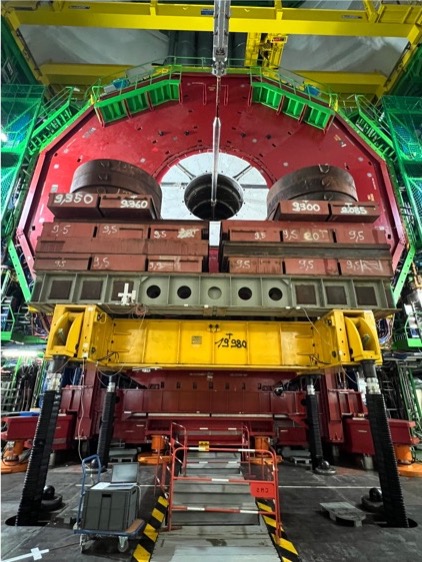
Four thin legs emerge from the floor of the CMS cavern to lift incredibly heavy parts of the CMS detector. For a few days during this Year-End Technical Stop, the ‘spindles’ have been put through their paces with a heavier load than usual: 367 tonnes of blocks were stacked on top of a riser to test whether they behaved as expected.
ABOVE: Timelapse of the spindle testing.
During the Long Shutdown 3, due to start at the end of June this year, CMS and the LHC will undergo a complete transformation for the next phase of experimentation at CERN: High Luminosity, or ‘HiLumi’. Most of the CMS detector will be replaced, upgraded, or modified between July 2026 and 2030, when HiLumi is scheduled to start.
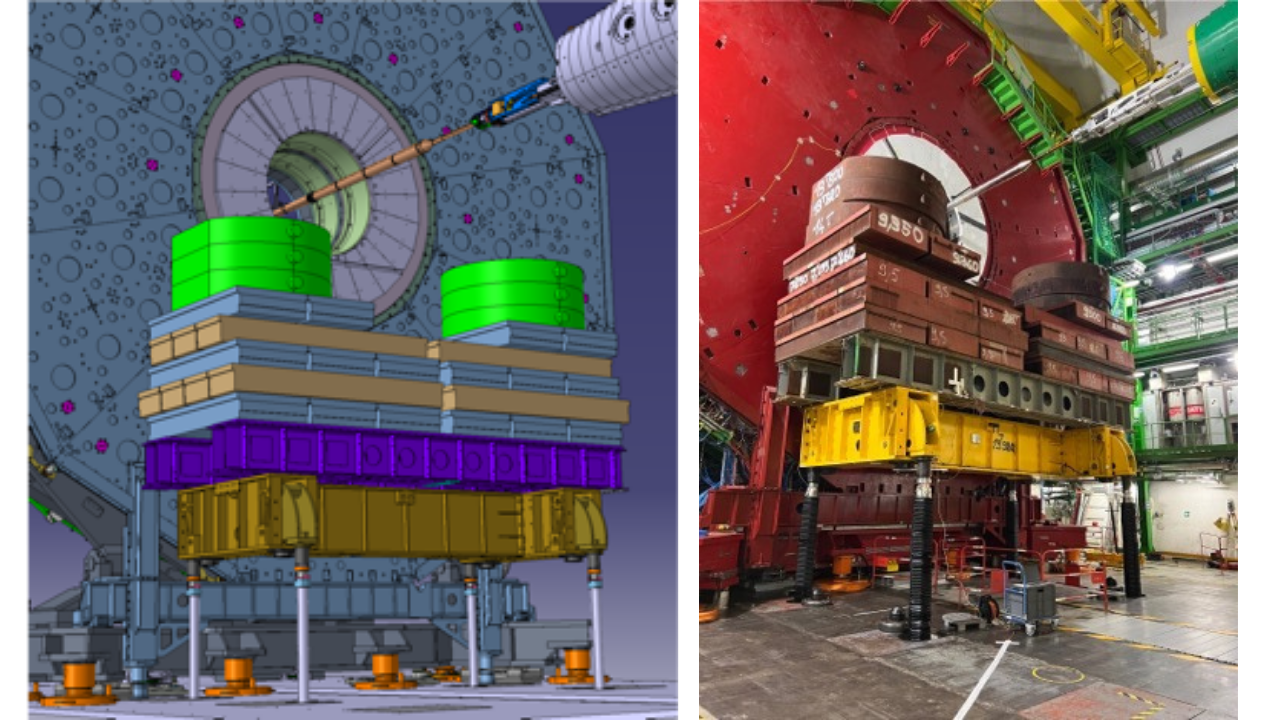
ABOVE: The loads were piled on top of a riser on the spindles, and then lifted and lowered to check the correct functioning of the system. (T. Loiseau | CERN)
In order to optimise operations, the existing spindle system will be used to remove the current Endcap Calorimeter and install the new High Granularity Calorimeter, the HGCAL. This delicate operation requires the spindles to handle higher loads than they usually do.
Typically, the spindles raise and lower the Forward Hardron Calorimeter (HF) (Video), but given the exceptional work required, a load test was performed to validate the heavier-lifting scenario. Several mechanical and electrical parameters were monitored during spindle testing.
ABOVE: Video showing the usual procedure of moving the HF with the spindles. (T. Trofimov)
The test was successful; the system behaved as expected, and so it can be used during the Long Shutdown to install the new HGCAL!
Multiple teams were involved in running the test, led by the CMS Technical Coordination mechanical teams, who planned and executed it. The EN-HE team provided and installed the loads, and the CERN EN-MME and BE-GM groups helped monitor the mechanical parameters. HSE attended and independently validated the test, while the company that will lift the HGCAL during installation also observed the procedure.
Further Links