
The seventh CMS Open Data Workshop brought educators to Notre Dame to build teaching materials from real LHC data.
In 2012 CMS drafted and adopted a data preservation and open access policy which, among other things, allows for data re-use for education and outreach. It’s one thing to adopt the policy and quite another to implement it, especially this part of it, given the complex data that come from CMS. In order to help surmount this access hurdle the CMS open data team organised and held an Open Data Workshop over three days (28-30 July) at the University of Notre Dame in the US. This was the seventh CMS Open Data Workshop and the first to focus exclusively on educational use-cases of CMS open data. The goal was simple: to have educators use CMS open data in their classrooms and lectures.
Nearly 20 students, teachers, and lecturers came to Northern Indiana during a heat wave and nearly triple that number participated online from mostly the western hemisphere, especially from the United States (with a large contingent of teachers and students from the QuarkNet program) and Ecuador. During most of the first day and part of the second the facilitators introduced what resources were available in terms of CMS open data, explained some of the physics behind them, and demonstrated examples of what could be done with the data. Once these introductions and demonstrations were done the focus shifted on the participants, meaning that what happened next over the next two days was entirely up to them. The idea was to organise this workshop like a “hackathon” where teams of people would brainstorm and work together to create something, in this case, educational materials from CMS open data.
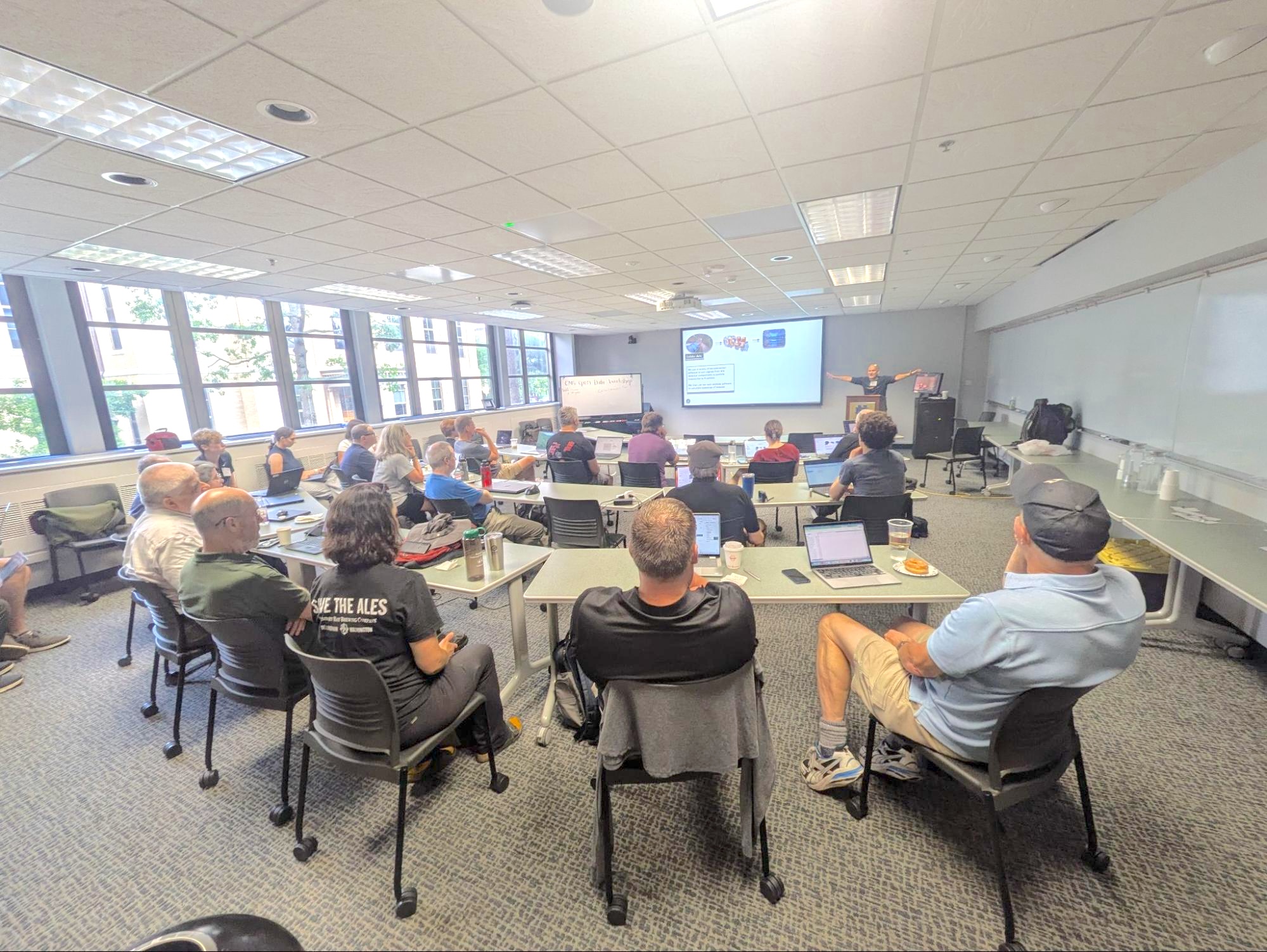
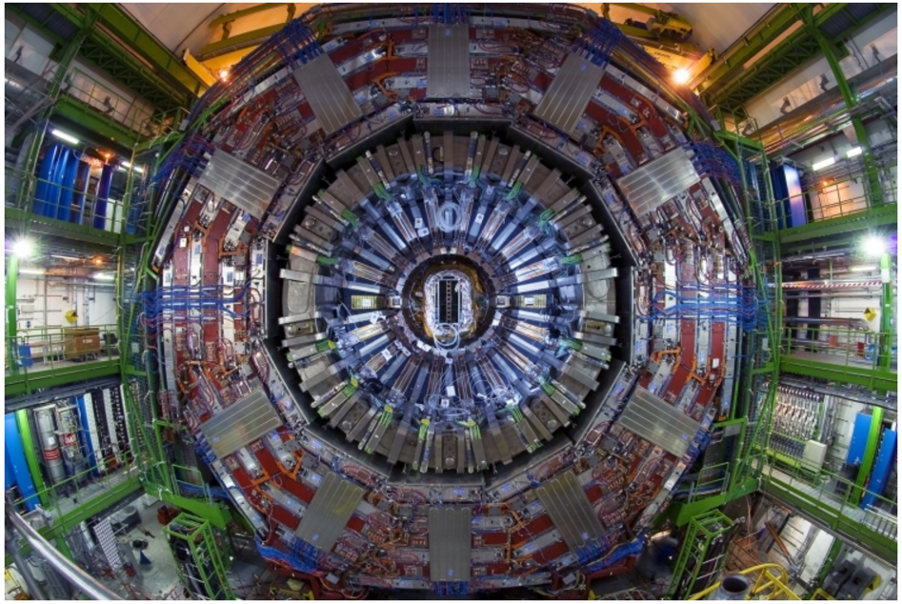
ABOVE: CMS Data Preservation and Open Access co-coordinator Matt Bellis welcomes the participants and introduces them to the CMS detector and its data
The second day consisted of mostly brainstorming, hacking, and “office hours” with the experts in-person and remotely. The participants were clearly fueled by enthusiasm and interest in particle physics as several impromptu lessons took place during the day along with a lot of hacking. Online there were several virtual breakout rooms, live notes, and activity on the workshop Mattermost channels. At the end of the day progress was assessed. On the third and last day the participants (and some of the facilitators) presented their work. The enthusiasm of the participants from the previous day had carried over into their presentations. It was clear that some great progress was made in a relatively short time. Based on this progress it was clear that the workshop was a great step towards its ultimate goal: to have educators use CMS open data to teach coding, data analysis, and particle physics.
The CMS open data team gratefully acknowledges the local support of the University of Notre Dame and QuarkNet.