
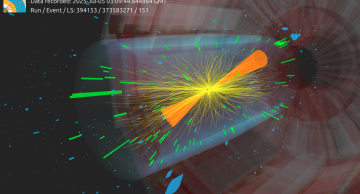
As high-transverse momentum particles punch through the plasma formed from light ions, the CMS experiment sees a possible imprint from the initial shape of the collisions
For the first time, CMS has observed both suppression of high transverse…
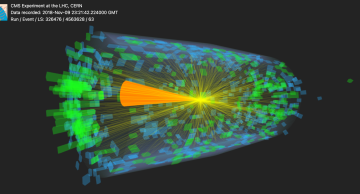
CMS investigates charm-quark jets in heavy-ion collisions and finds no evidence of additional radiation inside the dead cone
When lead ions collide at the Large Hadron Collider, they create an extreme state of matter known as the quark-gluon plasma…
The CMS experiment reports the first observation of a “wake” created by a fast-moving parton in quark-gluon plasma.
Wake effect in quark-gluon plasma
When the LHC collides heavy nuclei, such as lead, at nearly the speed of light, it creates…
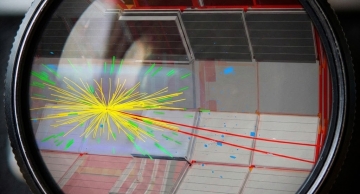
The CMS experiment presents the first measurement of ϒ mesons – bound states of a bottom quark-antiquark pair – in oxygen-oxygen and neon-neon collisions, and strongly indicates that their production is suppressed owing to quark-gluon plasma…
The CMS Collaboration announces several new results for the Hard Probes 2026 conference.
The CMS Collaboration presented a number of new exciting results at The 13th International Conference on Hard and Electromagnetic Probes of High-Energy…