Chasing Higgs boson pairs in the two-lepton final state with neural networks
CMS has published its first search for Higgs boson pair production with two leptons and two bottom quarks in the final state using data collected at a centre-of-mass energy of 13.6 TeV – improving the sensitivity of the search significantly.
By CMS Collaboration
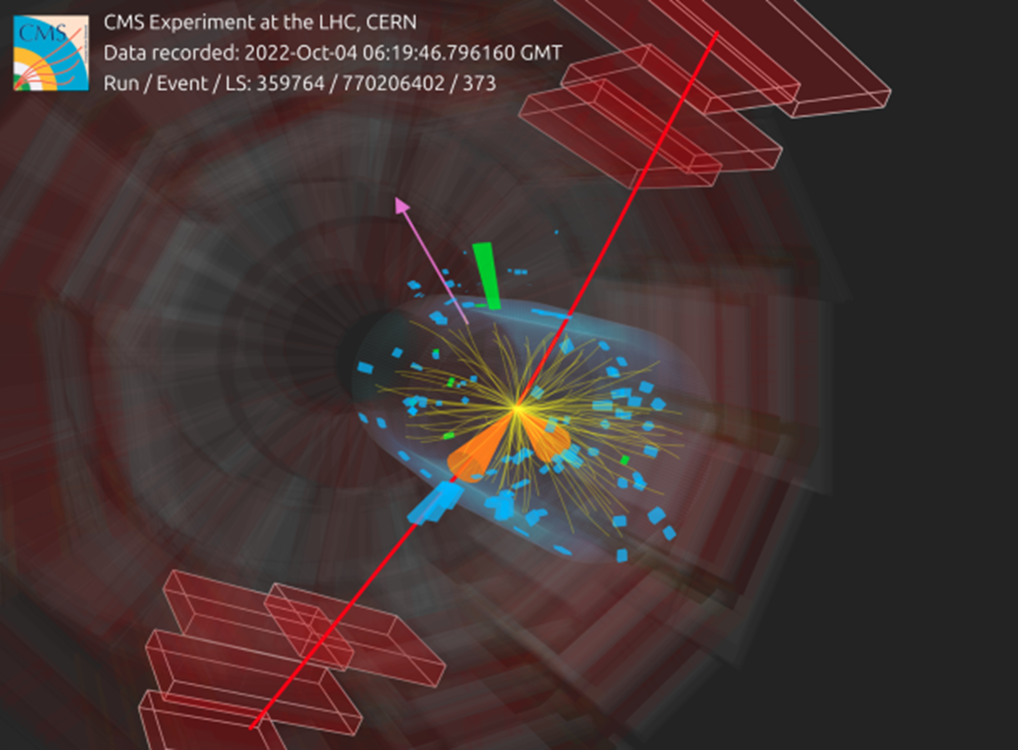
Measuring how the Higgs boson interacts with itself provides a crucial test of the Standard Model of particle physics. The most direct way to probe this self-interaction is by looking for events where the LHC produces two Higgs bosons at once (HH production). This process is extremely rare: in the Standard Model, Higgs boson pairs are produced 1000 times less often than single Higgs bosons.
Because the Higgs bosons decay almost instantly, we cannot observe them directly. Instead, we have to reconstruct them from their decay products. In this study, we search for HH production using a specific signature: one Higgs boson decaying into a bottom quark–antiquark pair, while the other decays into two W bosons, which themselves produce two charged leptons (electrons or muons) and neutrinos. Only about 59 signal events are expected in the analysed dataset – from a total of five quadrillion (5 x 10¹⁵) proton–proton collisions. Meanwhile, top quark–antiquark pair production can produce the same final-state at a rate roughly 100,000 times larger. It’s like searching for a needle in a haystack, but you never know for sure if you’re currently looking at a needle or a piece of hay.
To identify the signal events, we use neural networks (NNs). They combine many reconstructed properties of what is observed in the detector, and use them to predict how signal-like an event is, as shown in the figure below.
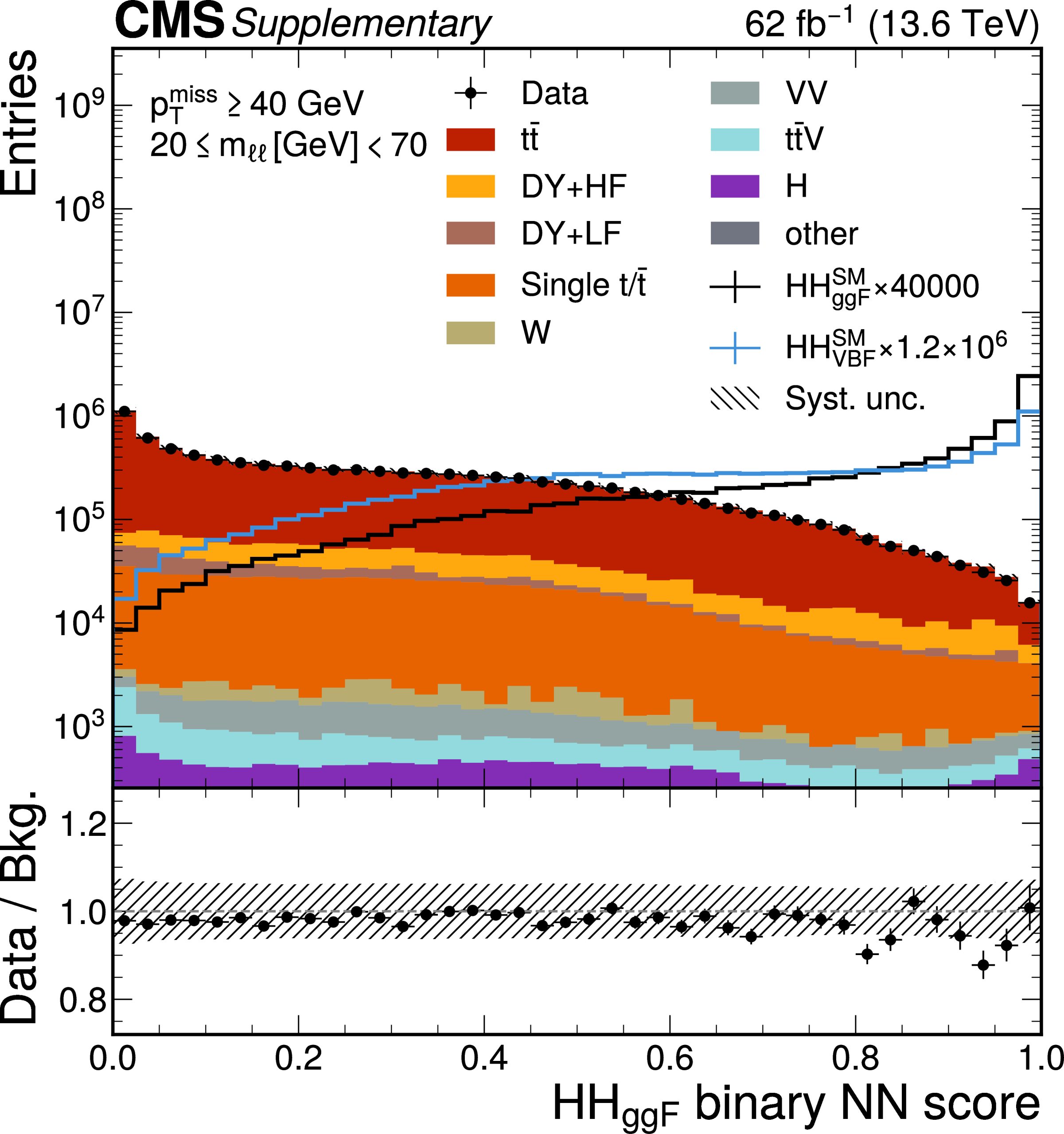
Above: Output score of a binary specialist NN that differentiates signal from background. Small scores (close to 0) are assigned to events that look like background, and large scores (close to 1) are assigned to events that look signal-like. The signal lines have been scaled up for visibility.
In this analysis, we trained not one but three NNs: a first network sorts events into two signal-like categories and several background-dominated categories, while two “specialist” networks are used to separate genuine Higgs boson pair events from background within the two signal categories. This strategy, combined with improved triggers and a better algorithm for identifying jets from bottom quarks, improved the sensitivity by roughly 50% compared to the previous version of this search, once differences in dataset size are accounted for.
We found no significant excess of Higgs boson pair events; the data are consistent with Standard Model predictions. We set upper limits on Higgs boson pair production: it cannot occur at more than 12 times the Standard Model’s predicted rate at the 95% confidence level. Combined with earlier CMS results from previous LHC running, this upper limit improves to 7.9 times the predicted rate.
We also constrain the elusive Higgs self-coupling strength, ruling out large deviations from its expected value (see figure below), along with a related interaction between two Higgs bosons and two force-carrying particles (W or Z bosons).
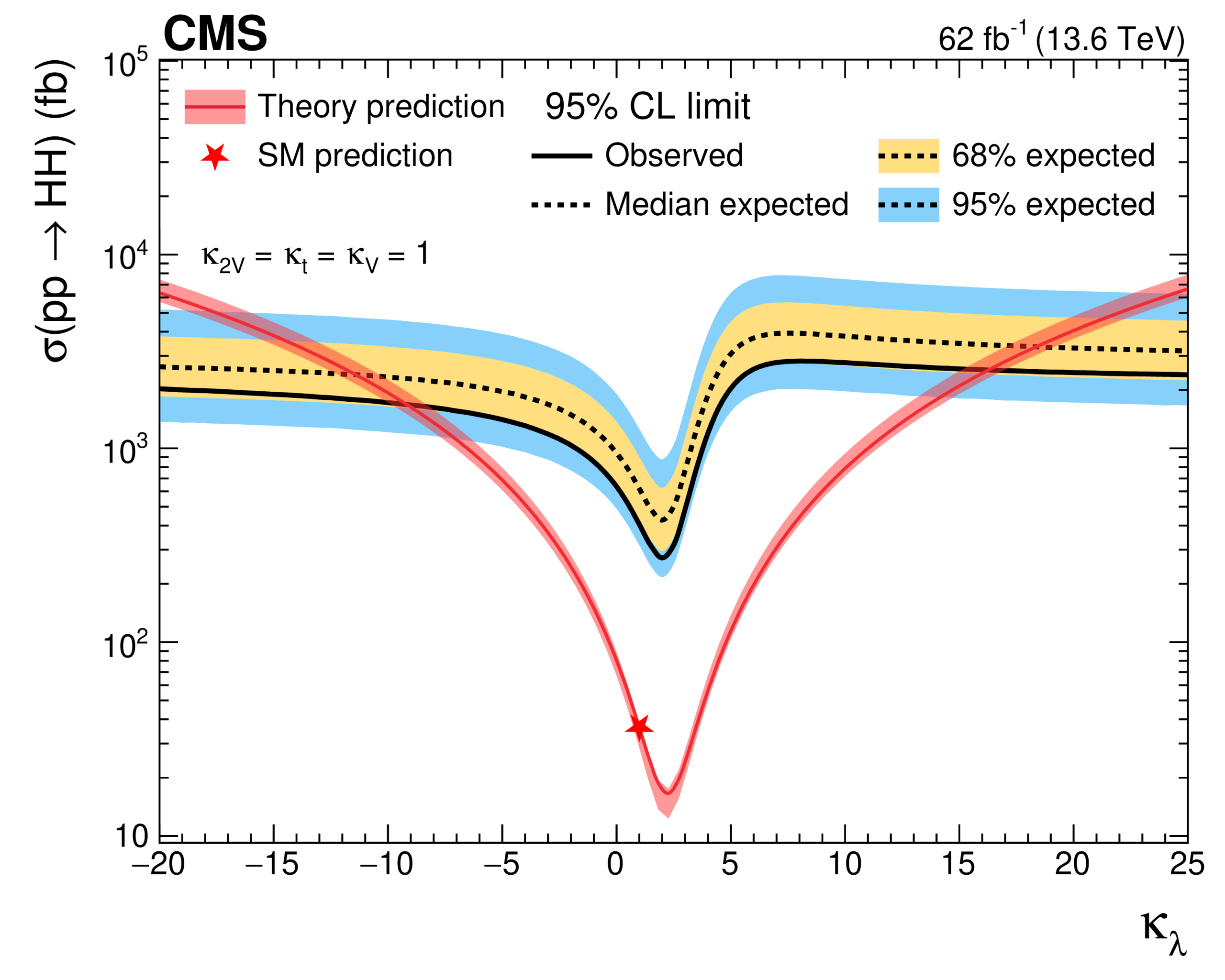
Above: Observed (solid black line) and expected (dashed black line) upper limits on the HH production rate as a function of the self-coupling parameter κλ. All values for κλ where the theory prediction (red line) is larger than the observed upper limit can be excluded with 95% confidence level.
The result itself demonstrates how much sensitivity can still be gained through more advanced analysis techniques alone, even using the same data sample. Combined with the steadily increasing amount of data, especially with the upcoming High-Luminosity LHC, searches like this one are expected to eventually catch a direct glimpse of Higgs boson pairs.
Written by: Mathis Frahm, for the CMS Collaboration
Edited by: Muhammad Ansar Iqbal

Read more about these results:
CMS Publication (HIG-25-018): “Search for Higgs boson pair production in the bbWW decay channel with two leptons in the final state using proton-proton collision data at √s= 13.6 TeV“