Why look at the top quark? It is the heaviest known elementary particle, because it interacts more strongly with the Higgs field than any other known particle. Yet the top quark remains among the less explored parts of the Standard Model (SM), our theory of fundamental particles and their interactions. Studying top quarks may give clues about what the SM does not explain. One way to explore this is to search for new particles that interact only with top quarks.
There are many ways to study such interactions, but if a new particle interacts only with top quarks, it would be very difficult to see at the LHC. However, a new heavy particle could be produced alongside a top quark-antiquark pair. This new particle could then decay to another top quark-antiquark pair, creating a total of four top quarks in the collision.
The production of four top quarks in the same collision was only discovered in 2023 at the LHC. This opens up a new opportunity to examine if there are extra new particles hiding in this signature. A top quark decays almost immediately into a b quark and a W boson. The W boson can then decay either into quarks or into an electron or muon together with a neutrino. This CMS search focuses on collisions in which two top quarks produce electrons or muons, making these events easier to identify. The other two top quarks, which could come from the new particle, decay only into quarks.
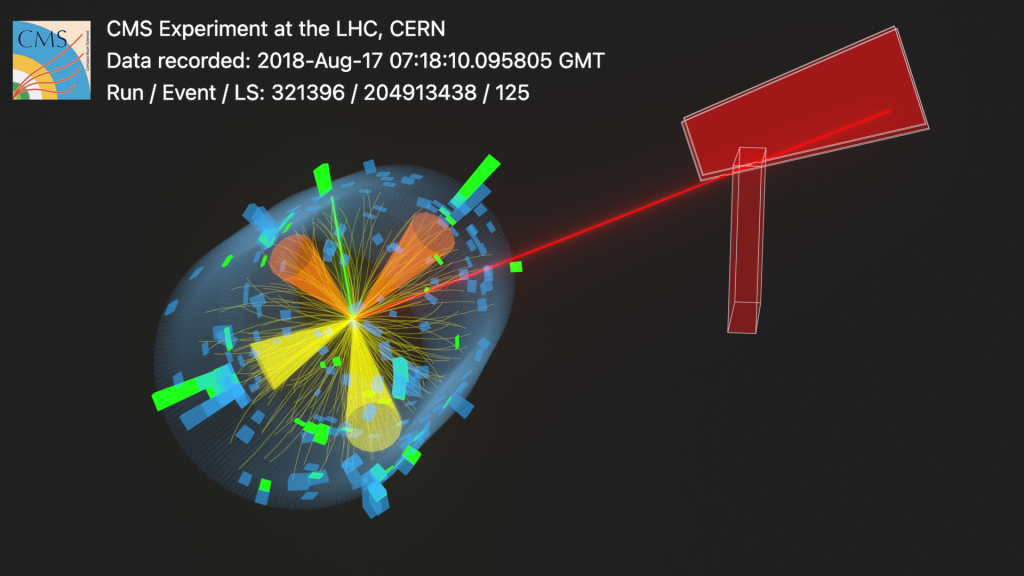
But how do we identify top quarks? The top quarks are so unstable that they decay almost immediately into more stable quarks, and we can see those decay products in the detector as sprays of particles called jets. The decay products of each of the two top quarks from the possible new particle can be emitted close enough together to appear as a single broad jet. CMS then uses these two jets to reconstruct the mass of the possible new particle, as illustrated in Figure 1.
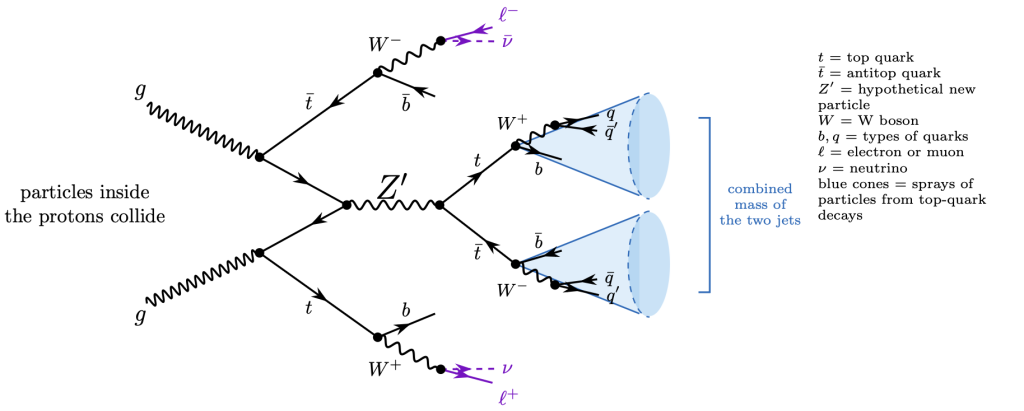
Figure 1: Schematic illustration of the type of collision studied in this search. Reading from left to right, the collision produces two top quarks and a new particle (Z′), which produces two more top quarks. Two of the top quarks produce electrons or muons, while the other two produce sprays of particles shown as blue cones. CMS combines information from these two sprays to search for the new particle.
There is one more challenge. The decay products of a top quark do not always look the same in the detector. When the top quark is moving more slowly, its decay products can spread over a wider area; when it is moving very fast, they appear much closer together. CMS therefore uses a jet-reconstruction method called HOTVR (“Heavy Object Tagger with Variable R”) whose jet size adapts to this changing pattern, together with machine learning to identify jets that are likely to come from top-quark decays. This allows the search to remain sensitive to new particles across a wide mass range, from 500 GeV to 4 TeV, including masses below 1 TeV that were difficult to study with earlier dedicated searches.
So, did CMS find a new particle? Not this time. The experiment compared the collision data with what physicists expect from the SM, looking for additional events that might point to something new. No convincing sign of a new particle appeared. This search therefore allows physicists to rule out the possibilities for such particles decaying to top quark pairs. For one of the theoretical scenarios involving a new particle that would produce a broad signal, CMS excluded masses up to 850 GeV. This does not mean that all new particles below this mass are excluded: the conclusion depends on the properties of the predicted particle and how strongly it interacts with top quarks. The search also tests other possible types of particles, further narrowing the possibilities for new physics involving top quarks.
This result is particularly interesting because CMS can now explore possibilities that earlier dedicated searches had difficulty testing. By selecting collisions in which two top quarks produce electrons or muons and using jet reconstruction techniques that adapt to different top-quark decay patterns, CMS can search for new particles across a wide range of masses, including below 1 TeV. Although no new particle was found, this search shows how four-top-quark events can help test ideas about new physics that were previously difficult to investigate. With more data from the Large Hadron Collider, CMS can continue looking for even rarer signs of particles that interact mainly with top quarks.
Written by: Saurav Bania, for the CMS Collaboration
Edited by: Haifa Rejeb Sfar