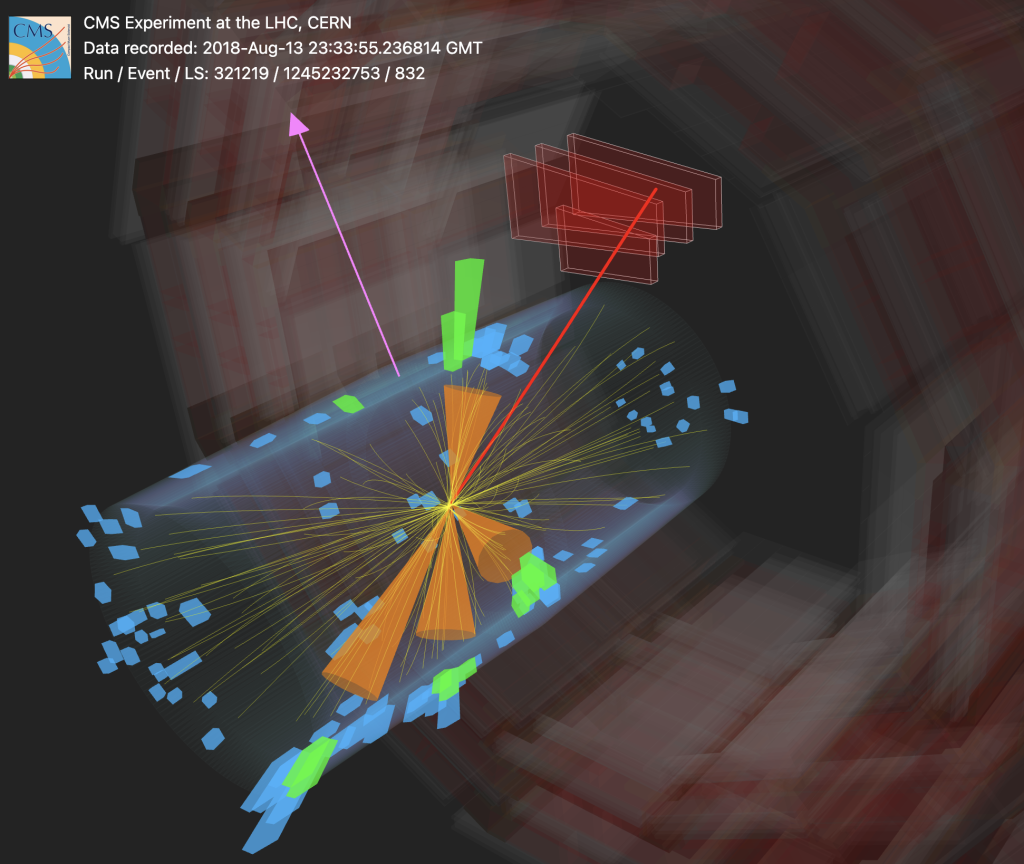
CMS has measured Vcb, a parameter of the Standard Model (SM) that describes transitions between beauty (b) and charm (c) quarks. Traditional measurements rely on the decays of B hadrons, using two complementary experimental approaches. Both probe the transition of a b quark into a c quark within the B hadron. However, because the b quark is tightly bound to others by the strong force, extracting Vcb requires complex calculations of the B hadron’s internal structure. Both approaches thus share this dependence, and the resulting Vcb measurements do not fully agree. The origin of this discrepancy remains unresolved.
CMS instead studies a W boson decaying directly into a c–b quark–antiquark pair. To study this decay, CMS uses proton-proton collisions that produce pairs of top quarks. One of these top quarks decays into a W boson and a b quark, providing the W boson needed for the measurement. Here, the W→cb decay rate is directly related to Vcb, without needing to describe an initial bound state as in B meson decay processes. “This lets us probe the same weak interaction in a fundamentally different physical environment,” says Inseok Yoon, a postdoctoral researcher and one of the analysis coordinators.
Identifying the b quark from the rare W decay is challenging because the two top quarks already produce two b quarks through their own decays. Additional radiation can also produce b quarks, making it even harder to determine which jet came from the W boson. Flavour-tagging algorithms help identify whether each jet came from a b quark, c quark, or lighter quark. However, no single observable can reliably distinguish the signal from background processes. These backgrounds are far more abundant than the signal and can mimic the rare decay through different physical mechanisms.
To tackle this challenge, the researchers developed a machine-learning tool that combines information from the jets and the overall event topology. By learning the characteristic features of the different background processes and how they can imitate the signal, the algorithm can better distinguish the rare decay from these overwhelming backgrounds.
“Everything begins with understanding how each ordinary process can look like this rare decay,” says Yeonjoon Kim, the PhD student who developed the machine-learning and statistical methods. “Once the algorithm learns to recognise the signal and the different background processes, the best way to distinguish them follows naturally.”
The researchers then compared the predictions with the observed data to determine how much signal was present, while accounting for uncertainties in the background estimate. The analysis of data collected in 2016–2018 shows that the rare W boson decay into a c–b quark–antiquark pair can be distinguished from more common processes in proton collisions and used to measure Vcb. Figure 1 shows the measured value of Vcb and its uncertainty. Within that uncertainty, the result is compatible with both traditional determinations.
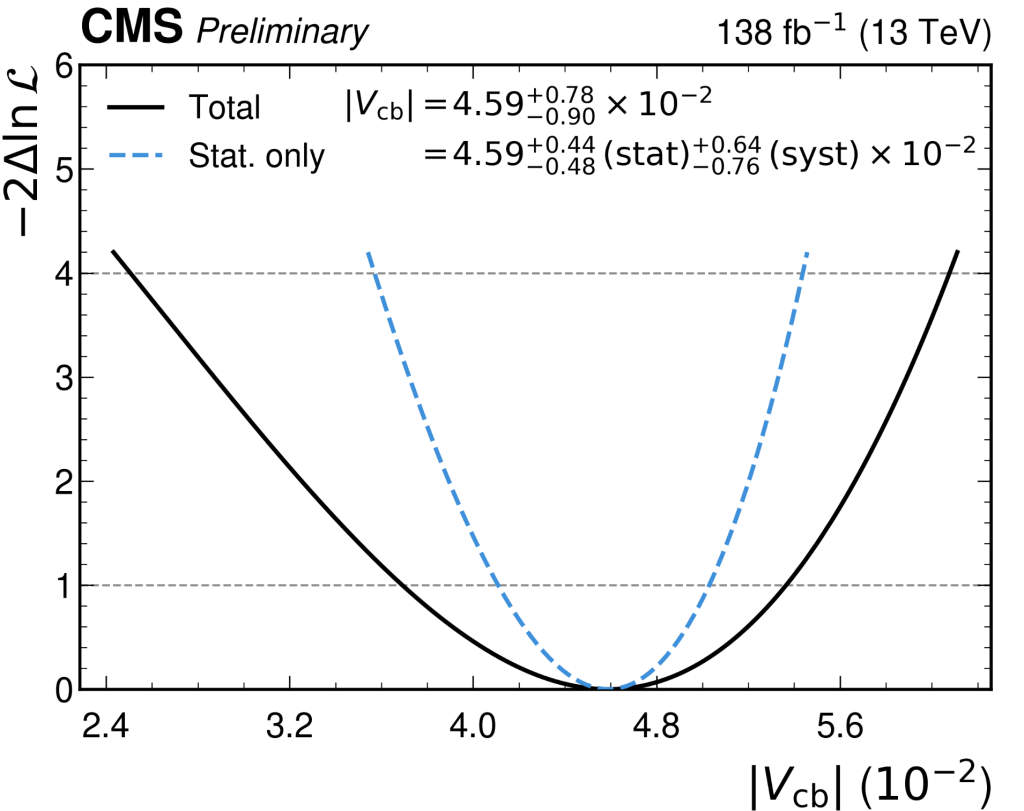
Figure 1. Measurement of Vcb using data collected in 2016–2018. The lowest point of each curve marks the preferred value, while its width indicates the uncertainty.
A subsequent analysis of data collected in 2024 achieved a more precise result, benefiting substantially from state-of-the-art b- and c-quark tagging techniques. Figure 2 shows how these data constrain Vcb.
“Identifying jets from b and c quarks with great precision allowed us to recognise the rare W decay more effectively,” says Emily Tsai, a PhD student who developed the jet flavour identification strategy. “To make full use of this, we carefully calibrated how well the tagging algorithm works in real data, correcting for differences from simulation.”
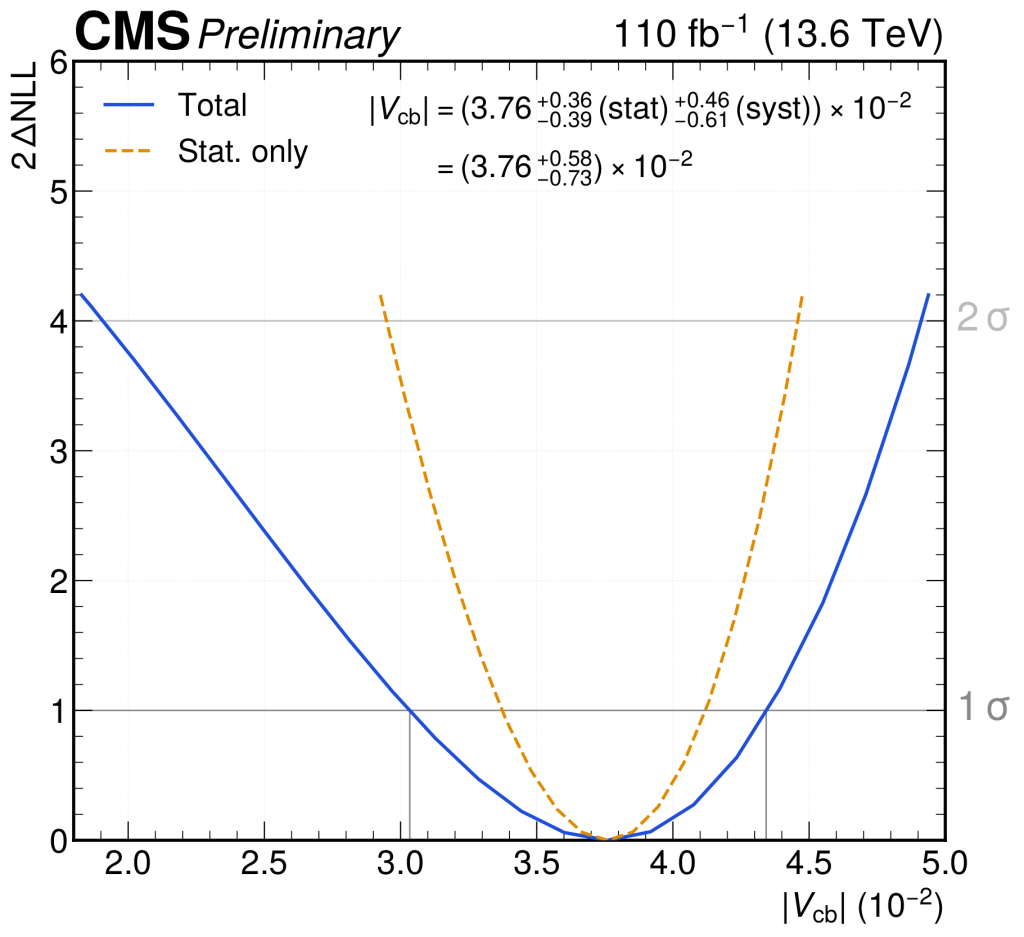
Figure 2. Measurement of Vcb using data collected in 2024. The lowest point of each curve marks the preferred value, while its width indicates the uncertainty.
Together, these measurements provide a complementary way to study Vcb, avoiding the complex theoretical calculations needed to describe the behaviour of the quarks inside B hadrons. By studying the connection between b quarks and c quarks through W boson decays, CMS brings an independent perspective to a longstanding puzzle. As more data are analysed and the precision improves, this approach could help clarify the disagreement between the traditional measurements and test whether our current understanding of particle physics tells the full story.
Written by: Inseok Yoon for the CMS Collaboration
Edited by: Haifa Rejeb Sfar

Read more about these results:
(TOP-26-001): “Measurement of the |Vcb| element of the CKM matrix from top quark pair events in proton-proton collisions at √s = 13 TeV”
(TOP-26-002): “Measurement of the CKM matrix element |Vcb| using top quark pair decays at √s = 13.6 TeV”