
CMS sets the world’s most stringent limits on B⁰ and B⁰ₛ decays into four muons.
After examining the Run 3 dataset collected between 2022 and 2024, the CMS experiment has established the most stringent limits to date on the extremely rare decays of neutral B mesons into four muons.These ultra-rare processes offer a powerful test of our current understanding of fundamental particles. Even a small deviation from theoretical expectations could point to the existence of new particles or previously unknown interactions. By pushing the measurable decay probabilities to unprecedentedly low values, CMS significantly narrows the space where new physics could be hiding.
Why four muons?
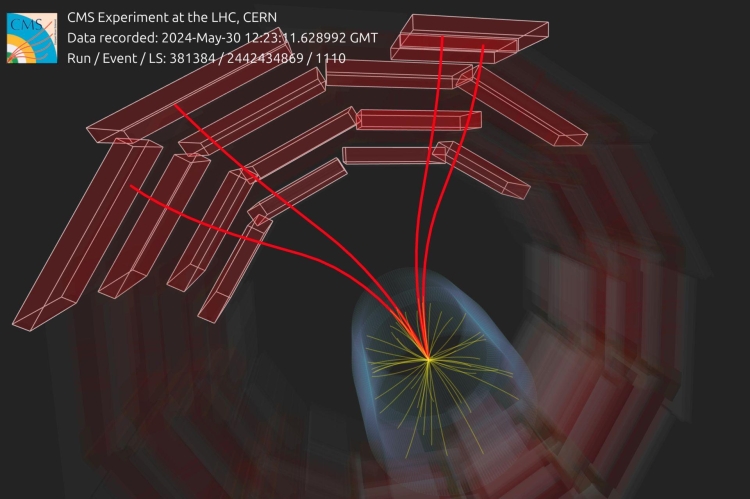
B mesons, which contain a bottom quark (or b-quark), can be used as powerful probes for rare phenomena. In the Standard Model, the propability of direct decays of B⁰ or B⁰ₛ into four muons without intermediate resonances is extraordinarily small. Several theories that extend the Standard Model predict that hypothetical heavy particles could enhance these decay rates. This analysis targets the direct processes B0→μ+μ-μ+μ- and Bs0→μ+μ-μ+μ-, explicitly vetoing known resonances.
A first search at CMS
The analysis scrutinizes 171 fb-1 of proton–proton collision data collected at 13.6 TeV at the Large Hadron Collider during Run 3 (2022–2024), marking the first time CMS has searched for these direct four-muon decays.
Events containing four well-identified muons are selected. The main challenge comes from background events, where other known processes can imitate the signal.
To address this, the analysis team used a Boosted Decision Tree (BDT), a machine-learning algorithm trained to distinguish subtle differences between signal-like and background-like events. This approach significantly enhances the sensitivity of the search.
After all selections,the invariant mass of the four-muon system is examined. A genuine signal would appear as a narrow peak at the known B-meson mass. To reduce systematic uncertainties, the analysis compares the search to a well-measured decay with a similar signature, B⁰ₛ → J/ψ(μ⁺μ⁻) ϕ(μ⁺μ⁻), which serves as a reference.
Results
No statistically significant excess of events is observed. CMS therefore sets the most stringent limits to date on these decay modes.
“Even though we did not observe a signal, we significantly improved the sensitivity to these decays. Each new constraint narrows the space where new physics could be hiding.” says Marco Buonsante, PhD student and principal author of the analysis.
Looking ahead
This result highlights the power of combining the large Run 3 dataset with advanced machine-learning techniques. As the LHC continues to deliver more data, the sensitivity to these ultra-rare decays will keep improving. The upcoming HL-LHC will provide an order of magnitude more data, greatly enhancing the potential to observe these extremely suppressed processes.
By probing ever smaller decay probabilities, CMS reinforces one of the most precise tests of the Standard Model, shaping the path toward discovering what may lie beyond our current understanding of the fundamental laws of nature.
Written by: Marco Buonsante, for the CMS Collaboration
Edited by: Andrés G. Delannoy
Read more about these results:
-
CMS Physics Analysis Summary (BPH-24-007): "Search for the rare B0s (B0)→ μ+ μ- μ+ μ- decays in proton-proton collisions"
-
@CMSExperiment on social media: Bluesky - Facebook - Twitter - Instagram - LinkedIn - TikTok - YouTube