
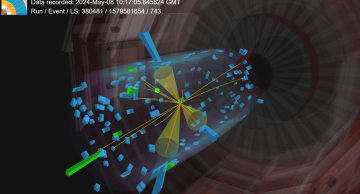
The CMS experiment utilises proton–proton collision data collected between 2016 and 2026 to search for rare decays of the W boson into three charged hadrons.
The W boson, which carries the weak nuclear force, was discovered at CERN in 1983 by…
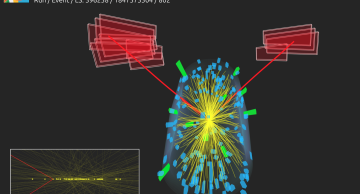
The CMS experiment uses data collected between 2016 and 2026 to observe, for the first time, leptons (electrons and muons) emitted from protons scattering off one another.
Since the first high-energy proton colliders began operating more than…
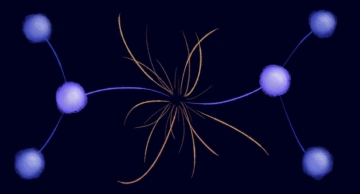
CMS advances the study of Higgs boson’s self-interaction by searching for Higgs boson pairs decaying into bottom quark–antiquark and tau lepton–antilepton pairs in collisions recorded between 2022 and 2024.
Is the Standard Model (SM) the…
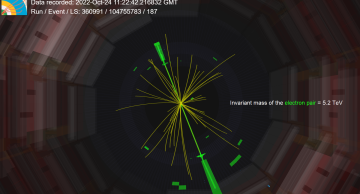
CMS probes the highest-energy lepton pairs ever recorded to search for hints pointing to a Higgs boson made of smaller constituents.
Is the Higgs boson truly an elementary particle, or could it be composed of more fundamental constituents? This…
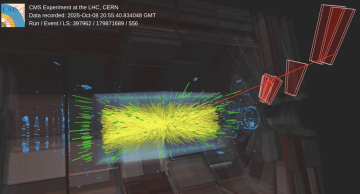
A special test run, with more than twice as many near-simultaneous collisions as usual, allowed CMS to test new methods of tracking and identifying particles, years before the upgraded High-Luminosity LHC comes online.
For a few days during…
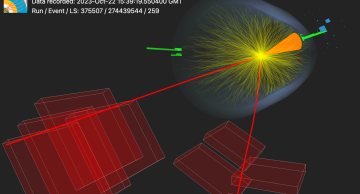
Using Z bosons, the CMS experiment reveals new details of how the Quark-Gluon Plasma drains energy from energetic quarks and challenges current theoretical descriptions.
To understand the Quark-Gluon Plasma (QGP), the hottest matter in the Universe…
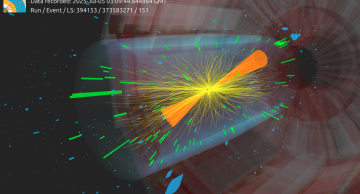
As high-transverse momentum particles punch through the plasma formed from light ions, the CMS experiment sees a possible imprint from the initial shape of the collisions
For the first time, CMS has observed both suppression of high transverse…
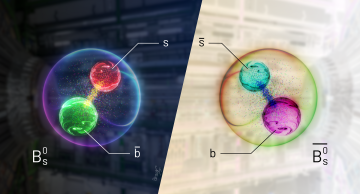
The CMS experiment uses its largest sample of B mesons to date to perform a high-precision test of subtle differences between matter and antimatter.
One of the greatest mysteries in physics is why our universe is made almost entirely of…
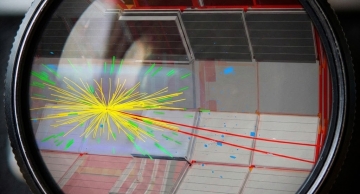
The CMS experiment presents the first measurement of ϒ mesons – bound states of a bottom quark-antiquark pair – in oxygen-oxygen and neon-neon collisions, and strongly indicates that their production is suppressed owing to quark-gluon plasma…
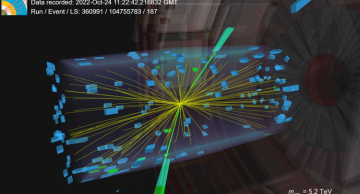
CMS observes rare collisions that produce pairs of electrons or muons with the highest combined invariant mass ever recorded, extending the search for undiscovered heavy particles.
The CMS experiment at CERN has carried out one of its most…
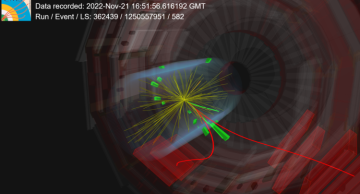
The CMS experiment reports the first observation of the rare decay of an eta meson to two muons and two electrons.
The CMS detector was originally built to discover the Higgs boson and search for heavy particles that could transform our…
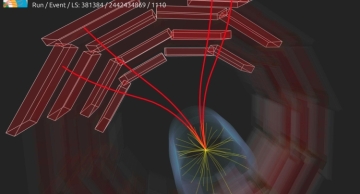
CMS sets the world’s most stringent limits on B⁰ and B⁰ₛ decays into four muons.
After examining the Run 3 dataset collected between 2022 and 2024, the CMS experiment has established the most stringent limits to date on the extremely rare decays of…