
CMS pushes the sensitivity frontier towards a measurement of the rare Higgs boson decay into a Z boson and a photon
The 2012 discovery of the Higgs boson at CERN by CMS and ATLAS was a landmark achievement in the world of particle physics - but it was only the beginning. With a mass of 125 GeV, the Higgs boson is uniquely positioned: light enough to be produced abundantly at the LHC, yet heavy enough to decay into a wide variety of other particles. By precisely measuring how often it decays through these different channels, physicists can test whether the Higgs boson behaves as the standard model predicts.
One of the rarest and most intriguing types of Higgs boson decay occurs with the production of a Z boson and a photon. Unlike many other Higgs boson decays, this one does not happen directly but through a quantum loop: short-lived particles interact with the Higgs boson and enable its decay. Even heavy, yet-to-be-discovered particles can potentially participate in the loop, providing a particularly sensitive window into potential new physics. As illustrated in Fig.1, this decay is also very special because it is the only process that directly involves all three neutral bosons of the standard model: the photon (the mediator of the electromagnetic force), the Z boson (one of the mediators of the electroweak force), and the Higgs boson.
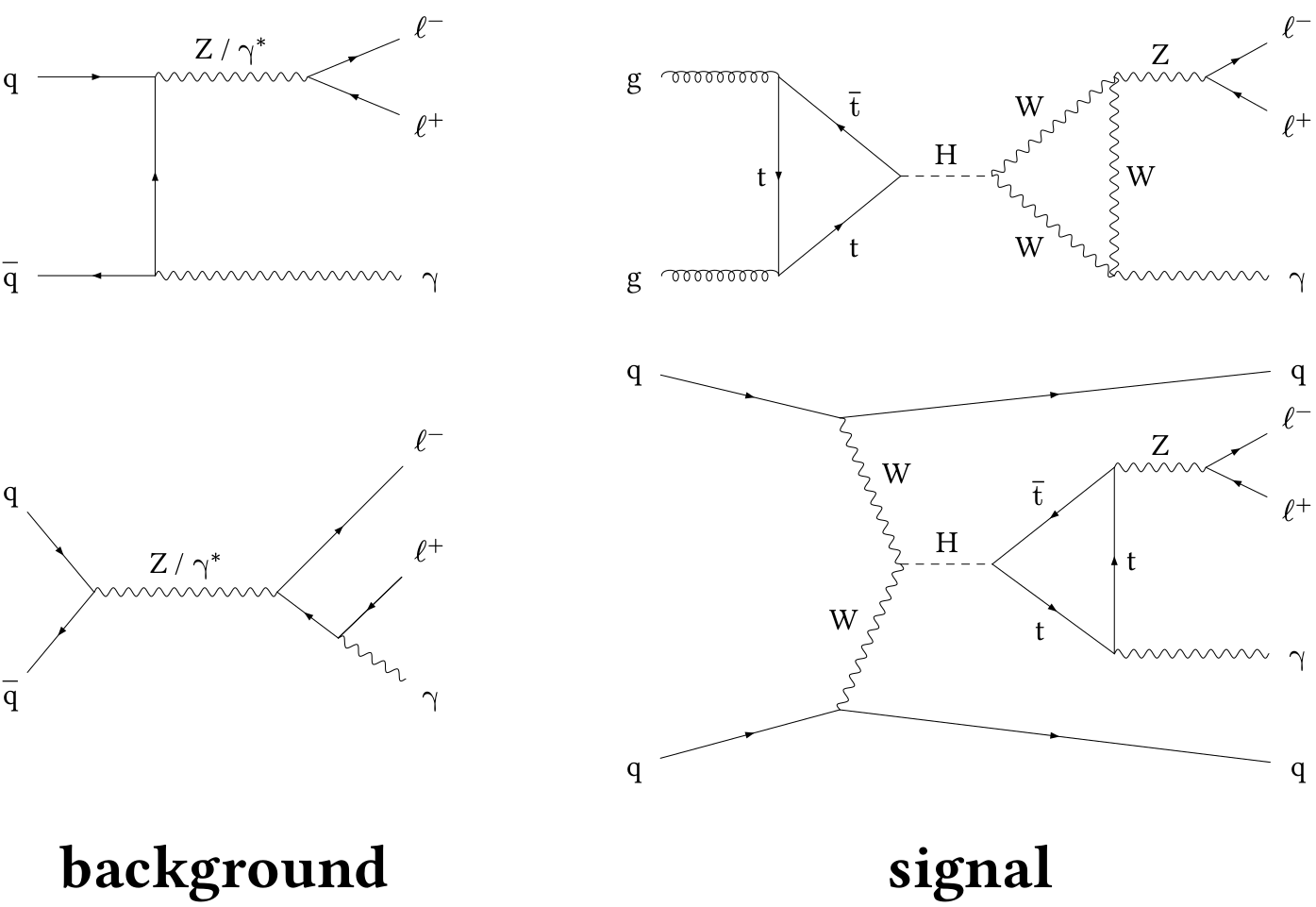
Figure 1: Examples of Feynman diagrams illustrating background and signal processes. For the signal processes, some Higgs boson production modes include additional particles in the final state used for categorization, as seen in the bottom right diagram.
Despite more than a decade of data taking and the production of over 20 million Higgs bosons, this rare decay has yet to be observed with sufficient statistical significance. It only occurs in about one every thousand Higgs bosons decays, making it an extremely small signal. Moreover, only about 6% of Z bosons decay into muons or electrons, the two lepton flavors that can be measured with the high precision required for this analysis. “The biggest challenge is detecting the decay while ensuring the analysis remains unbiased,” explains Xingchen Fan, Ph.D. student from Cornell University, “since the signal is buried within a dominant background of similar events coming from other standard model processes.”
This latest CMS analysis marks a major step forward. For the first time, it includes data from part of Run 3 of the LHC. But the progress does not come from more data alone. The Run 2 dataset has also been reprocessed with improved calibrations, upgraded tagging algorithms, and refined analysis strategies, squeezing every bit of information from the full joint sample. Despite analyzing only part of the available dataset, this result is on par with the most sensitive measurement of this rare decay to date. In particular, the analysis employs additional triggers and refines event categorization using advanced machine-learning techniques. It also targets production modes in which the Higgs boson is produced in association with another electroweak boson or with a pair of top-antitop quarks.
“This analysis was truly a team effort.” says Mingtao Zhang, Ph.D. student from Peking University. “By combining expertise from collaborators from almost every corner of the world, we ensured the study was solid and reliable. Thanks to the time zone overlaps, it seems we kept our work going with a global relay team!”
The new results, reported in Fig.2, are consistent with the standard model, with a measured signal strength—defined as the ratio of the measurement with respect to the theoretical expectation—of 1.1+0.5−0.6. While the statistical significance has not yet reached the threshold required to claim an observation, as shown in Fig. 3, this study represents an important step towards future analyses.
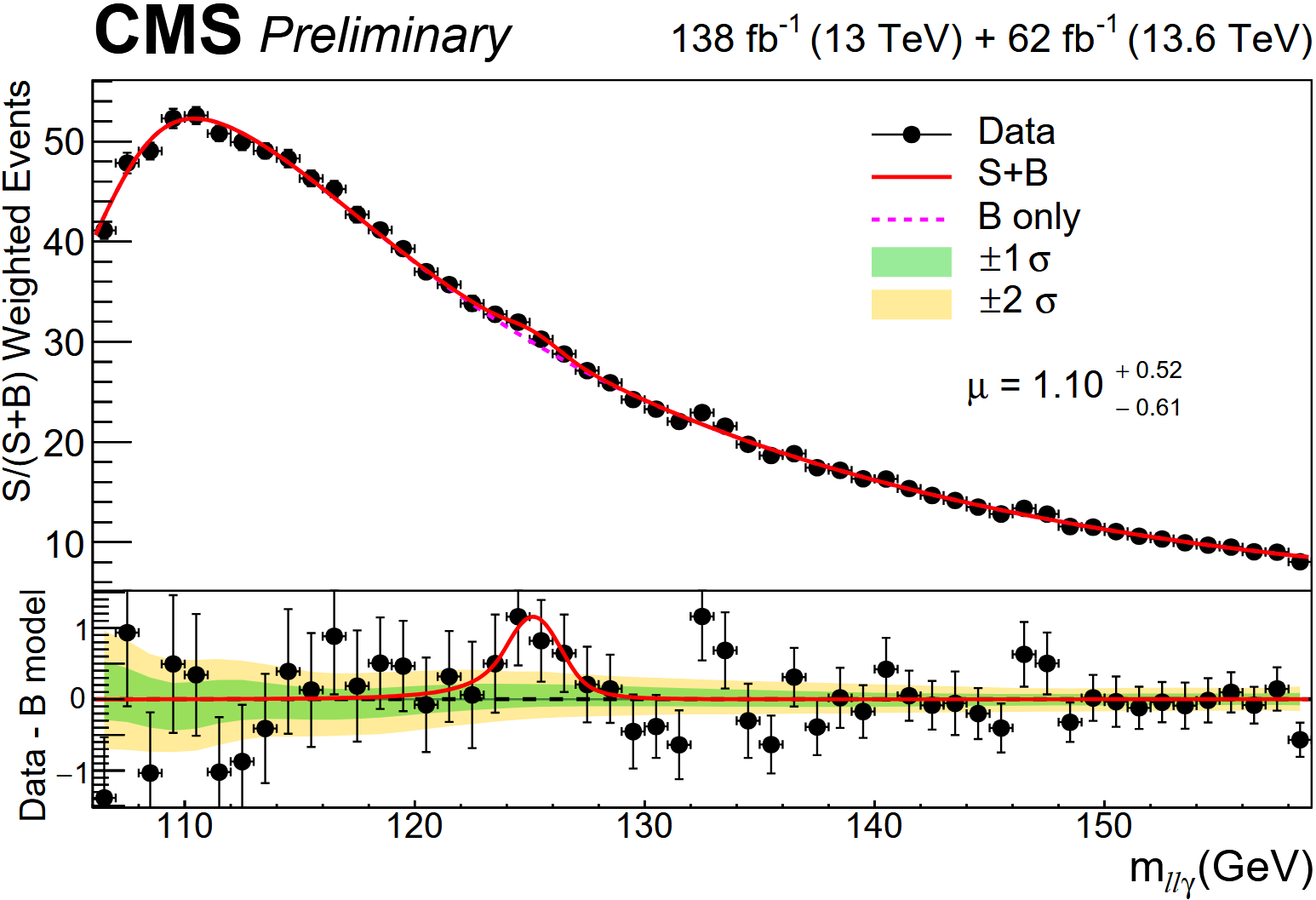
Figure 2: Invariant mass of the final state particles in a simultaneous fit of signal plus background model for all categories of the analysis.
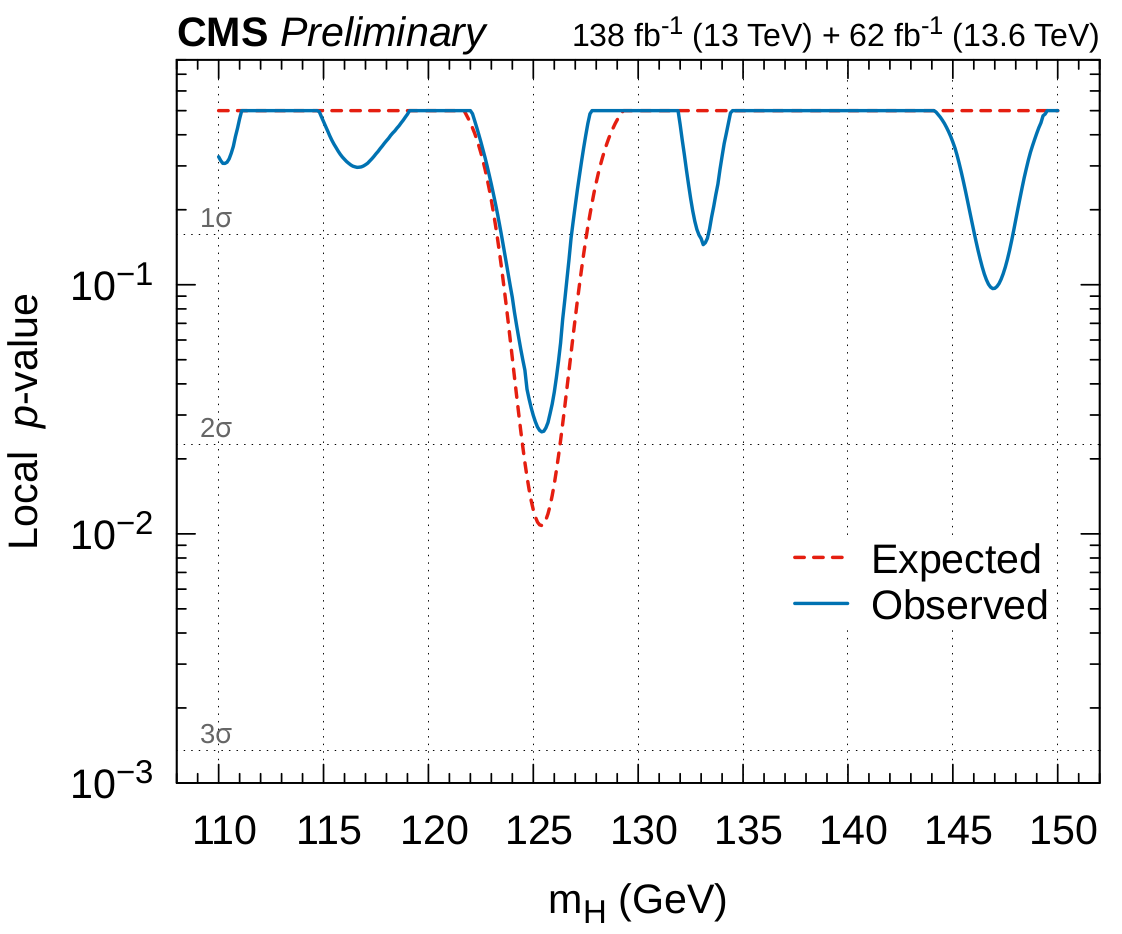
Figure 3: Local p-value scan showing the likelihood of a random fluctuation of the background leading to the observed data at a given Higgs boson mass hypothesis. The observed significance at the Higgs boson mass of 125 GeV is 1.9σ, compatible with the theory expectations and below the threshold required for evidence (3σ) and observation (5σ).
As Anders Barzdukas, Ph.D. student from the University of California, Santa Barbara, explains “With the full Run 3 dataset—and, starting in 2030, at the High-Luminosity LHC—CMS aims not just to observe this decay, but to measure it precisely. This rare process will become one of the most valuable probes of the standard model and potential new physics beyond it.”
Written by: Francesco Orlandi, for the CMS Collaboration
Edited by: Andrés G. Delannoy
Read more about these results:
-
CMS Physics Analysis Summary (HIG-25-010): "Search for the rare Higgs boson decay H→Zγ in proton-proton collisions at √s = 13 and 13.6 TeV"
-
@CMSExperiment on social media: Bluesky - Facebook - Twitter - Instagram - LinkedIn - TikTok - YouTube