
As high-transverse momentum particles punch through the plasma formed from light ions, the CMS experiment sees a possible imprint from the initial shape of the collisions
For the first time, CMS has observed both suppression of high transverse momentum (pT) particles and anisotropy in their azimuthal distributions in a small collision system, which together represent a hallmark signature of jet quenching in quark–gluon plasma (QGP). This strengthens the evidence that QGP is formed in small systems.
The extreme temperatures generated in heavy ion collisions melt the nuclei into a strongly interacting soup of quarks and gluons. Surprisingly, flow-like correlations were also observed before in proton-lead collisions, which hinted at the formation of QGP in small systems. This led to a surge of studies that confirmed the collective flow behavior in these collisions. However, jet quenching signatures went unobserved in proton-lead collisions, and therefore a piece of the puzzle remained missing.
The imprint of the initial shape on high-momentum particles
Although the quark–gluon plasma expands collectively at relativistic speeds once it is formed, hydrodynamic flow is not the most energetic process in the collision. That distinction belongs to jets, energetic sprays of particles that traverse the medium. Both low-energy and high-energy probes are governed by the geometry of the plasma and carry complementary information about its properties.
CMS already gleaned possible evidence of jet energy loss in the plasma from a first look at the oxygen-oxygen collision data collected in 2025. The next question was whether this particle suppression would also manifest itself as a high-pT anisotropy tied to the geometry of the medium; if correlation with initial collision geometry is observed, then medium-induced parton energy loss is the most likely explanation. “Having seen the jet energy suppression in the early oxygen-oxygen collision results last fall, we immediately set out to determine whether the high-momentum anisotropy would follow,” said Andi Mankolli, a PhD student at Vanderbilt University and one of the analyzers of the study.
Overcoming the challenge of isolating high-pT anisotropy in oxygen-oxygen collisions
Measuring the anisotropy signal, however, requires mitigating background from particle correlations that are not related to the geometry of the QGP and its hydrodynamic expansion. These so-called “nonflow” correlations are short-ranged in pseudorapidity, η (angle relative to the beam axis) and arise mostly from jets. By enforcing a separation in η, these short-range correlations are suppressed.
In the high-pT regime, the nonflow correlations of jet particles dominate over those resulting from the anisotropic quenching of the jets in the plasma. Therefore, additional subtraction was performed using measurements in proton-proton collisions, where no anisotropy signal is assumed. “Before the proton-proton subtraction, the v2 coefficient at high pT decreases rapidly as the η separation increases,” noted Dr. Shengquan Tuo, a physicist from Vanderbilt University and lead analyzer in the study. “Remarkably, after subtraction, the signal becomes independent of the separation, indicating that the residual nonflow contributions are effectively eliminated.” The measured v2(pT) distributions have been compared with several theoretical models, as shown in Fig. 1.
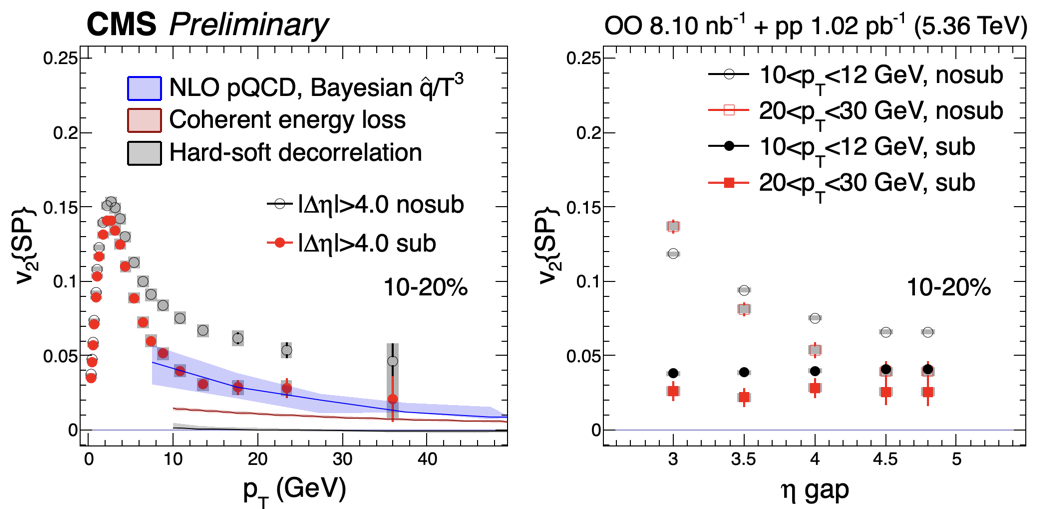
Figure 1: The azimuthal anisotropy v2 as a function of pT (left) shown before and after proton-proton baseline subtraction and compared to theoretical models with various levels of interaction between soft and hard particles. And the v2 as a function of the η separation (right) between the analyzed particles, again shown before and after baseline subtraction, for two ranges of high-pT.
As theoretical models improve, the new CMS measurements will help determine whether the same physics rules both large and small quark-gluon plasma systems, bringing researchers closer to understanding one of nature’s most extreme forms of matter.
Written by: Andi Mankolli, Shengquan Tuo, and Julia Velkovska, for the CMS Collaboration
Edited by: Andrés G. Delannoy
Read more about these results:
-
CMS Physics Analysis Summary (HIN-26-005): "Coming soon!"
-
@CMSExperiment on social media: Bluesky - Facebook - Twitter - Instagram - LinkedIn - TikTok - YouTube