
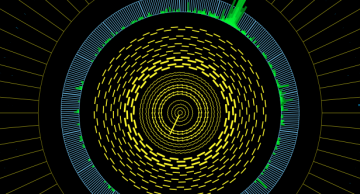
New, undiscovered charged particles could be produced by the LHC, leaving tracks in CMS that look similar to tracks from Standard Model particles. If the new particle decays to other, unseen new particles inside the CMS tracker, a very striking…
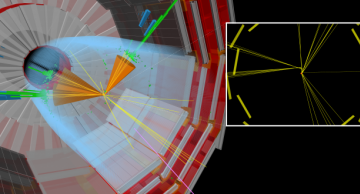
Nowadays, artificial neural networks have an impact on many areas of our day-to-day lives. They are used for a wide variety of complex tasks, such as driving cars, performing speech recognition (for example, Siri, Cortana, Alexa), suggesting…
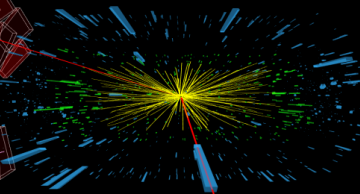
At the LHC, protons do not collide one at a time. Instead, the protons are combined into bunches, packages of more than 100,000 million (1011) protons. These bunches are then pointed at each other at the four collision points of the LHC. Even when…
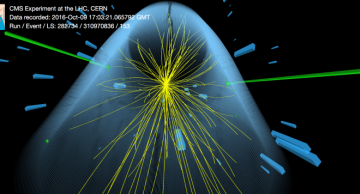
A new result by the CMS Collaboration narrows down the mass of the Higgs boson to a precision of 0.1%.
After reporting the observation of the Higgs boson at the CERN LHC in 2012, scientists the ATLAS and CMS Collaborations have been busy…
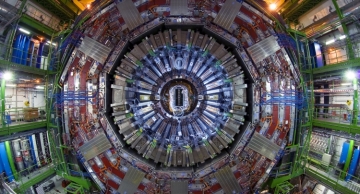
For the first time, CMS physicists have measured the production rate of top quark pairs as a function of three experimental observables simultaneously. The new result helps to answer several fundamental questions, among which, the properties of…
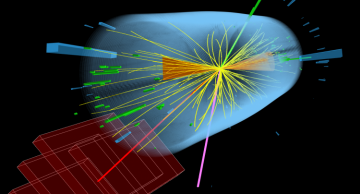
For the first time, CMS physicists have investigated an effect called the “running” of the top quark mass, a fundamental quantum effect predicted by the Standard Model.
Mass is one of the most complex concepts in fundamental physics, which went…
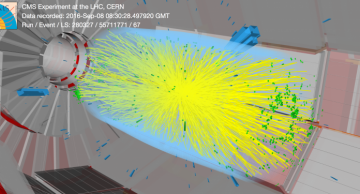
When the CMS experiment records particle collision events, a large number of unwanted extra collisions overlap in the detector and hide the rare particle collision that is worthwhile studying. CMS physicists have developed a new method that…
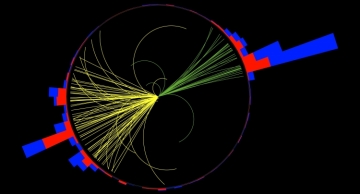
New algorithms from the Compact Muon Solenoid experiment use the ideas used in mobile phone facial recognition to better understand the collisions at the Large Hadron Collider.
One of the most exciting challenges at the Large Hadron Collider is the…
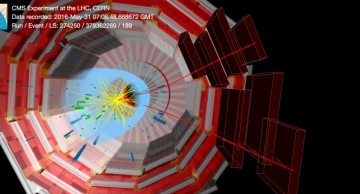
The Bs meson is a bound state of a strange quark and a beauty antiquark – as such it possesses both beauty and strangeness! For many years, searches for an extremely rare decay of the Bs meson, to a μ+μ- pair, remained a holy grail…
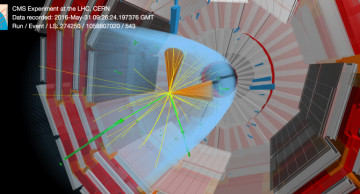
The CMS collaboration has carried out for the first time a direct search for a Higgs boson decaying into charm quarks, a vital step in understanding the Higgs particle and the Standard Model.
The discovery of a Higgs boson by both the ATLAS and…
Not many people know that there is a boson-boson collider hiding in the proton-proton collisions of the Large Hadron Collider. The idea is that during rare occasions other particles such as the photon and gauge bosons W and Z are created by the…
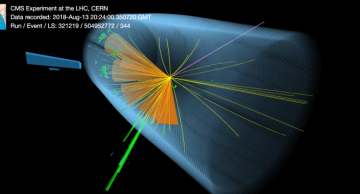
The CMS Collaboration has recently presented an updated search for new invisible particles. The technique capitalizes on the imbalance among the visible particles in a collision that such an object would induce. If dark matter is made of fundamental…