
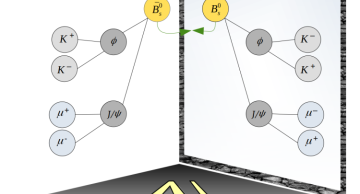
When we look at ourselves in a mirror, we see a virtual twin, identical but with left and right inverted. Charge-parity (CP) is the equivalent of a mirror for fundamental particles. If the symmetry was respected in nature, each particle would see a…

From time to time, we need to take our cars in for a checkup to make sure everything is up to speed, and here we check up on how well our CMS detector is working. The CMS detector is one of the main detectors at the Large Hadron Collider (LHC) at…

If you have ever had Neapolitan gelato, you know how important it is to combine three different flavours, each in just the right size. And the Standard Model (SM) of particle physics is not less tasty than that! In the SM, leptons are some of the…
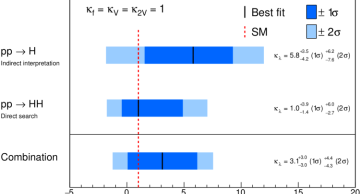
The Higgs boson plays a crucial role in the standard model of particle physics. It is the only particle whose field has nonzero vacuum expectation value. It’s like having a special wave whose status of minimum energy (the “vacuum”) has an average…
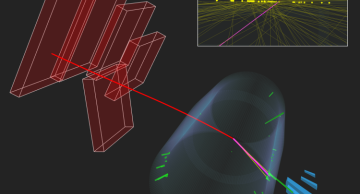
In quantum electrodynamics (QED), the quantum theory of electromagnetic interactions, the magnetic dipole moment of a particle acquires quantum corrections originating from interactions with virtual photons and other particles, often referred to as…
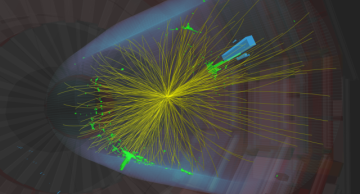
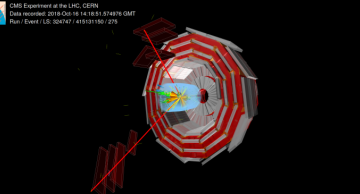
Above: Event display for a potential SUEP event, recorded at CMS in 2018, showing the characteristically high multiplicity of soft tracks in yellow.
Could there be a “dark world” composed of invisible particles held together by a new strong dark…
The CMS experiment at the LHC is set to explore the fundamental nature of our universe. It allows scientists to study particles, their interactions, and the forces that shape our world. Through these studies, a deeper understanding of the building…
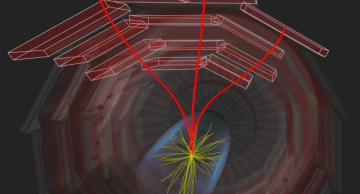
It was 1918 when the mathematician Emmy Noether published what is known as her most famous theorem, revealing the fundamental relation between the symmetries of a physical system and the laws enforcing the conservation of some of its characteristic…
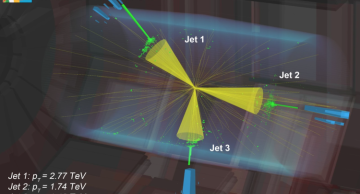
Three-jet event with an invariant mass of 7.2 TeV, showing the jets (yellow cones) and the energy deposited in the electromagnetic (green) and hadron (blue) calorimeters.
With the discovery of the Higgs boson, the Standard Model of particle physics…
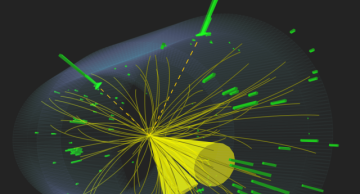
In 2012, the ATLAS and CMS Collaborations observed a new boson with a mass of 125 GeV, whose properties are compatible with those of the Higgs boson predicted by the Standard Model (SM) of particle physics. However, numerous models beyond the…
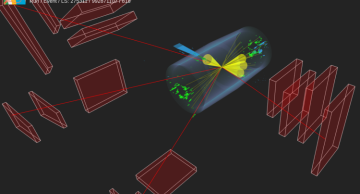
The CMS Collaboration has recently reported a new study of ZZ+jets production, a process described by the Standard Model of particle physics. The goal of such measurements is to compare the observed results with the theoretical predictions; any…
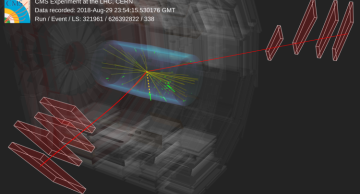
The discovery of the Higgs boson in 2012 marked a significant milestone in particle physics. Since then, researchers at the ATLAS and CMS Collaborations have been diligently investigating its properties and probing for rare production and decay…