
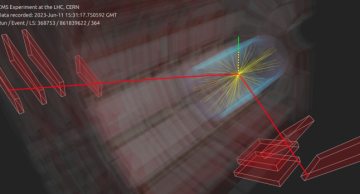
CMS pushes the sensitivity frontier towards a measurement of the rare Higgs boson decay into a Z boson and a photon
The 2012 discovery of the Higgs boson at CERN by CMS and ATLAS was a landmark achievement in the world of particle physics - but it…
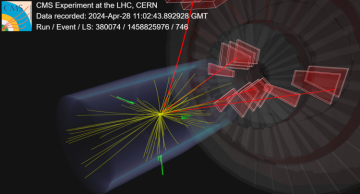
The CMS experiment uses data collected between 2022 and 2024 to perform a detailed study of Higgs boson production rates as a function of several variables. The measurements focus on the “golden channel”, characterized by four leptons (…
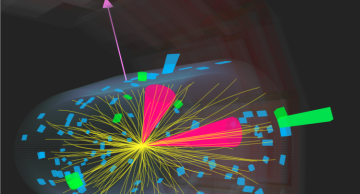
The CMS experiment has performed a new search for Charge-Parity violation in Higgs boson decays to tau leptons, shedding light on the origin of matter.
Since its discovery in 2012, the Higgs boson has helped scientists explore some of the Universe’…
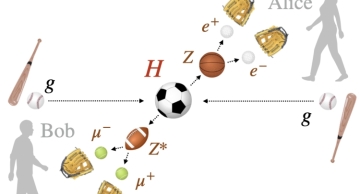
For the first time, the CMS experiment probes quantum entanglement in Higgs boson decays to a pair of Z bosons. The result is the most general analysis of kinematic distributions in the four-lepton final state, measuring spin correlations and…
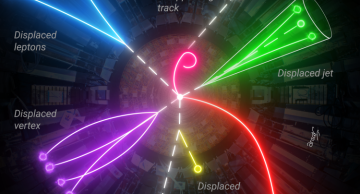
In Run 3, CMS expanded its trigger program to enhance capturing long-lived particles that decay far away from the point of collision – broadening the search for physics beyond the Standard Model.
Imagine a high-security vault. Most intruders…
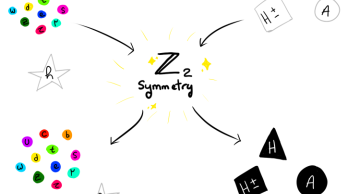
For the first time ever, the CMS experiment has designed a dedicated analysis using parametrised machine learning to look for new dark particles that don’t socialize with Standard Model fermions, one of them being a favourite candidate in the…
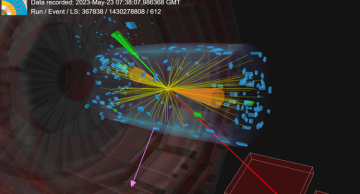
The CMS Collaboration reports the first measurements of the production of same-sign WW and WZ boson pairs in association with two jets at 13.6 TeV, using data collected during 2022–2024.
One of the most powerful probes of the Higgs mechanism…
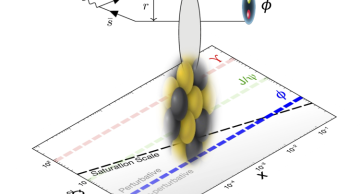
The CMS Collaboration reports the first measurement of coherent ϕ meson photoproduction, establishing a powerful new tool to explore the dense nuclear matter in the transition regime from perturbative to nonperturbative QCD.
The CMS Collaboration…
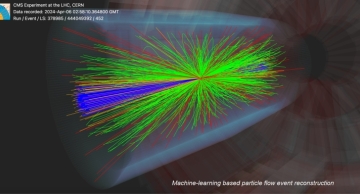
An interactive version of the above event display can be found at this page.
For the first time, the CMS experiment has demonstrated that machine learning can be used to reconstruct collisions at the LHC. This new approach improves the precision…
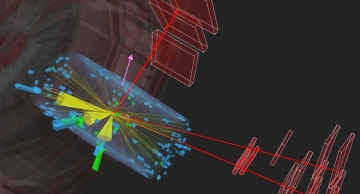
Using data collected from 2016 to 2023 and cutting-edge machine learning, CMS observes for the first time the creation of a top quark together with a W and a Z boson – a process so rare it occurs only once in a trillion proton-proton…
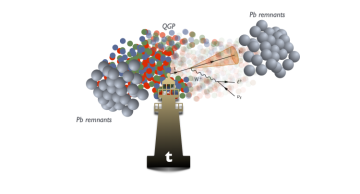
Five years after the first evidence that heavy metal hits the top quark, CMS now observes the clash of two titans with higher precision at unprecedented energy.
Using lead-lead collision data acquired in 2023 at the highest energy ever achieved by…
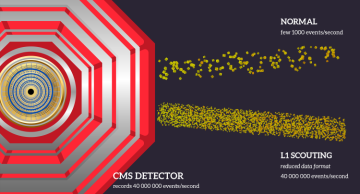
The CMS experiment is utilising a novel technique called L1 Scouting, which allows it to record data from all collisions, without any selection, but in a reduced format. A first pioneer physics result using this data showcases the immense…