
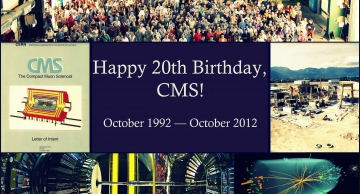
The CMS Letter of Intent was completed 20 years ago this month.
We propose to build a general purpose detector designed to run at the highest luminosity at the LHC. The CMS (Compact Muon Solenoid) detector has been optimized for the search of the…
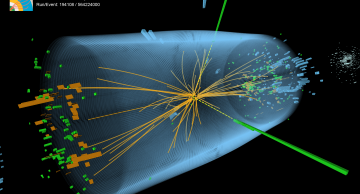
CMS Experiment, CERN
4 July 2012
The statement below is also available as PDF files in: English | French | Catalan | Chinese (traditional) | Chinese (simplified) | Croatian | Dutch | Finnish | Galician | German | Greek | Hindi | Hungarian | Italian…

*** draft *** draft *** draft ***
ICHEP agenda
CMS contributions
Media enquiries: CERN Press Office
This page shows new CMS results presented at the International Conference on High-Energy Physics (ICHEP) during 4—11 July 2012 in Melbourne,…

Hundreds of millions of collisions per second -- Detectors collecting data to analyse 24/7 : the LHC and its experiements generate millions of gigabytes of data. The Computing Grid, a huge, worldwide network of computers was invented to manage,…
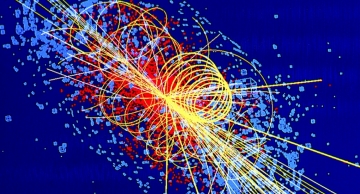
The Higgs boson is the fundamental particle predicted by the Brout-Englert-Higgs mechanism. This theory explains how fundamental particles acquire their mass. The search for the Higgs boson is one of the most fascinating scientific adventures. It…
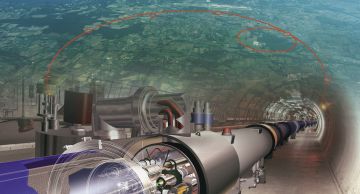
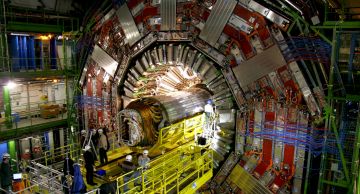
CMS is one of two general-purpose experiments at CERN's Large Hadron Collider (LHC) that have been built to search for new physics. CMS is designed to detect a wide range of particles and phenomena produced in the LHC's high-energy proton-proton and…
The LHC smashes groups of protons together at close to the speed of light: 40 million times per second and with seven times the energy of the most powerful accelerators built up to now. Many of these will just be glancing blows but some will be head…