
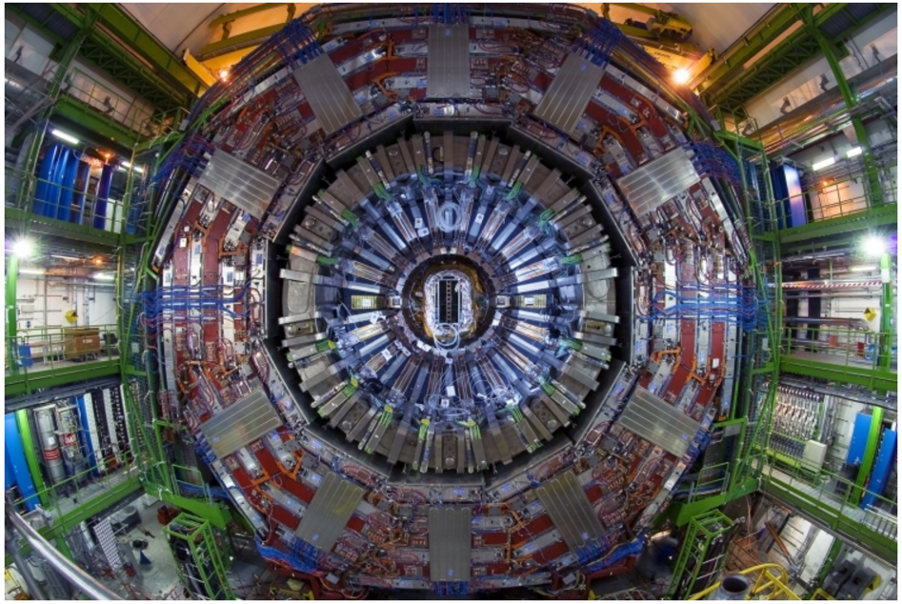
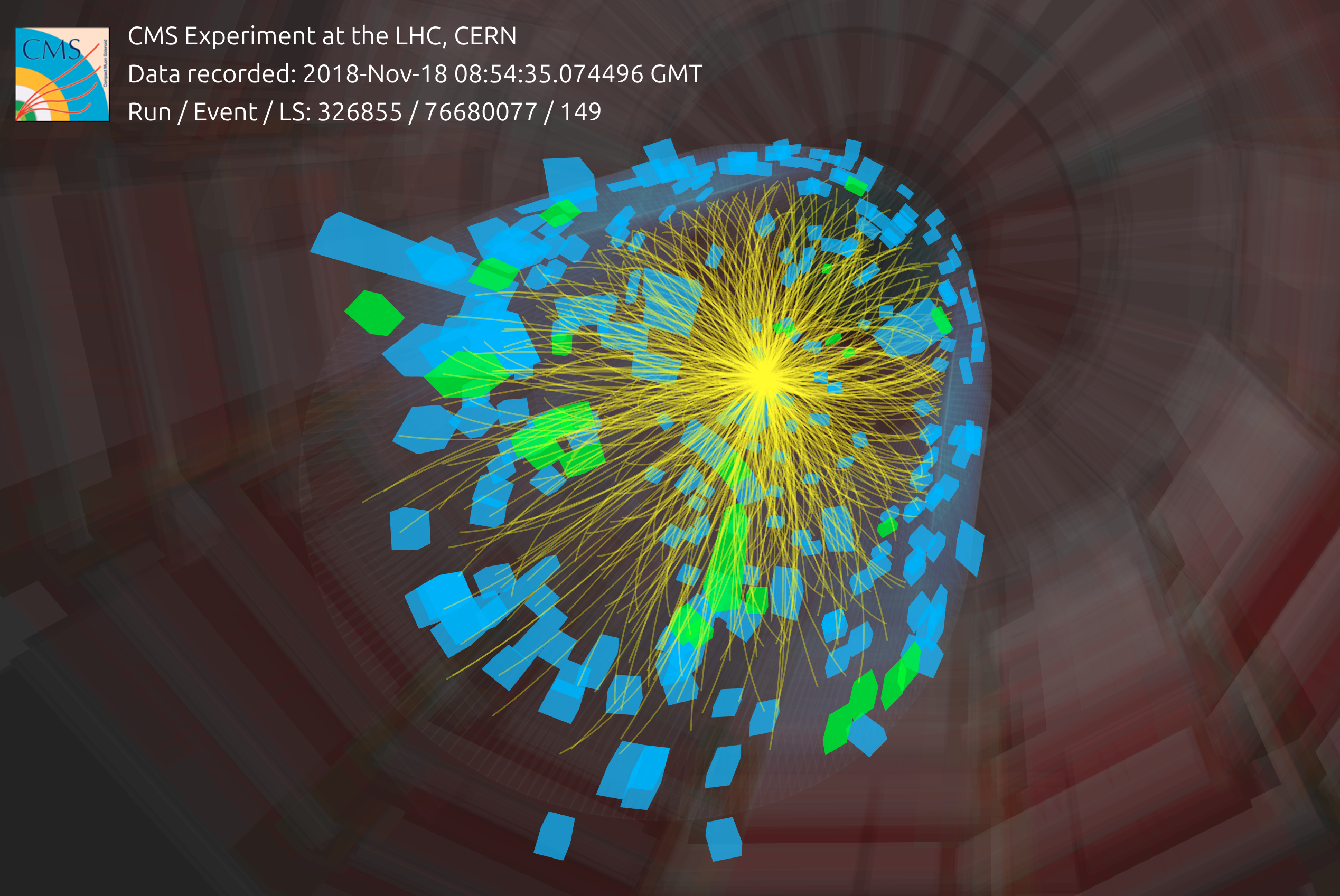
For the first time, the CMS experiment applies a technique called “event-shape engineering” to understand how charm quarks respond to the expanding geometry of the quark–gluon plasma formed in heavy-ion collisions.
The nucleus of an atom is made of protons and neutrons, which themselves are made of quarks bound together by gluons – we say that they are all confined – at normal temperature and density. When two heavy nuclei, such as lead, collide at speeds close to the speed of light, a tiny region of very high energy density forms at the point of collision. The energy density is so high that the nuclei melt into a “soup” of quarks and gluons; we call this “soup” the quark–gluon plasma. When the quark–gluon plasma forms in heavy-nuclei collisions inside the LHC, in the tiny volume where the nuclei collide, we recreate the conditions of free quarks and gluons in the universe just millionths of a second after the Big Bang!
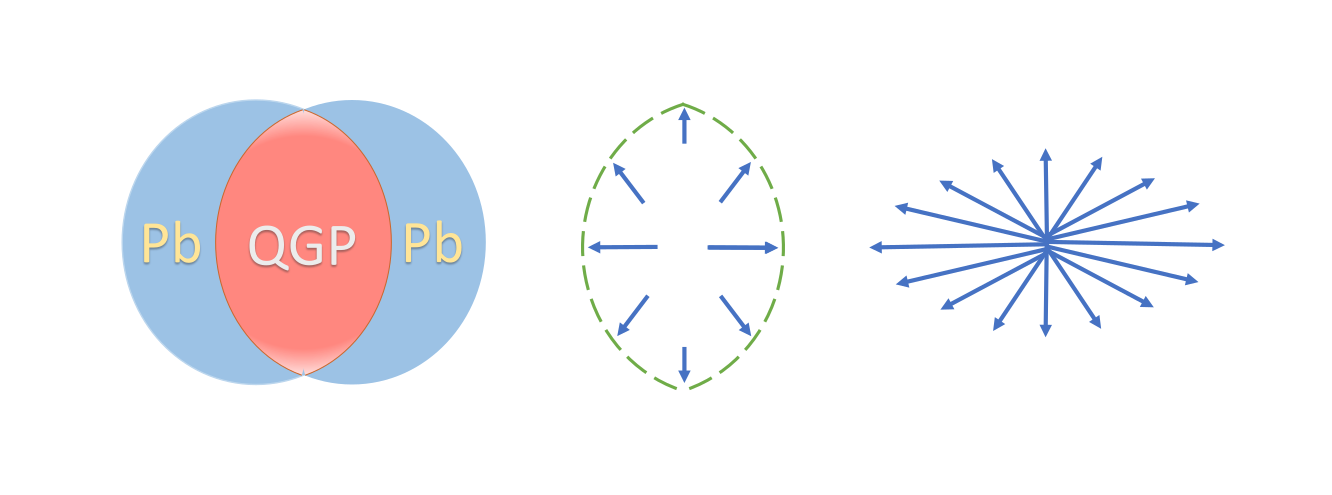
Above: A schematic diagram of the transverse view of lead (Pb) nuclei colliding with partial overlap at the LHC. The arrows show the pressure gradient along the direction.
But how does this quark–gluon plasma evolve and expand? In a typical collision, as shown above, the nuclei don't always hit perfectly head-on. Instead, they often overlap transversely in an almond-like shape. This initial asymmetry creates unequal pressure, forcing the plasma to expand more forcefully in certain directions – a phenomenon called "elliptic flow".
While we have long known that lighter particles participate in this collective flow, CMS researchers have now investigated whether the much heavier charm quarks – which are about 400 times more massive than the lightest (up) quarks – also follow this pattern. Using a technique called event-shape engineering, we isolated collisions with specific geometric shapes.
To do this, we used a parameter called the reduced flow vector, which is a mathematical way to describe how elongated or oval-shaped the overlap region of the colliding nuclei is. One can think of the reduced flow vector as a ruler that measures how much the collision shape differs from a perfect circle. This parameter helps us group collisions by their initial geometric shape and lets us study how the shape affects the movement of particles produced in the collision.
The new study utilises 0.61 nb–1 of lead–lead collision data collected by CMS in 2018. The analysis identifies D0 mesons – particles containing a charm quark and an up antiquark – and measures their elliptic flow, quantified by v2. We then compare this with the v2 measured for all charged particles, which provides information about the geometry and collective flow of each collision.
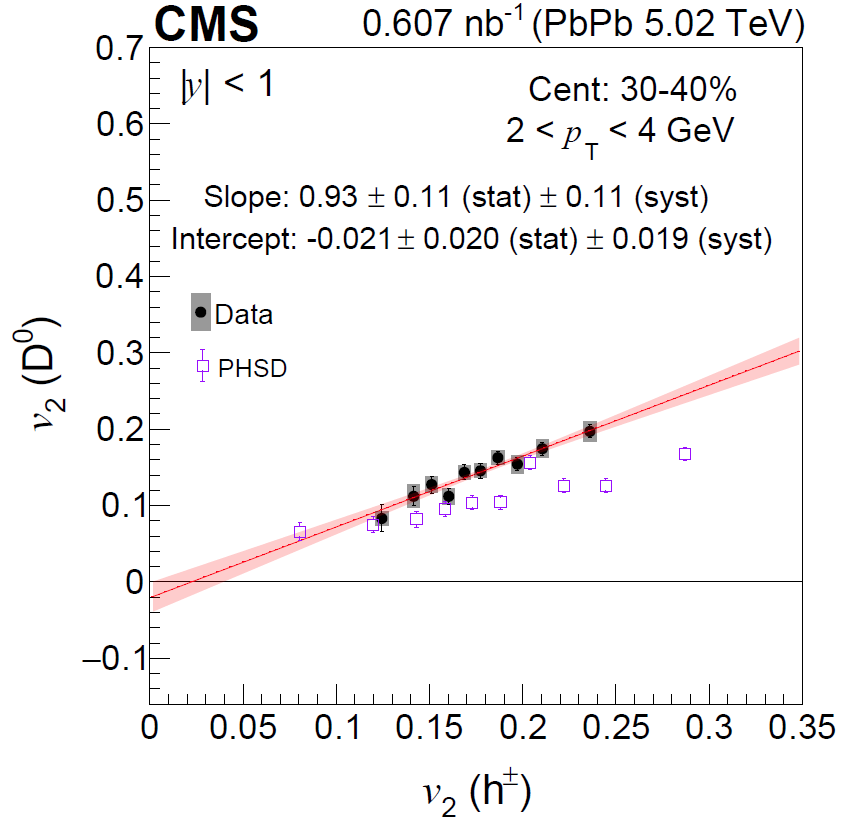
Above: The elliptic flow coefficient (v2) of the D0 meson as a function of the low-pT charged particle v2, representing the initial shape of the medium.
The results demonstrate that D0 mesons showed a strong linear correlation with the quark–gluon plasma medium shape, as shown in the figure above. When the initial overlap was highly oval, the D0 mesons flowed in an oval pattern. This suggests that even these heavy, high-momentum particles are strongly influenced by the initial geometry of the collision.
The results provide an insightful new perspective: by looking at charm-quark flow, we can "see" how quark–gluon plasma and charm quarks interact. With more data from the LHC Run 3 and upcoming High-Luminosity LHC, these techniques will help us improve our models of quark–gluon plasma and better understand the fundamental forces that shaped the early universe.
Written by: Soumik Chandra, for the CMS Collaboration
Edited by: Muhammad Ansar Iqbal
Read more about these results:
-
CMS Physics Publication (HIN-24-015): "Exploring the origin of D0 meson elliptic flow in PbPb collisions at √sNN = 5.02 TeV using event shape engineering"
-
@CMSExperiment on social media: Bluesky - Facebook - Instagram - LinkedIn - TikTok - Twitter/X - YouTube