
Category: Physics
-
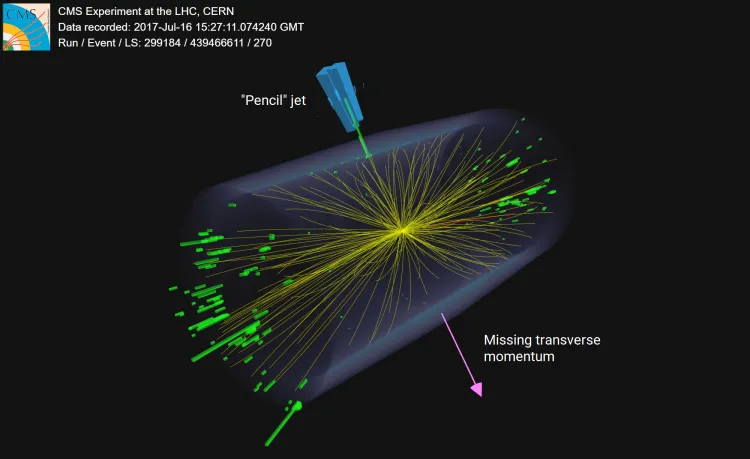
Dark matter and pencil jets: The search for a low-mass Z’ boson using machine learning
The CMS experiment conducts the first search for dark matter particles produced in association with an energetic narrow jet—the pencil jet.
-
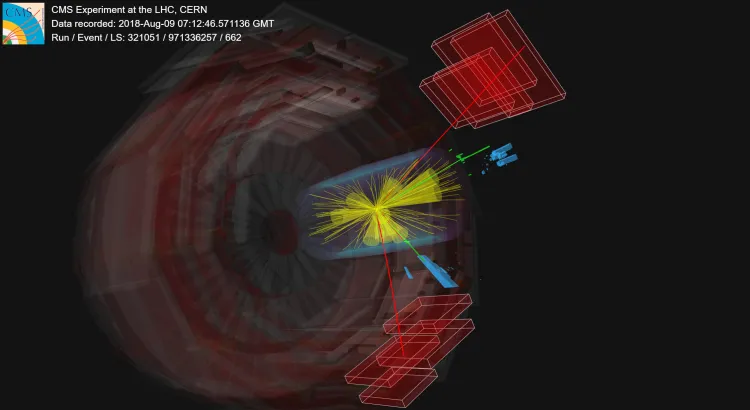
Mind the gap! Top quark pairs with W bosons continue to defy the latest predictions
In a recent measurement, the CMS experiment confirms a slight but persistent disagreement between the simulated and the observed rates of events in which a top quark pair is produced accompanied by a W boson.
-
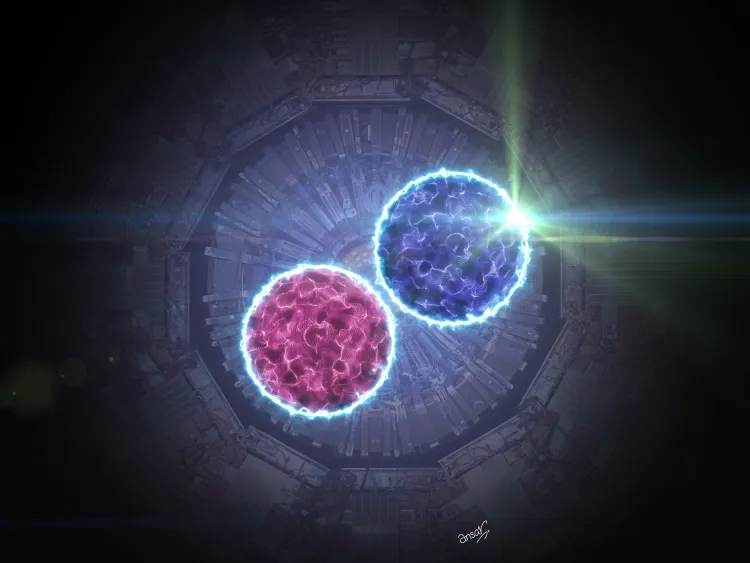
Shiny top quarks: what happens when top quarks emit light?
The CMS experiment has conducted a comprehensive study of the rates of production of top quark pairs created along with a photon, both inclusively and as a function of several kinematic variables.
-
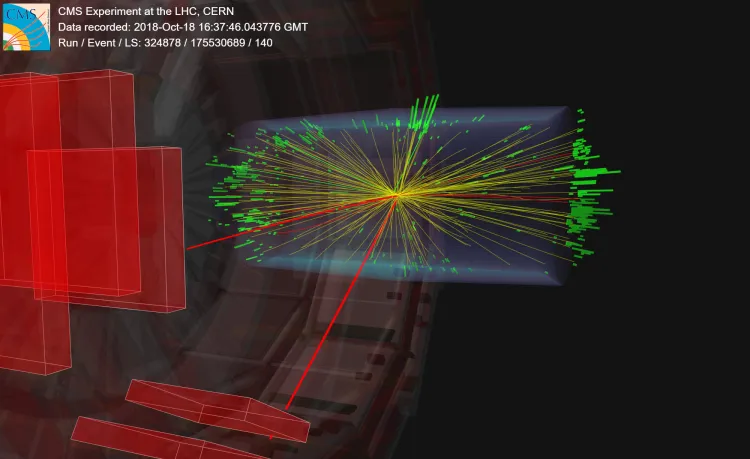
The Higgs boson as a window into dark matter
The CMS experiment studies the Higgs boson as a potential window into dark matter, and sets constraints on this mechanism, which gives rise to isotropic sprays of low-energy particles.
-
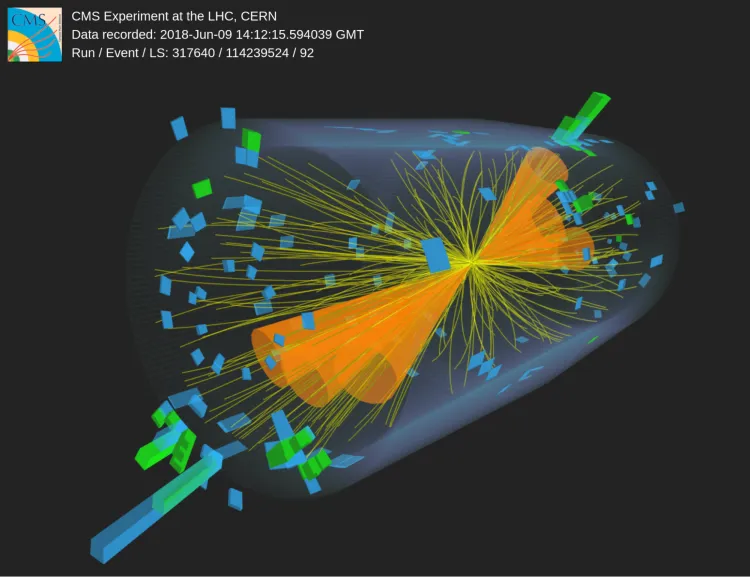
Hunting the heavy Z: Searching for a new Z boson by studying hadronic decays of top quark pairs
The CMS experiment has conducted a search for heavy beyond-standard-model particles (referred to as a Z′ boson) that give rise to a top quark-antiquark pair decaying into hadrons.
-
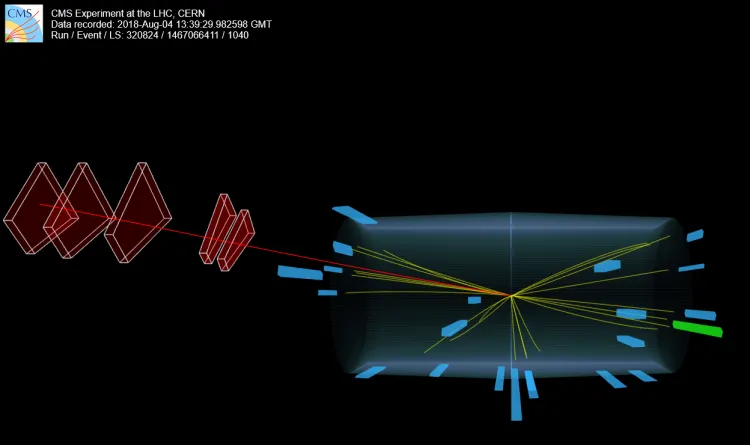
Unveiling B Meson Production at CMS
The ratios of the B meson production fractions have been measured for the first time in the CMS experiment.
-
CMS at Moriond 2025
The CMS Collaboration announces 50 new results for Moriond 2025. In Higgs physics, following a comprehensive research program aimed at characterizing the Higgs boson by measuring its properties and interactions across various decay and production channels, CMS has performed an extensive combination of these measurements.
-
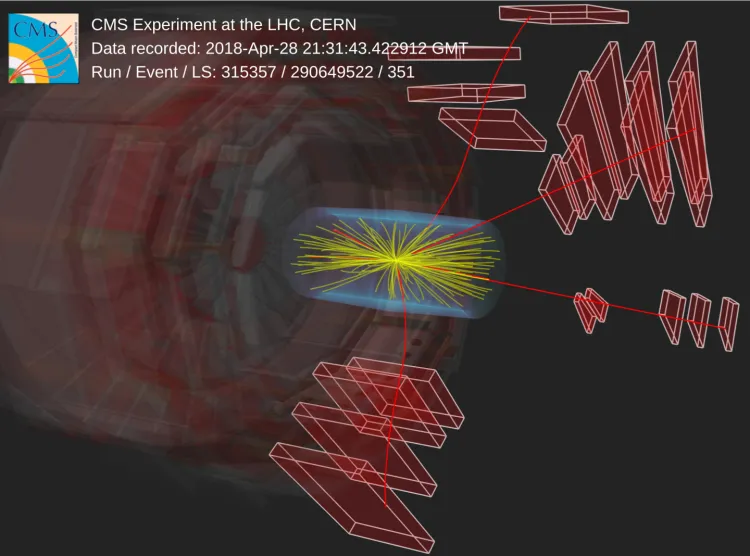
Peeking inside the proton: the story of Z+ϒ
CMS discovers associated production of a Z boson and an ϒ meson.
-
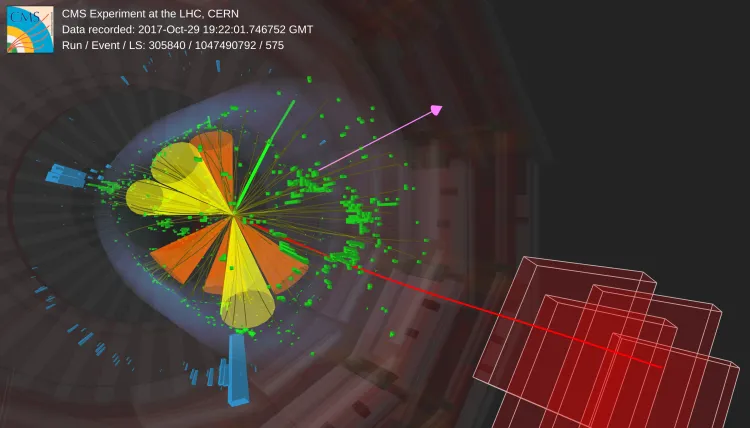
The Higgs boson with toppings
The Higgs boson is deeply connected to the mechanism that generates the masses of elementary particles.
-
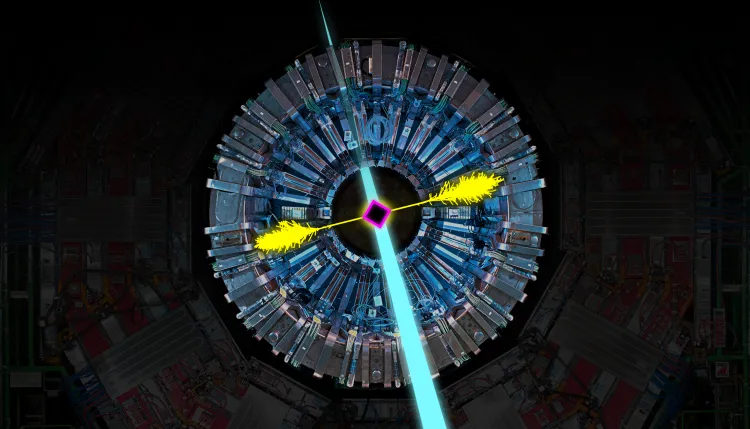
The “Large Photon Collider”: CMS observes scattering of light by light at the LHC
CMS scientists discover some of the rarest collisions that the LHC can produce – such as the scattering of light by light – and learn more about the quantum nature of electromagnetism, search for new particles, and much more.