
Category: Physics
-
CMS at Higgs 2025
The CMS experiment announces new results for the Higgs 2025 conference.
-
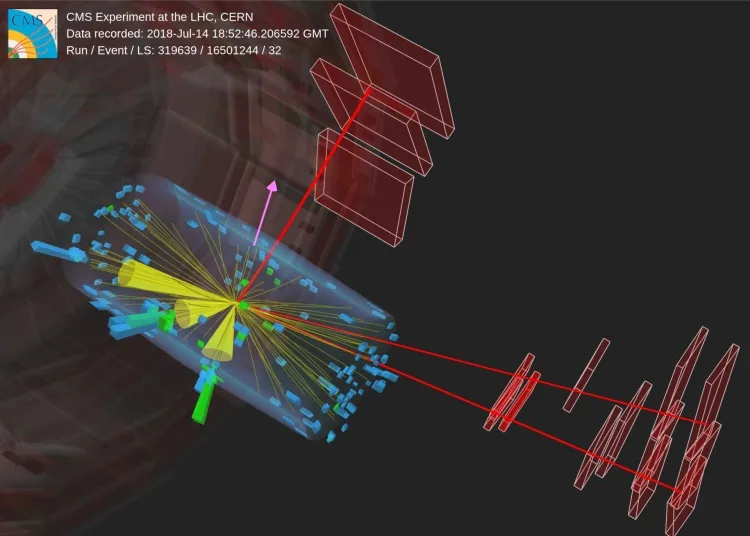
CMS observes rare top quark interaction with a W and a Z boson
Using data collected from 2016 to 2023 and cutting-edge machine learning, CMS observes for the first time the creation of a top quark together with a W and a Z boson – a process so rare it occurs only once in a trillion proton-proton collisions!
-
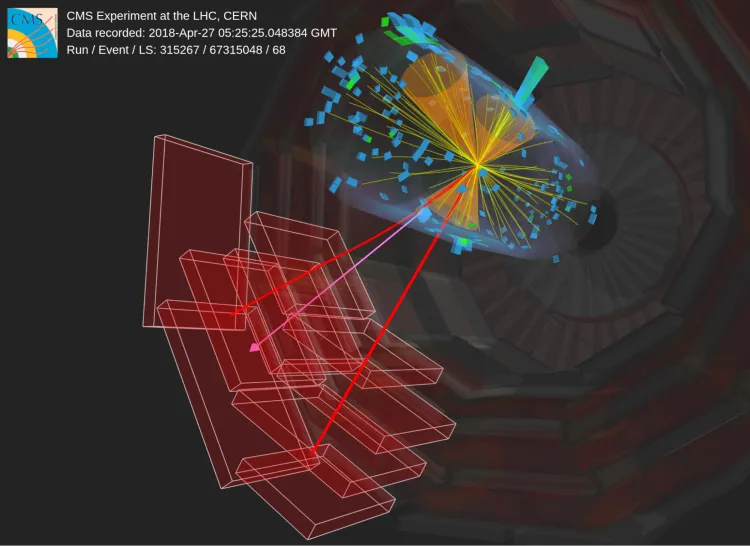
Using physics-based machine learning to hunt dark matter
In the first search of its kind at a particle collider, the CMS experiment looks for partially visible sprays of particles (jets), containing leptons and dark matter using physics-informed machine learning.
-
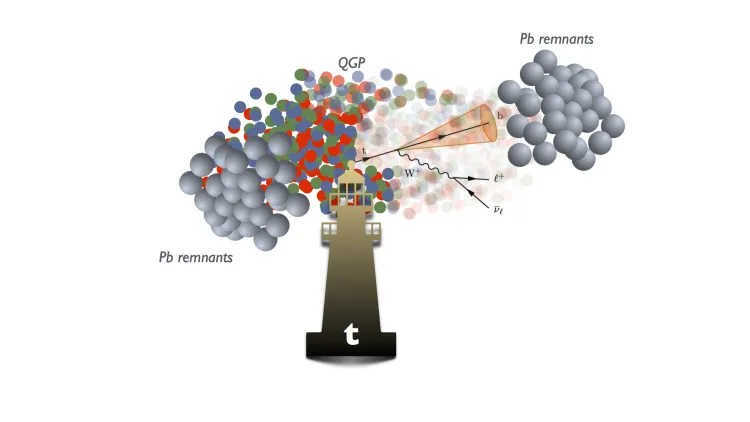
Clash of the titans: top quark meets lead ions
Five years after the first evidence that heavy metal hits the top quark, CMS now observes the clash of two titans with higher precision at unprecedented energy.
-
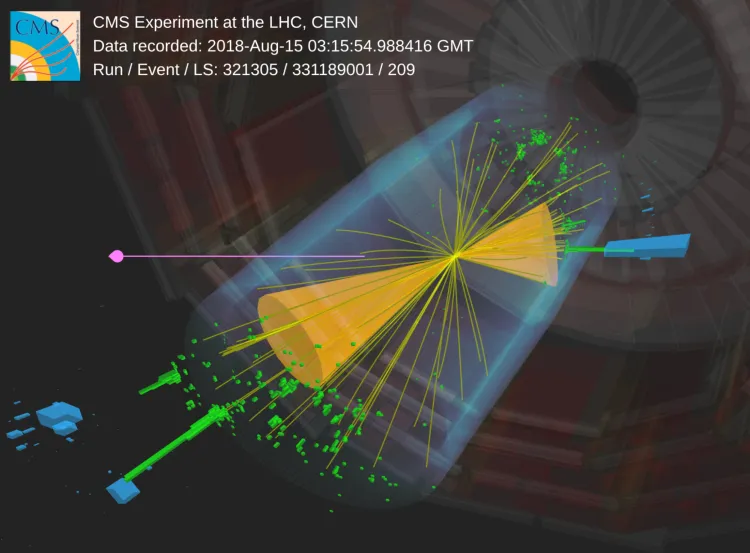
Double the Higgs, double the mystery! The hunt for a new, heavy particle decaying to a pair of Higgs bosons
CMS scientists are on the hunt for a new, heavy particle that decays into a pair of Higgs bosons.
-
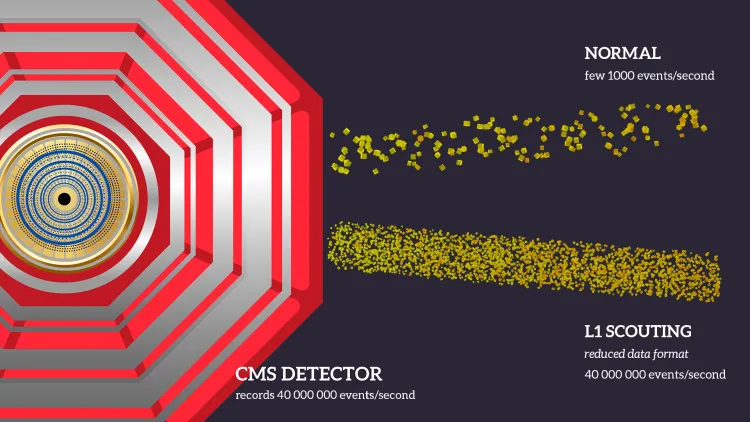
How CMS records all 40 million events per second
The CMS experiment is utilising a novel technique called L1 Scouting, which allows it to record data from all collisions, without any selection, but in a reduced format.
-
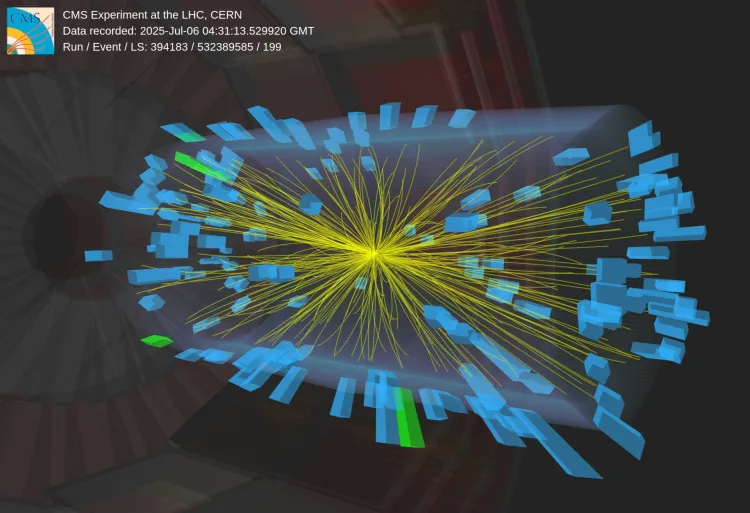
Collective motion in tiny systems: oxygen and neon collisions as a window into nuclear structure
CMS observes collective motion of particles in light-ion collisions, providing robust evidence of how initial nuclear geometry maps to final-state flow.
-
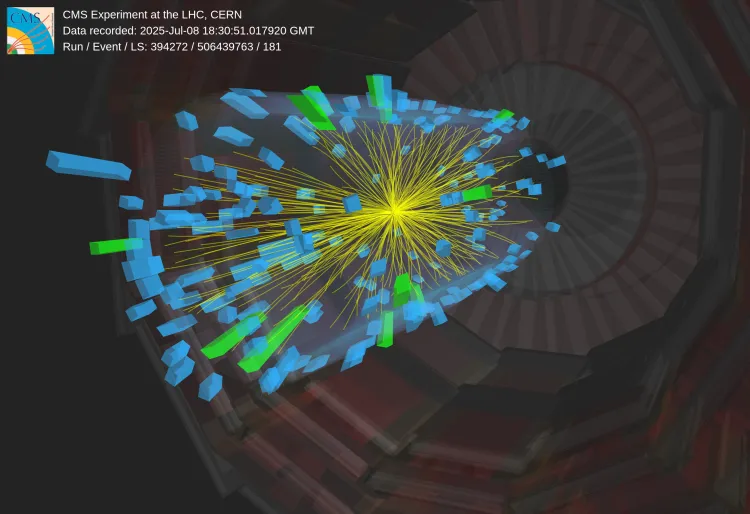
LHC’s first oxygen-oxygen and neon-neon collisions – CMS spots an interesting pattern
The CMS experiment has analyzed the first-ever neon-neon collisions, looking for signs of quark-gluon plasma.
-
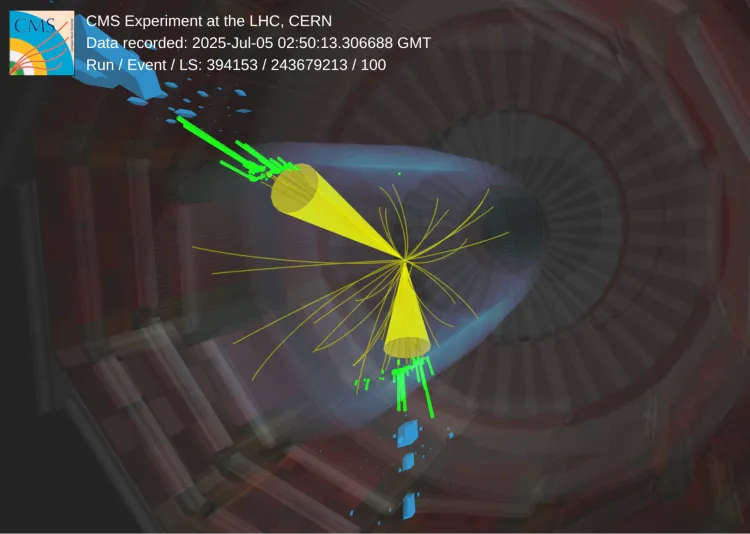
LHC’s first oxygen collisions – CMS spots signs of small-scale quark-gluon plasma
CMS scientists study the first-ever oxygen-oxygen collisions at the LHC, and observe signs of quarks and gluons losing energy when they travel through quark-gluon plasma – a state that existed just after the Big Bang.
-
CMS at the Initial Stages 2025 conference
At the Initial Stages conference, CMS announces first brand new results based on the recent oxygen-oxygen and neon-neon collision data.