
Category: Physics
-
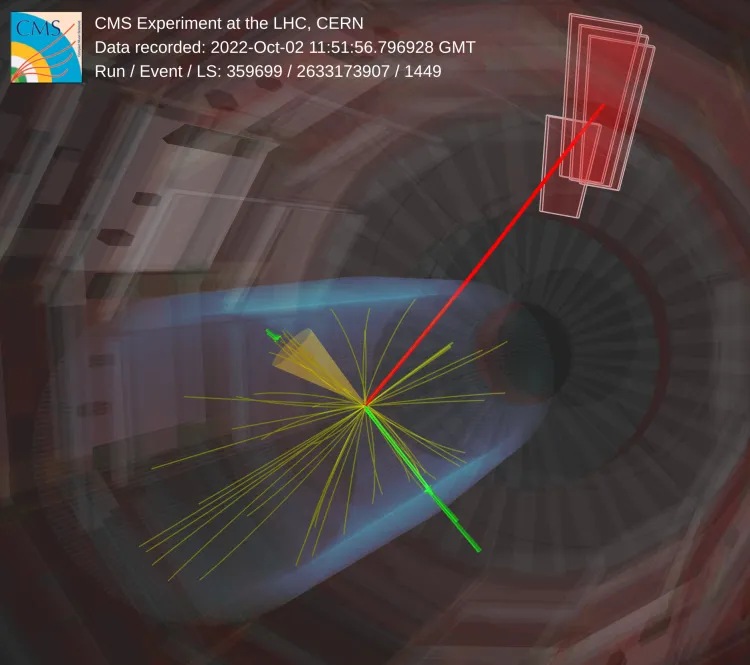
Not quite single at 13.6 TeV: top quark comes in association with a W boson
Back in September 2022, four months after the start of the LHC Run 3, the CMS collaboration released the first measurement using data at the new collision energy of 13.6 TeV.
-
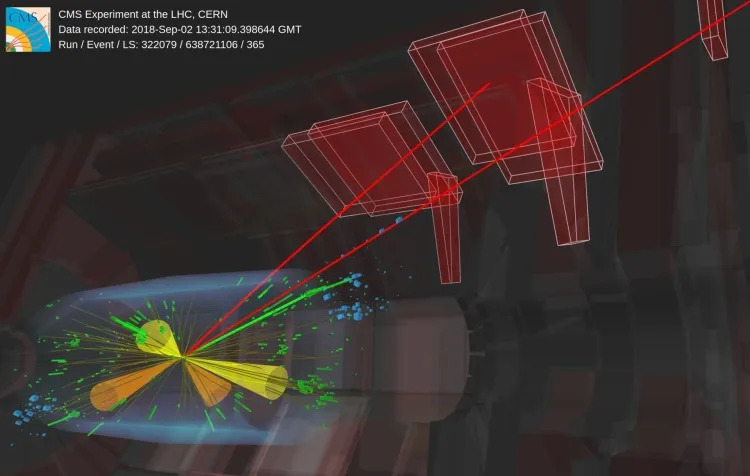
A novel trail: simultaneous probe of rare top quark events
Even after almost 30 years since its discovery, the top quark is still offering unprecedented opportunities to improve our understanding of nature.
-
Can AI find new particles on its own?
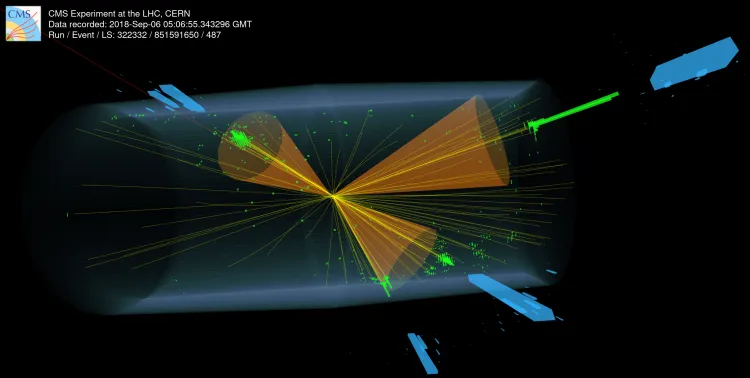
One of the events determined by the AI algorithm to be highly anomalous and therefore potentially coming from a new particle.
-
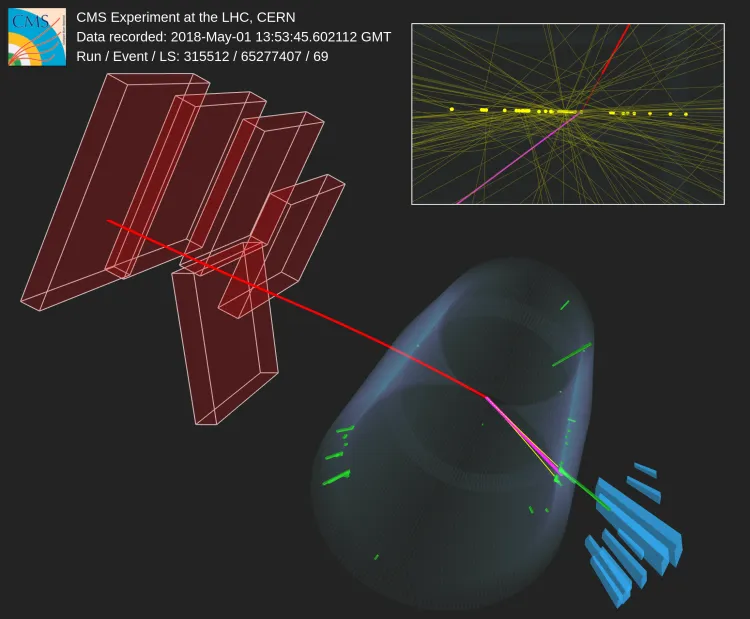
Disclosing quantum corrections to electromagnetic interactions of tau leptons
In quantum electrodynamics (QED), the quantum theory of electromagnetic interactions, the magnetic dipole moment of a particle acquires quantum corrections originating from interactions with virtual photons and other particles, often referred to as the anomalous magnetic moment of that particle.
-

Missing Piece to the Higgs Production
The Higgs boson was one of the biggest scientific discoveries of the last decades and opened the doors to a new era for particle physics: unveiling its mysteries and measuring its properties.
-
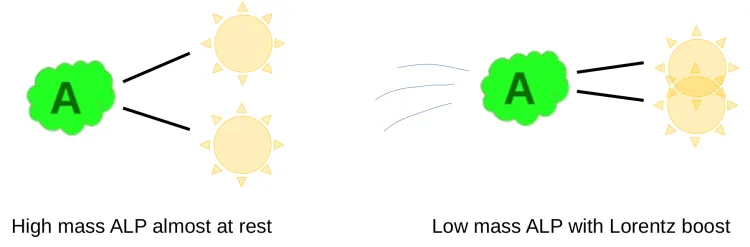
The Higgs window to new phenomena: ALPs this time!
More than a decade after the discovery of the Higgs boson, we still expect this particle to give us first-hand information about theories that can solve some of the shortcomings of the standard model of particle physics (SM).
-
A dark world ruled by a strong force
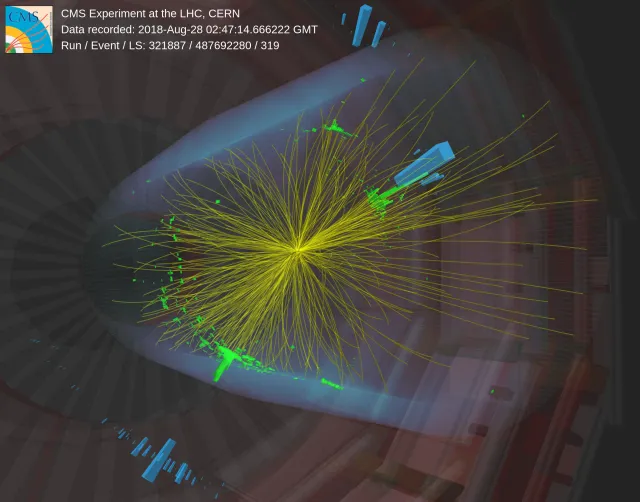
Above: Event display for a potential SUEP event, recorded at CMS in 2018, showing the characteristically high multiplicity of soft tracks in yellow.
-
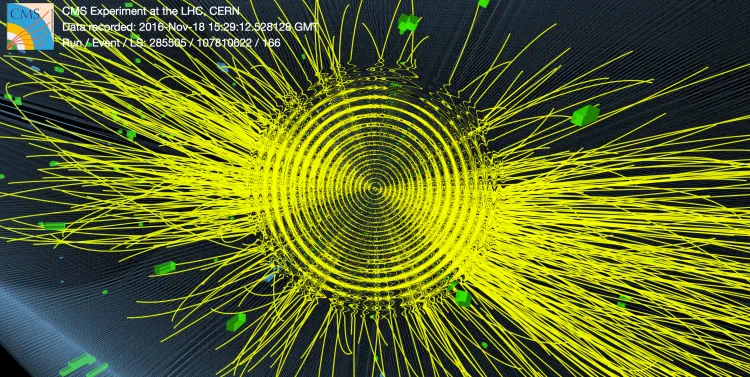
Hearing the sound of quark-gluon plasma
Neutron stars, ultra-cold atomic gases, and the quark-gluon plasma… You may find them totally unrelated but, surprisingly enough, they share a common feature: a fluid-like state of matter containing strongly interacting particles!
-
Illuminating the Subatomic Shadows: Unravelling the rarest signatures of the Higgs boson
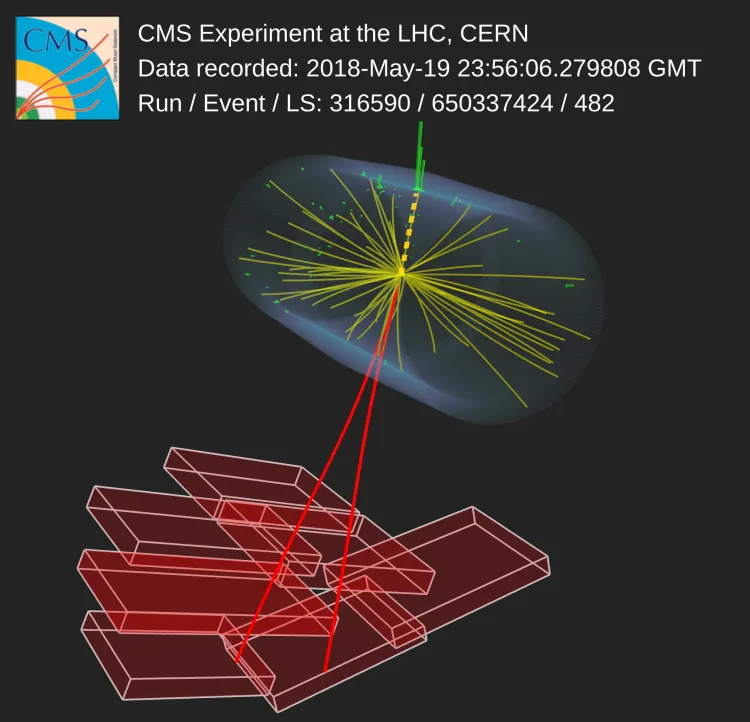
A proton-proton collision at a centre-of-mass energy of 13 TeV, recorded by CMS, compatible with the production of a Higgs boson decaying to a J/ψ meson, which decays to two muons (red lines), and a high-energy photon (green box, top).
-
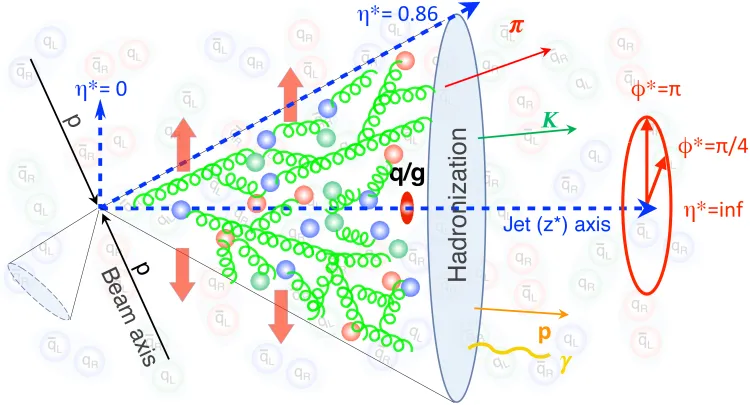
A Big Bang from a Quantum Quark?
The universe is governed by four known fundamental forces: gravity, electromagnetism, the weak force, and the strong force.