
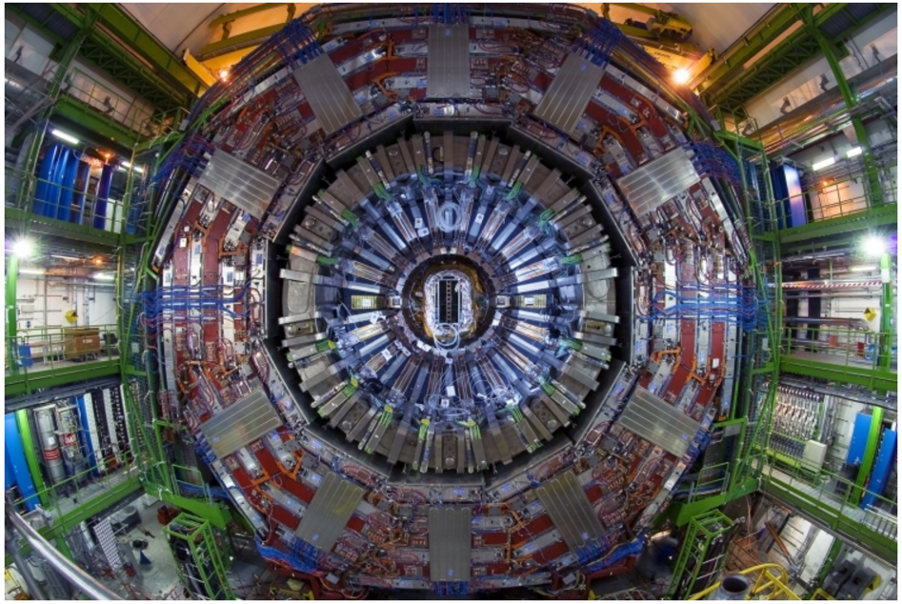
For the first time ever, the CMS experiment has designed a dedicated analysis using parametrised machine learning to look for new dark particles that don’t socialize with Standard Model fermions, one of them being a favourite candidate in the search for dark matter.
Using proton-proton collisions delivered by the LHC in 2016–2018 and 2022, CMS collaborators have been looking for new scalar particles in a theoretical framework that had never before been tested with a dedicated analysis, leading to the widest excluded mass range to date for this model.
Are there more Higgs-boson-like particles ?
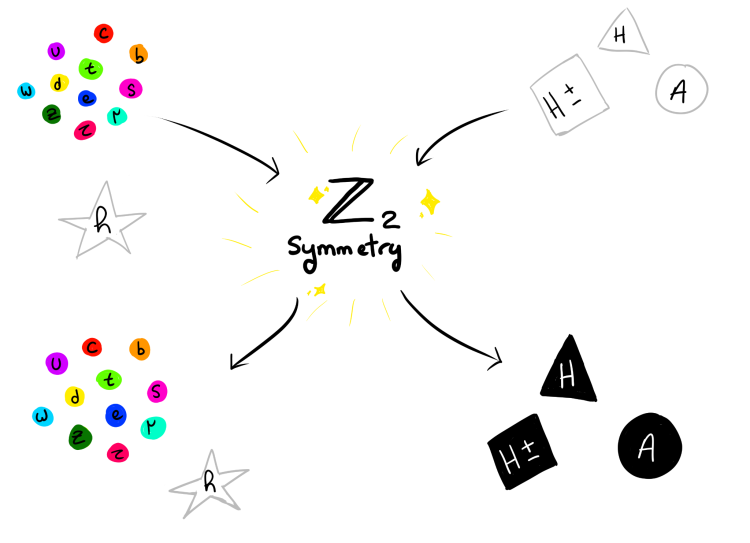
Having found a Higgs boson (a scalar particle), theorists naturally ask themselves: could there be more than one? In fact, rather than a single Higgs boson, which is the only observable particle, the Standard Model predicts a so-called Higgs doublet. While we’re at it, let’s add a second electroweak doublet; why not ? The effect is the conception of 4 new scalar particles: two neutral ones, labeled H and A (with H the lightest of the two), and two charged ones, H+ and H-. The search for such extra scalar particles has already spanned several decades, but only when they actually interact with our Standard Model particles. With an extra ingredient, called the ℤ2 symmetry, the new scalars become allergic to our matter particles, the fermions, and only prefer to talk to bosons like themselves: the Higgs boson, but also the W and Z bosons. They become so-called inert, or dark, scalars and the model inherits this name - the Inert Doublet Model.
Proton-proton collisions at the LHC may produce twins of dark scalars, mostly pairs of A and H scalars. The A scalar decays to a second H scalar produced together with a Z boson, as illustrated in Fig. 1. In our detector, we can very clearly identify Z bosons when they decay to a pair of electrons or a pair of muons. And what about the two H scalars? That is the beauty of the ℤ2 symmetry: they cannot decay to anything, being the lightest of all scalars. Since we expect dark matter to be stable and very rarely interact with ordinary matter, they represent compelling dark-matter candidates, only registering in our CMS detector as missing transverse energy.
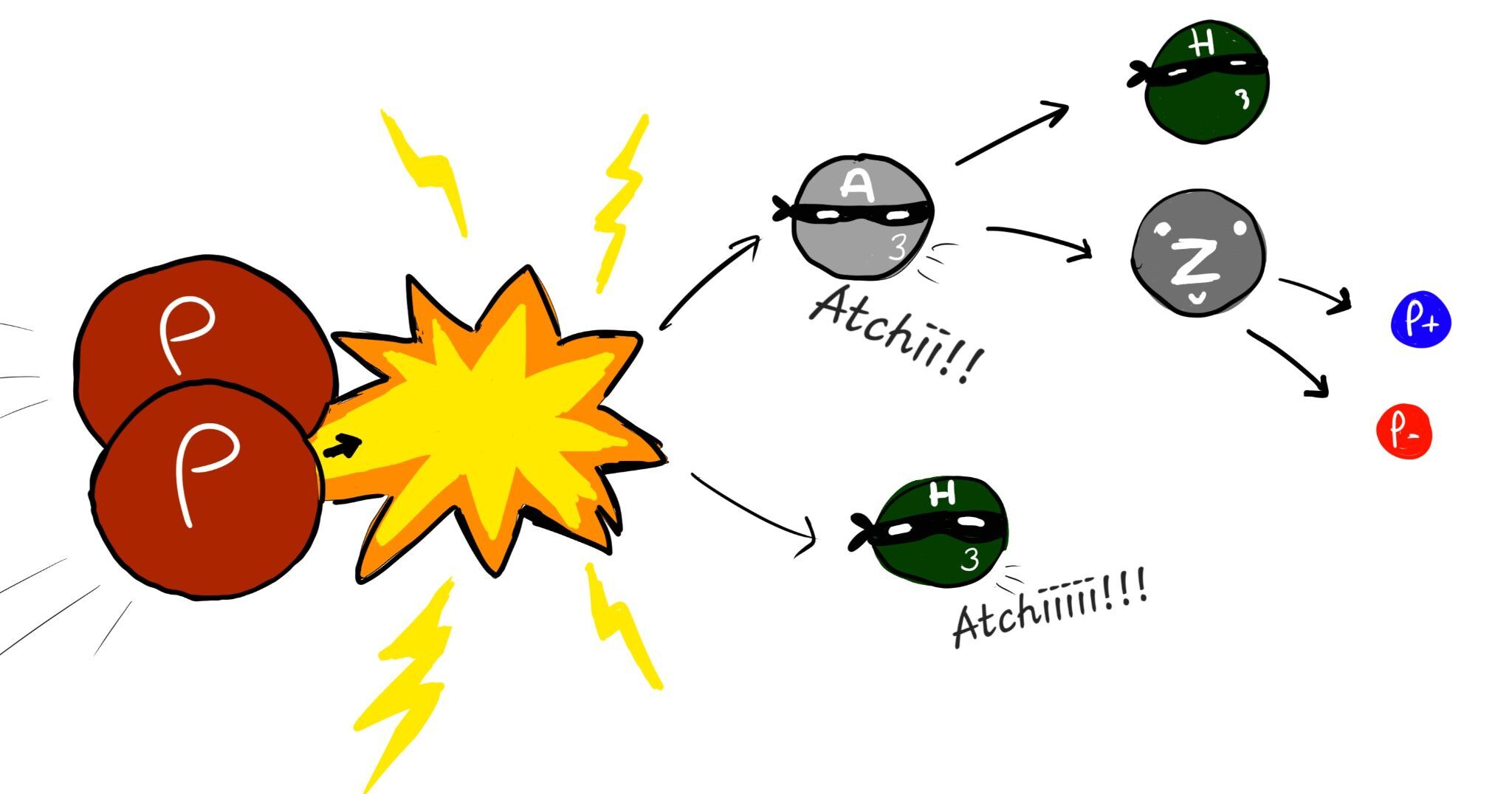
Figure 1: Sketch of the production of a pair of dark scalars that leads to a final state with two H scalars and a pair of leptons of same flavour and opposite charge.
A clean final state, easy to search for!
So here we are: we are looking for two charged leptons (electrons or muons) of same flavour and of opposite charge (because they come from the neutral Z boson) and some missing transverse energy from two hypothetical H scalars. Easy-peasy! We embark on this mission looking at about half the total amount of data recorded to date. But, of course, there is a “but”.
…And easy to mimic!
Unfortunately for our CMS experimentalists, lots of known particles can mimic the same final state configuration; we call them background processes. As we do not know what kind of masses the new particles may have, we have to test over a large range of values, and different values will lead to different backgrounds. As seasoned strategists, we designed a Neural Network that is trained to separate our signal, whatever its postulated mass, to all contributing backgrounds. Also, we require specific selections in order to minimize the contribution from each of those backgrounds, and finally rule out the range of masses where a signal is not observed.
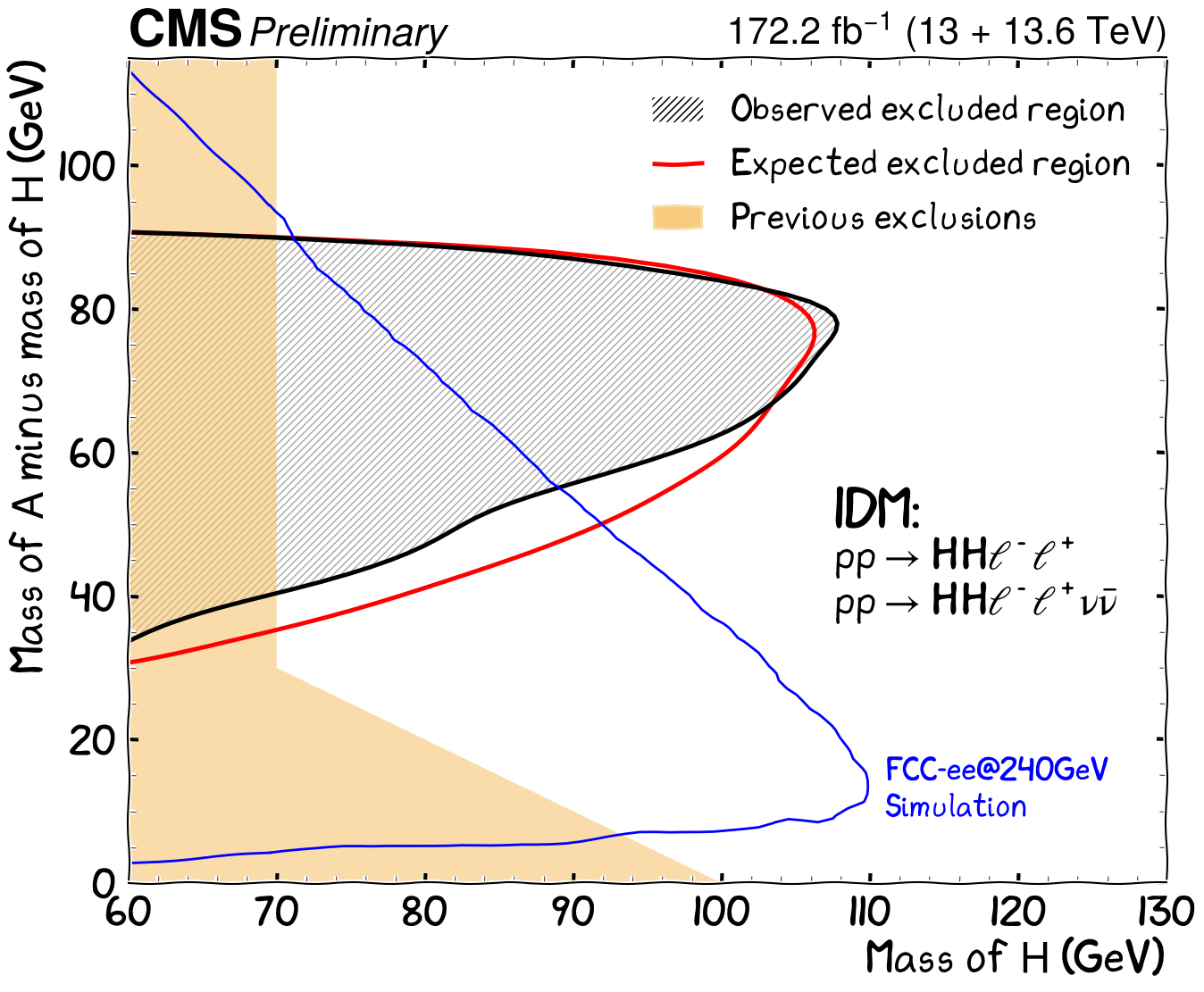
Figure 2: Simplified distributions for the observed and expected reach obtained with the CMS data, and with the expected simulated FCC-ee reach showing that this result will stay competitive for a long time.
Dr. Teddy Curtis from the analysis team explains, “a key challenge in this search is disentangling the rare dark matter signal from the millions of Standard Model events that can mimic it. To extract this "needle-in-a-haystack" signature, we designed a sophisticated parameterized neural network that exploits subtle differences in the kinematic features—such as the momentum and energy distributions of the observed particles—across a wide range of hypotheses for the masses of the H and A bosons”.
So, did we find those allergic guys?
The results show no evidence for these dark scalars, but this first dedicated search sets the widest range of excluded masses to date, presented in Fig. 2. The exploration of this model with collider data has begun. With the rest of the data collected so far and the High-Luminosity LHC phase starting soon, plenty more data will be available to continue this study. The same analysis strategy was tested with simulations of the Future Circular Collider that CERN is planning to build next, which will be sensitive to a different range of masses. Until a further collider project materializes, this CMS result will remain at the top of the game!
Written by: Anne-Marie Magnan, for the CMS Collaboration
Edited by: Andrés G. Delannoy
Read more about these results:
-
CMS Physics Analysis Summary (NPS-25-002): "Search for pair production of additional neutral scalars within the Inert Doublet Model in a final state with two electrons or two muons in proton-proton collisions at √s = 13 and 13.6 TeV"
-
@CMSExperiment on social media: Bluesky - Facebook - Twitter - Instagram - LinkedIn - TikTok - YouTube