
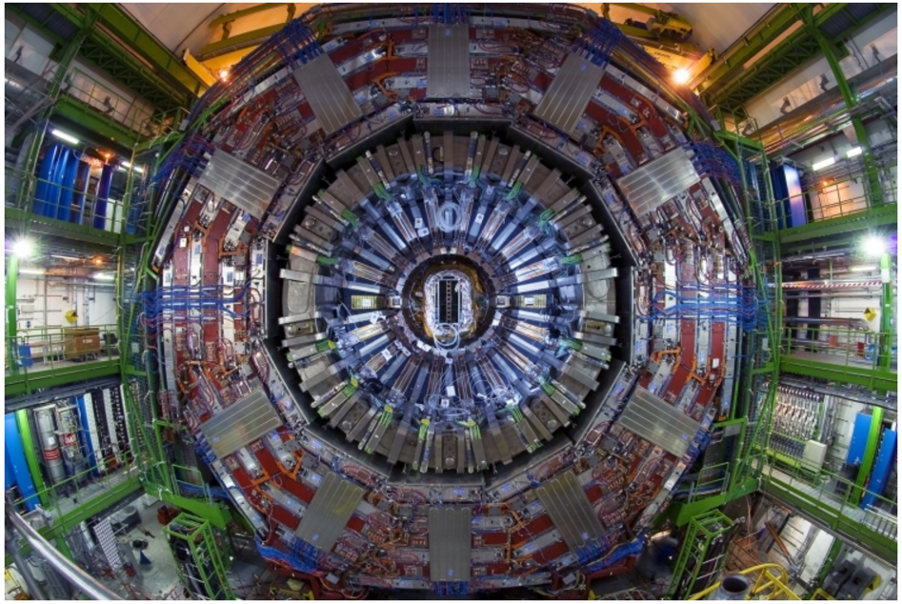
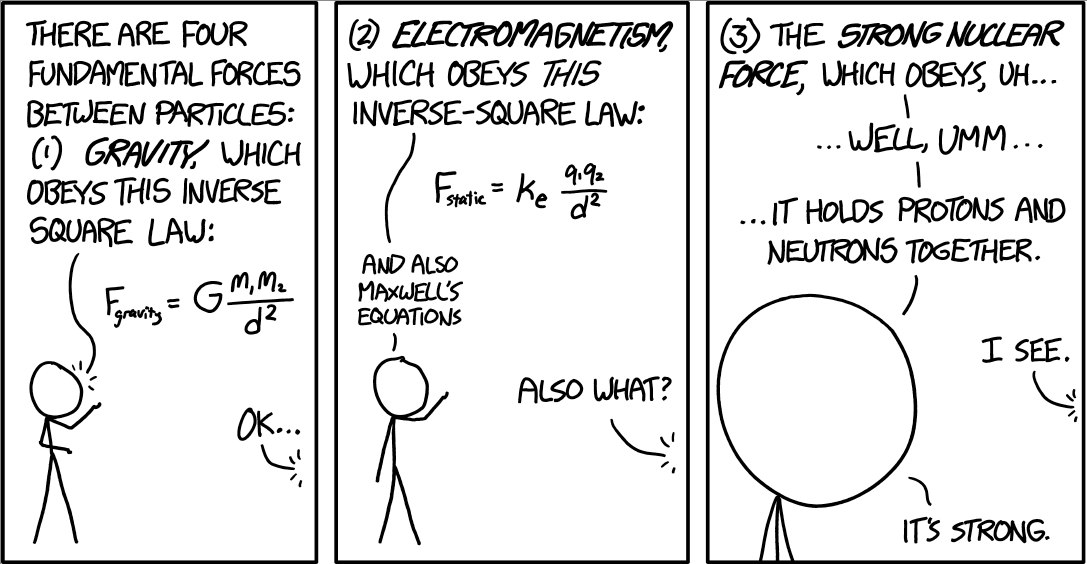
The strong nuclear force is the most mysterious of the four fundamental forces of nature. By studying four-way energy correlations between particles produced by the strong nuclear force, researchers at the CMS experiment have taken another step forward in understanding this enigmatic force of nature. Attribution: XKCD 1489
The strong nuclear force is completely unlike every other force of nature. One key feature is that the force between two particles increases the further apart they get, as though the strong force were a rubber band connecting the two particles. Imagine you have two of these rubber bands. If you place one of the rubber bands between your thumb and pinkie, you can “measure” (feel) the strength of the strong force. Now twist the second rubber band around the first, and then use it to connect the thumb and pinkie on your other hand. Feel how the force instead depends in a complicated way on the relative positions of all of your fingers. Moving any finger changes the force on all the others, and this resulting force is not easy to predict from your experience with only one rubber band.
What does this correspond to in the study? When quarks and gluons (the particles that experience the strong force) are produced at the LHC, they appear as dense sprays of many particles, known as jets. Inside these jets, the motions of all of these particles are governed by the strong nuclear force, as though there are many rubber bands all twisted together. Here, using proton-proton collision data collected in 2018, CMS measures for the first time correlations involving four particles inside a jet. This is just like measuring the tension in the pair of twisted rubber bands held between your two hands. By probing the strong force in this way, this measurement offers a new way to probe the dynamics of the strong force, and provides us with a glimpse of how our universe and all matter is formed.
Four-way energy correlations inside jets
One of the most basic processes at the LHC is the production of quarks and gluons in association with a Z boson. The well-studied decay of the Z boson into a pair of muons (a heavier cousin of the electron) allows easy identification of these events, while the huge potential energy carried in the strong nuclear force’s rubber bands results in the dense sprays of many particles that forms the jet recoiling against the Z boson. By picking out quadruples of particles inside these jets, we can study the resulting correlations from different arrangements of the connecting “rubber bands” due to the strong force.
CMS studies three different four-particle configurations, including one where the four particles are arranged in two pairs with a common midpoint. This can be visualized using the analogy of two pairs of particles connected by intertwined rubber bands. In actuality, there are many lines of force connecting the particles, and the full picture looks more like a game of cat’s cradle (Figure 1, left).
CMS measures correlations between the energies of these four particles as a function of how far apart the two pairs are and how they are oriented relative to one another, much like moving your hands to explore how the tension in the twisted bands changes. Figure 1, right shows a heatmap of these correlations, with one pair of particles fixed along the equator of the plot and the color intensity showing the correlation strength of the other pair in a given relative separation and orientation. The bright spots in the center and edges of the plot correspond to an enhancement rate of particle production from the strong nuclear force when two particles come very close together and pull on each other, while the dark region corresponds to fewer particles when all particles are distant (such as shown in the cat’s cradle diagram).
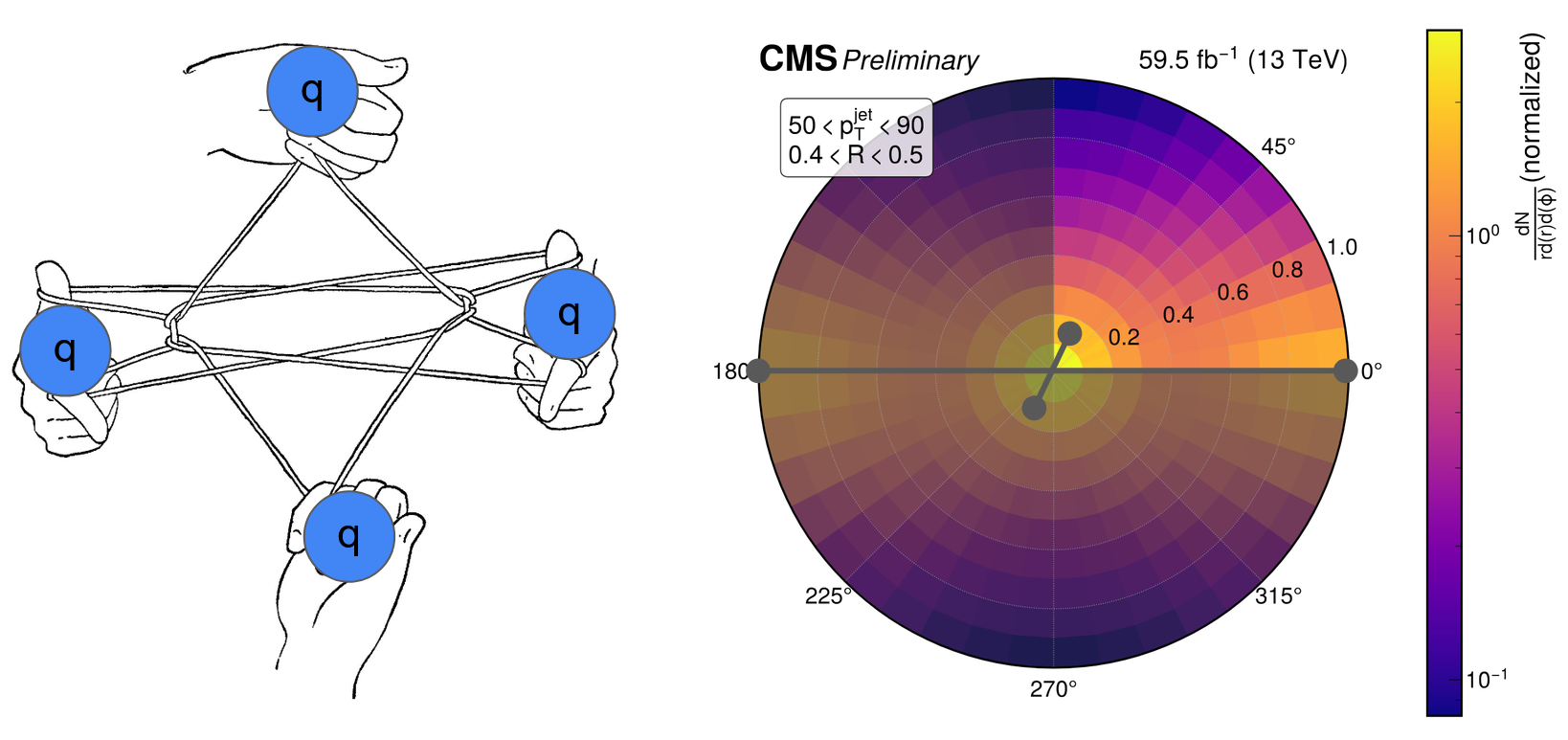
Figure 1: Left: diagram of the force lines between four quarks, represented as a game of cat’s cradle. Adapted from “String Figures and How to Make Them” by C. Jayne (1906). Right: correlations in the production of two pairs of particles. The measurement is only performed in the first quadrant, and is copied three times to make a full disk for visualization.
Figure 2 shows the ratio between the observed data and the predictions from two models of the jet formation process, Pythia and Herwig. Both models only contain two-body interactions, and fail to completely describe the three- and four-way energy correlations revealed in the data.
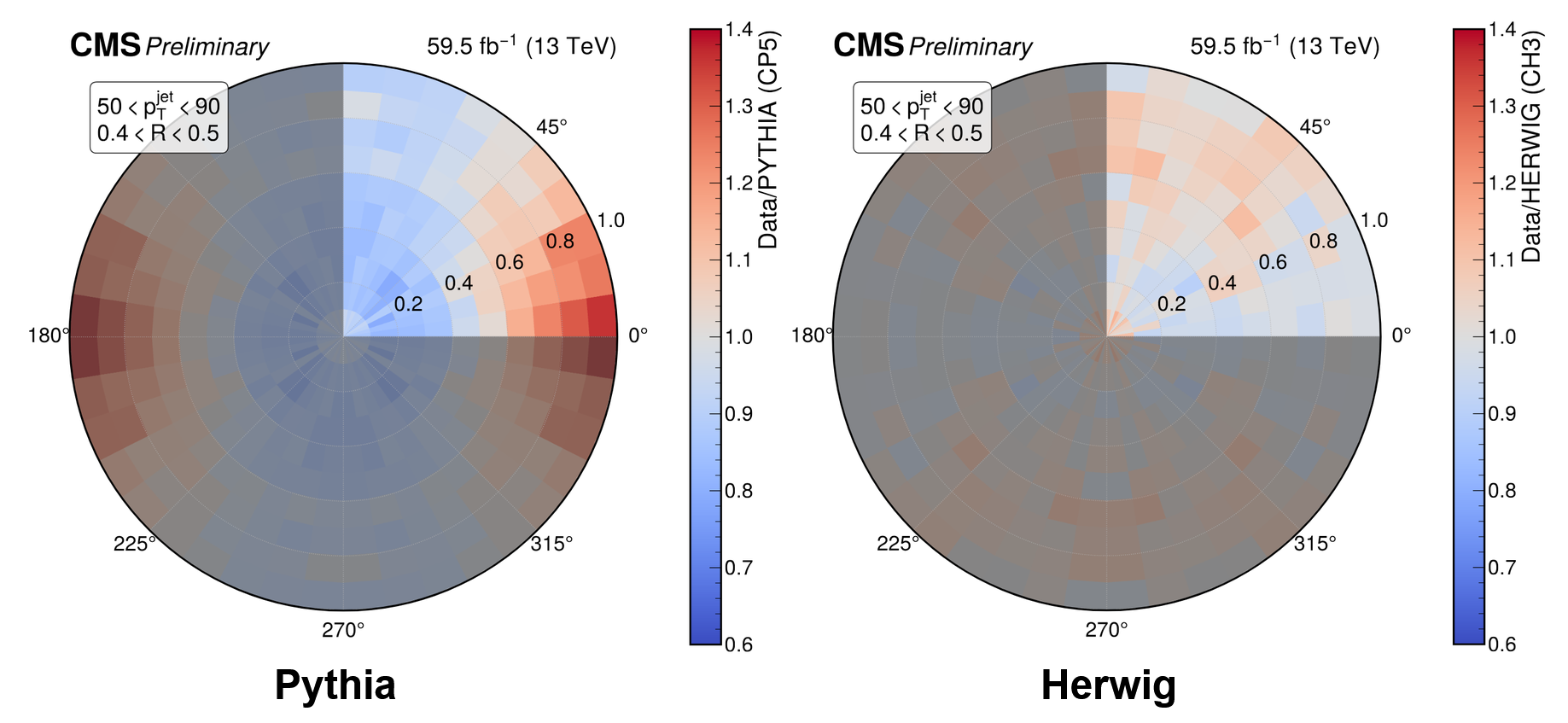
Figure 2: Ratio between the observed data and predictions from two models of jet production from the strong nuclear force, Pythia8 (left) and Herwig7 (right).
As Simon Rothman, PhD student at MIT and the lead author of the analysis explains, “The strong nuclear force is far and away the least well-understood of the fundamental forces. Our results provide new insight into the multi-particle dynamics that make the strong force so difficult to understand and model.”
Written by: Simon Rothman, for the CMS Collaboration
Edited by: Haifa Rejeb Sfar
Read more about these results:
-
CMS Physics Analysis Summary (SMP-25-009): "Measurement of four-point energy-energy correlator subspaces in Z+jets events"
-
@CMSExperiment on social media: Bluesky - Facebook - Instagram - LinkedIn - TikTok - Twitter/X - YouTube