
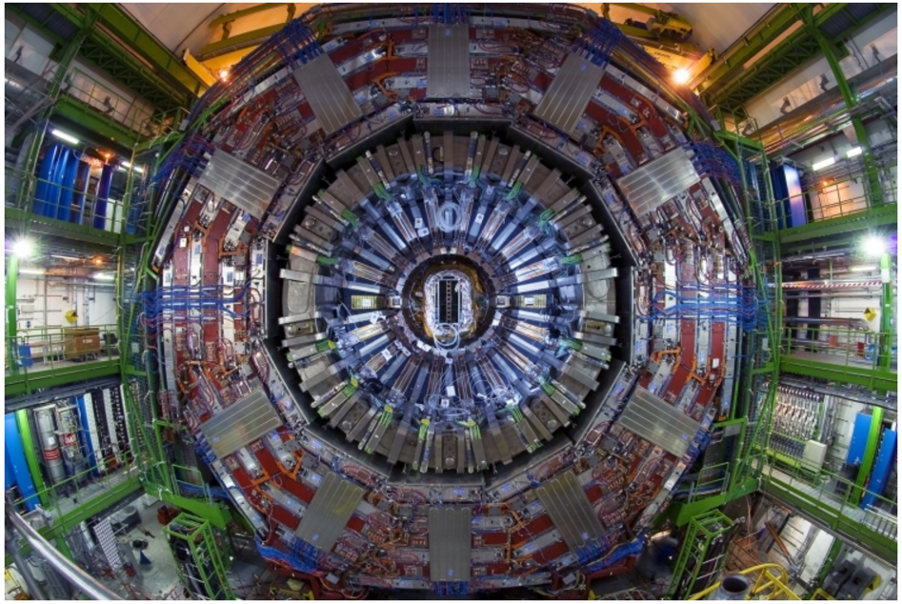
CMS probes the highest-energy lepton pairs ever recorded to search for hints pointing to a Higgs boson made of smaller constituents.
Is the Higgs boson truly an elementary particle, or could it be composed of more fundamental constituents? This question is one of the major open challenges in particle physics. Using the full proton-proton collision dataset collected during Run 2 of the LHC and the first two years of Run 3 (2022-2023), the CMS experiment has searched for subtle deviations from the Standard Model that could reveal signs of a composite Higgs boson. Although no evidence for new physics is observed, the analysis sets the most stringent constraints to date on the electroweak oblique parameters W and Y, which the Standard Model predicts to be zero. These parameters provide a model-independent way to describe possible effects of new heavy particles. These results also place limits on several well-motivated Higgs compositeness scenarios, reducing the range of possible new physics scenarios.
This analysis combines two complementary strategies to search for physics beyond the Standard Model. It looks directly for new heavy particles that could be produced at the LHC, while also searching for indirect evidence of even heavier particles through subtle deviations in the production of high-energy electron and muon pairs. Even if such particles are too massive to be produced directly, they may leave measurable fingerprints in the observed kinematic distributions, especially for higher energies.
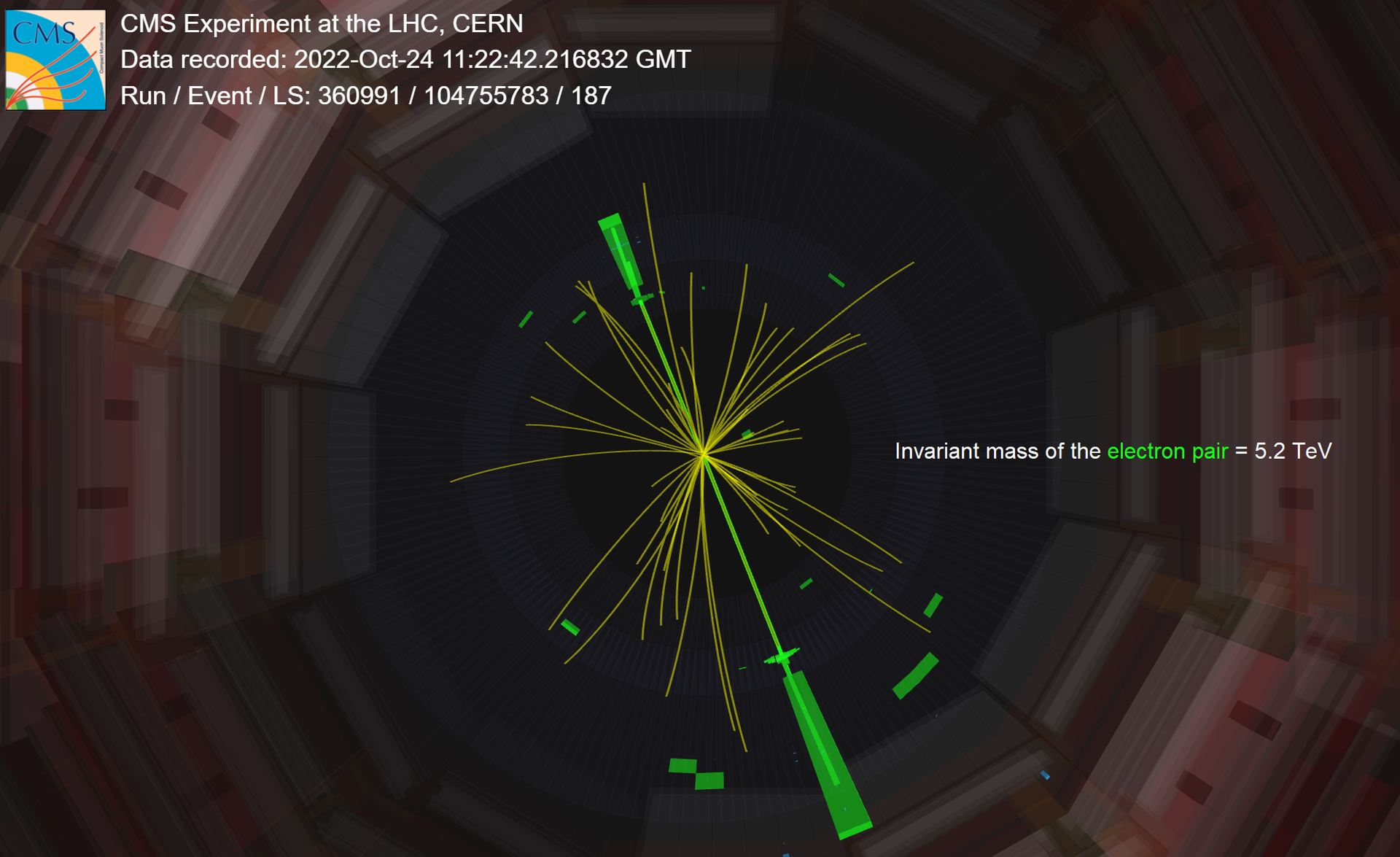
To perform this search, CMS analysed proton-proton collisions collected at centre-of-mass energies of 13 and 13.6 TeV. Events containing two energetic electrons or muons were selected, allowing the experiment to probe lepton-pair masses extending to several TeV. The top image shows an exceptional event containing two electrons with an invariant mass of 5.2 TeV; the highest-mass dielectron event ever recorded by CMS. Such rare events provide a unique window into possible new particles and interactions beyond the Standard Model.
A key ingredient of the analysis is a novel simulation technique that enables many different new-physics scenarios to be tested without generating a separate simulated sample for each possibility. Instead, Standard Model simulations are reweighted to predict the effects of new physics while preserving their theoretical precision.
The data are found to be consistent with the Standard Model predictions. The analysis sets the most stringent CMS constraints to date on the oblique parameters W and Y when combined with a CMS Run 2 search for a heavy W’ boson (see Fig. 1). The results also place the strongest CMS limits so far on models predicting a composite Higgs boson.
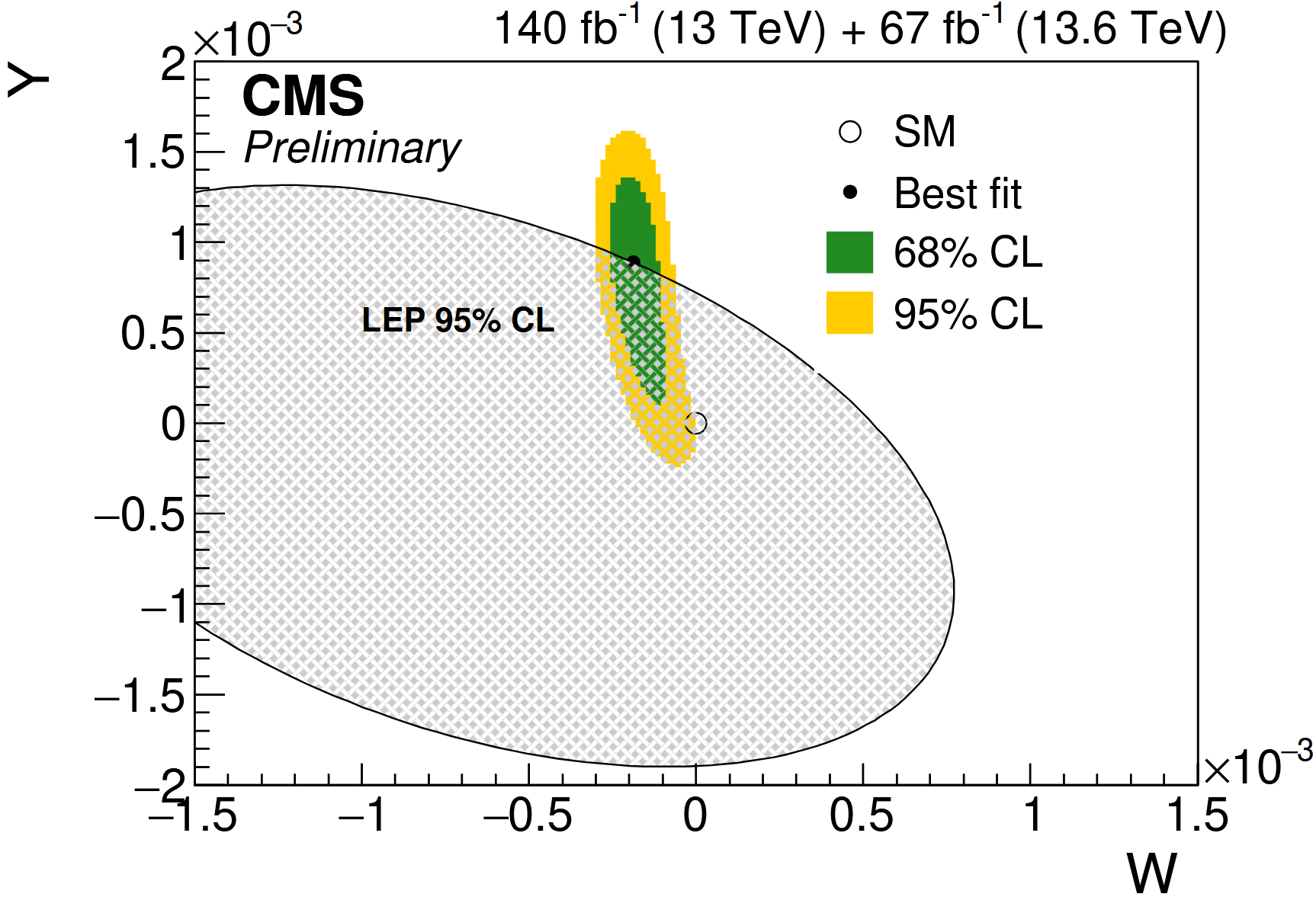
Figure 1: Allowed values of the W and Y parameters, which describe possible small deviations from the Standard Model caused by new heavy particles. The constraints shown include results from a CMS Run 2 search for a heavy W′ boson, resulting in the most stringent limits on these parameters to date.
“While we have not found evidence for a composite Higgs boson yet, this result shows how powerful precision measurements at the LHC can be in searching for new physics. With the much larger datasets expected from future LHC runs, these techniques will significantly enhance our ability to uncover indirect signs of physics beyond the Standard Model,” said Oliver Carretero, a PhD student at CIEMAT (Madrid).
Written by: Oliver Manzanilla Carretero and Juan Alcaraz, for the CMS Collaboration
Edited by: Andrés G. Delannoy
Read more about these results:
-
CMS Physics Analysis Summary (EXO-25-001): "Search for Higgs compositeness effects in high-mass dilepton final states in proton-proton collisions at √s = 13 and 13.6 TeV"
-
@CMSExperiment on social media: Bluesky - Facebook - Twitter - Instagram - LinkedIn - TikTok - YouTube