
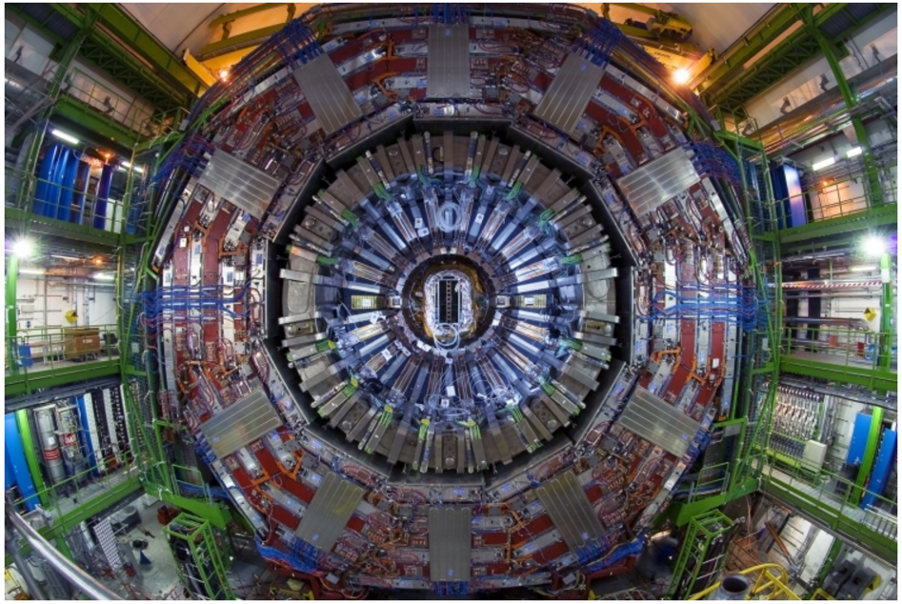
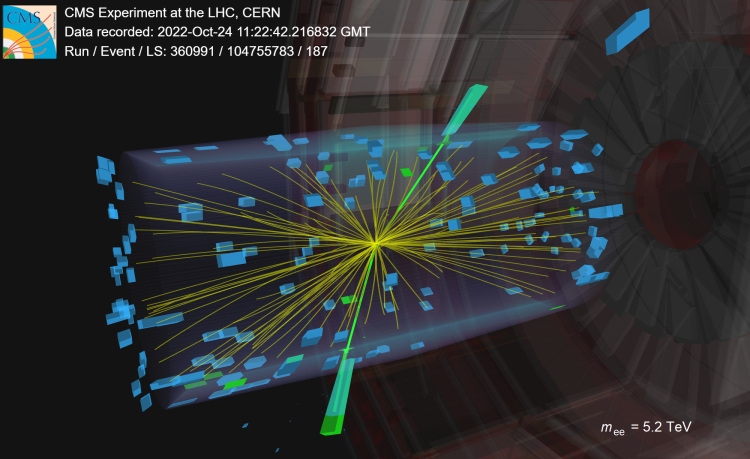
CMS observes rare collisions that produce pairs of electrons or muons with the highest combined invariant mass ever recorded, extending the search for undiscovered heavy particles.
The CMS experiment at CERN has carried out one of its most sensitive searches yet for new heavy particles that could reveal physics beyond the Standard Model. Using the proton-proton collision data collected between 2022 and 2025, a data set of unprecedented size and energy, CMS searched for new particles decaying into pairs of electrons or muons – collectively called leptons here – at the highest energies accessible at the LHC. Although no evidence for such new particles was observed, the analysis sets the world’s strongest limits to date on several possible extensions of the Standard Model, excluding hypothetical particles with masses below 5.55 TeV.
Pairs of electrons or muons provide one of the cleanest ways to hunt for new physics because they leave clear signals in the CMS detector. If a new heavy particle were produced in a collision at the LHC, it could quickly decay into two leptons, creating a distinctive excess of events containing lepton pairs of a particular mass.
Even though the signal itself is very clear, it is hidden inside billions of events from ordinary collisions, making this search very much like looking for a needle in a haystack. We sometimes describe the strategy as a “bump hunt”: if enough collisions produce lepton pairs with the same mass, a bump would appear above the smooth background distribution expected from known processes.
To look for such bumps, CMS analysed data collected in Run 3, corresponding to twice the full dataset recorded during the LHC’s previous running period. The collisions also occurred at a higher energy than before: 13.6 TeV instead of 13 TeV. That small increase makes a surprisingly large difference when searching for extremely massive particles.
“At these energies, we are exploring territory where new particles could realistically appear for the first time,” explains Franco Caviglia, a PhD student involved in the analysis. “Even a small increase in collision energy can open a surprisingly large new search window.”
CMS searched for several kinds of new particles, including heavier versions of the Z boson, known as Z′ bosons, and hypothetical particles carrying gravity (gravitons) linked to extra dimensions of space. Such particles are predicted in theories that try to explain some of the Universe’s deepest mysteries, including matter-antimatter asymmetry, dark matter, and unified forces at extremely high energies.
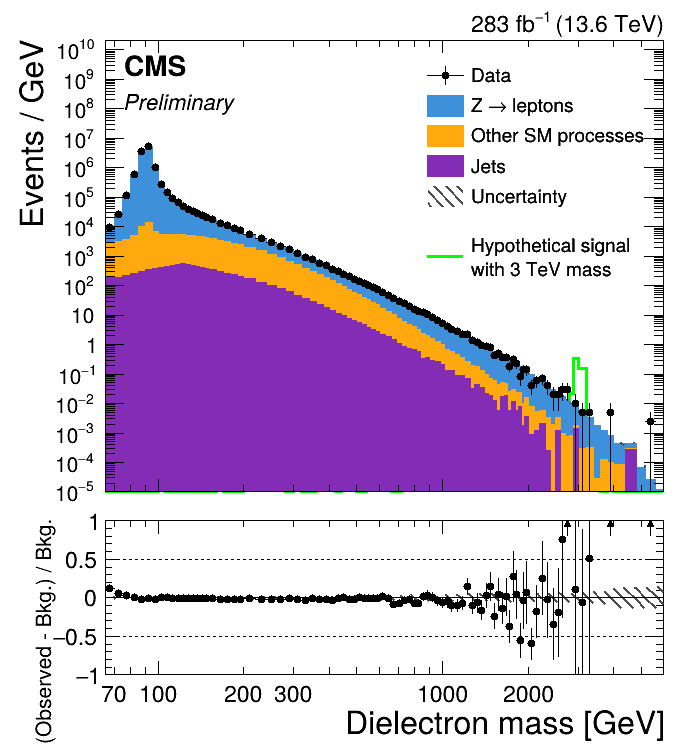
Above: The measured distribution of dilepton masses (black points) compared with the expectation from known Standard Model processes (coloured histograms). A new heavy particle would appear as a localized excess, or “bump” in the high-mass tail of the distribution.
The highest-mass event observed in the search contained two electrons with a combined mass of 5.2 TeV, making it the most energetic dilepton event ever recorded by CMS. While intriguing, a single event is not enough to claim evidence for a new particle. Statistical studies show that the observation remains compatible with the expected background from known Standard Model processes.
“The exciting part of these searches is that a single unusual event can immediately catch your attention,” says Matheus Macedo, a postdoctoral researcher working on the analysis. “But particle physics demands patience; we need enough evidence to separate a real signal from a statistical fluctuation.”
No significant deviation from the Standard Model prediction was observed. Instead, the analysis allowed CMS to place the world’s strongest limits to date on several new particles. In particular, the experiment excludes new Z′ bosons with masses below 5.55 TeV in one benchmark model. These results significantly improve on previous LHC searches, thanks to the larger dataset and the increased collision energy delivered.
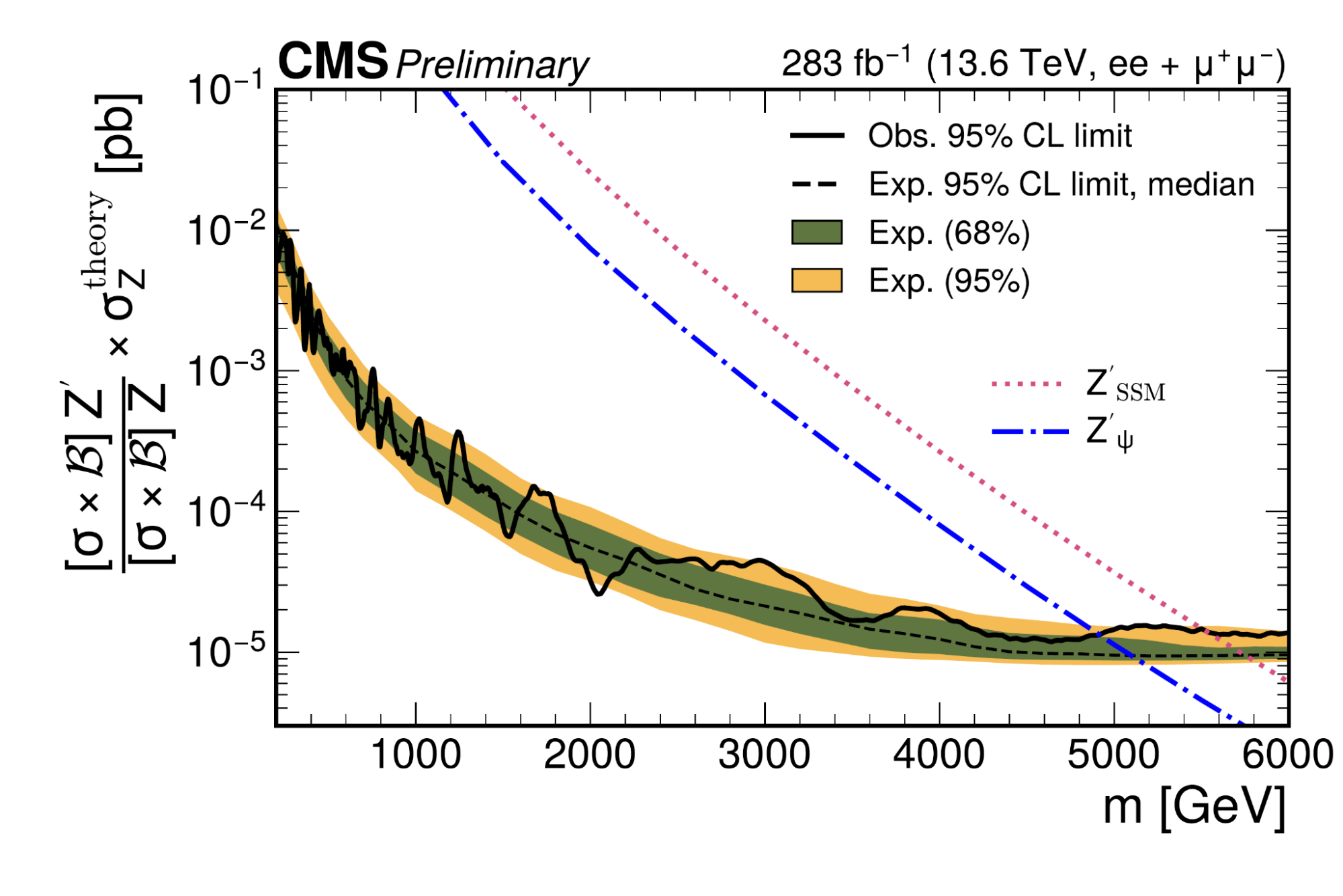
Above: Derived exclusion limits on hypothetical heavy particles. Particles with masses up to the intersection of the solid black line with the dotted and dot-dashed lines are excluded.
CMS is now probing masses above 5 TeV with unprecedented sensitivity, and the search is still only beginning. In the next decade, the High-Luminosity LHC will deliver far larger datasets, allowing physicists to search even more precisely for extremely rare signals that may still be hiding beyond today’s reach.
“Every time we extend the search range, we learn something new about how nature works,” remarks Ilia Kalaitzidou, a postdoctoral researcher working on the analysis. “Even when we don’t discover a new particle, we narrow down where new physics could still be hiding.”
Written by: Ilia Kalaitzidou, for the CMS Collaboration
Edited by: Muhammad Ansar Iqbal
Read more about these results:
-
CMS Physics Analysis Summary (EXO-25-021): "Search for resonant new phenomena in high-mass dilepton final states at √s = 13.6 TeV"
-
@CMSExperiment on social media: Bluesky - Facebook - Instagram - LinkedIn - TikTok - Twitter/X - YouTube