
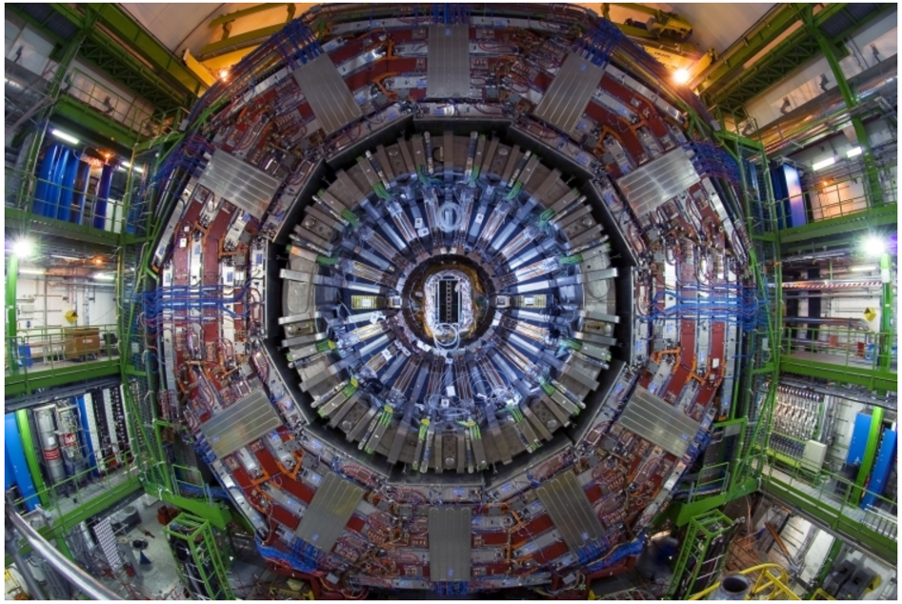
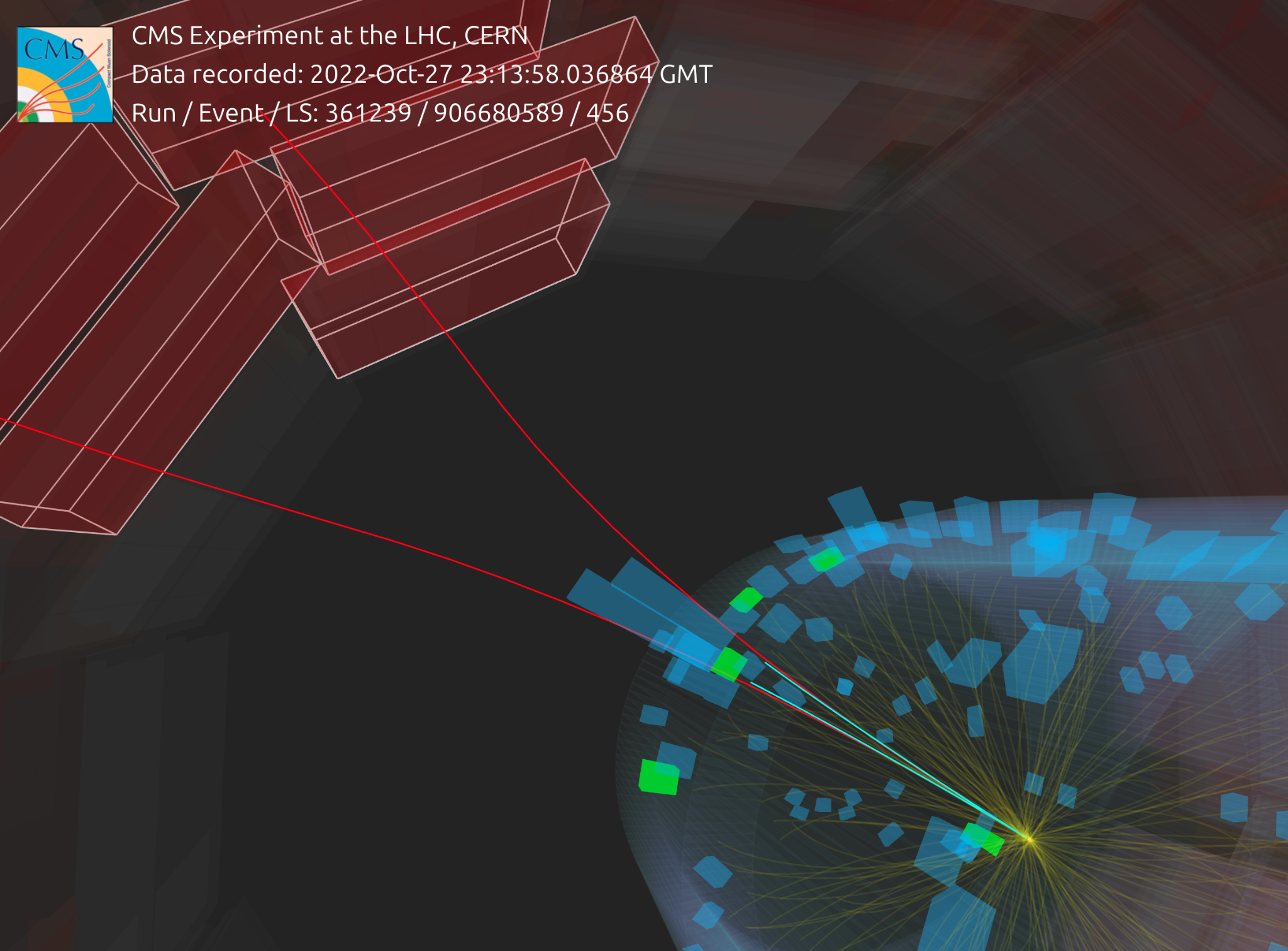
CMS observes the η meson decaying into two muons and two charged pions for the first time.
Over the past three years, the CMS experiment has steadily expanded our view of the eta (η) meson's rarest decays. Following the first observations of the η meson decaying into four muons in 2023 and into two muons and two electrons earlier this year, CMS has now achieved another milestone: the observation of the decay into two muons and two charged pions, η → μ⁺μ⁻π⁺π⁻, along with the most precise branching fraction measurement to date of the decay into four muons. These results provide new tests of the strong interaction, refine models of the η meson's internal structure, improve theoretical calculations related to the muon's magnetic moment, and open new windows in the search for physics beyond the Standard Model (SM).
The η meson is one of the lightest particles made of a quark and an antiquark. Although it is produced abundantly in proton-proton collisions at the Large Hadron Collider, its rarest decay modes occur only a handful of times in millions or even billions of decays. Measuring these tiny probabilities provides a sensitive test of the SM at low energies, where the strong force binding quarks together is so intense that its effects cannot be calculated precisely and must instead be modeled or constrained by data.
The newly observed decay complements CMS's earlier results. The previously observed four-lepton decays contain no hadrons in the final state, providing a comparatively clean measurement of the η meson's electromagnetic transition form factor: how strongly it couples to one or two "virtual" photons, short-lived photons that instantly convert into pairs of leptons. The η → μ⁺μ⁻π⁺π⁻ decay is different: it produces real pions alongside the virtual photon, bringing electromagnetic and strong-interaction effects together in the same decay, as shown in Figure 1, providing a different window into the particle's internal dynamics. Comparing all three decay channels allows physicists to test theoretical predictions from complementary perspectives.
These measurements also have implications beyond the η meson itself, as theoretical models are also used to describe the interactions of light quarks in other processes. In particular, they contribute to calculations of the SM prediction of the muon's magnetic moment, which is one of the best ways physicists have found to stringently test the SM in the last few years.
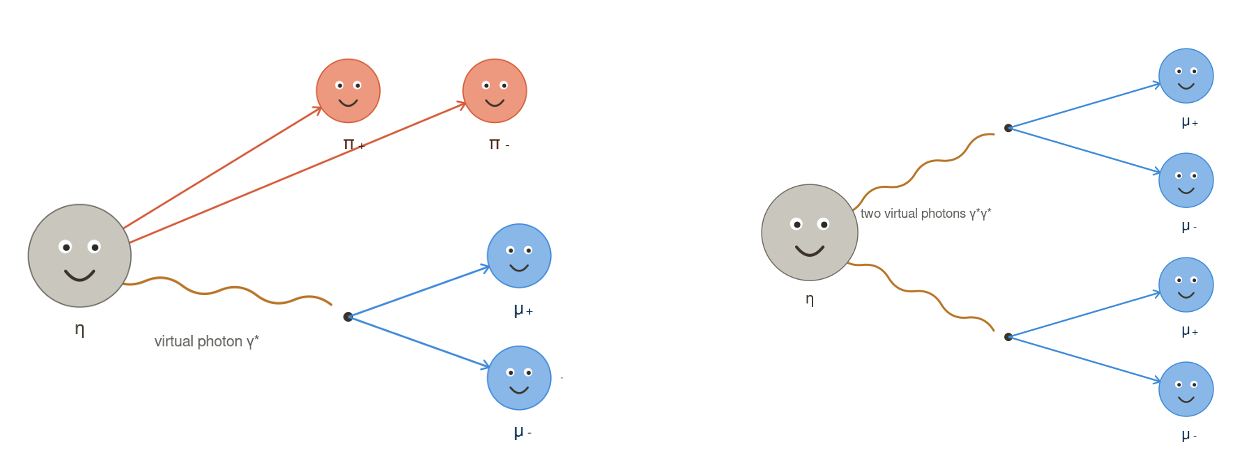
Figure 1: Two rare decay modes of the eta meson. Left: η → μ⁺μ⁻π⁺π⁻. Right: η → μ⁺μ⁻μ⁺μ⁻, a double-Dalitz decay in which two virtual photons each convert into a pair of muons.
Observing the new η decay required CMS to detect muons carrying only a small amount of momentum relative to the LHC beam energies. Such particles are normally overlooked by the triggers designed mainly to select collisions containing more energetic particles. To meet this challenge, CMS developed a dedicated high-rate trigger to capture low-mass muon pairs, enabling the collection of a large sample of events for analysis. Combined with the unprecedented sample of Run 3 data collected from 2022-2024, this trigger strategy made it possible to isolate the rare signal from the copious background at the LHC, as shown in Figure 2.
The η→μ⁺μ⁻π⁺π⁻ decay is established with an observed statistical significance of 6.2 standard deviations, corresponding to a probability of a few in a billion that the signal is a statistical fluke. In addition, the same dataset also contains nearly six times as many η→μ⁺μ⁻μ⁺μ⁻ events as the previous CMS analysis, enabling the most precise measurement of this branching fraction to date.
"It's exciting to see another piece of the η meson puzzle fall into place," says Yihui Lai, a postdoctoral researcher at Princeton University and lead analyzer in the study. "Each rare decay reveals a different aspect of the same particle, and together they allow us to build an increasingly precise picture of the η meson."
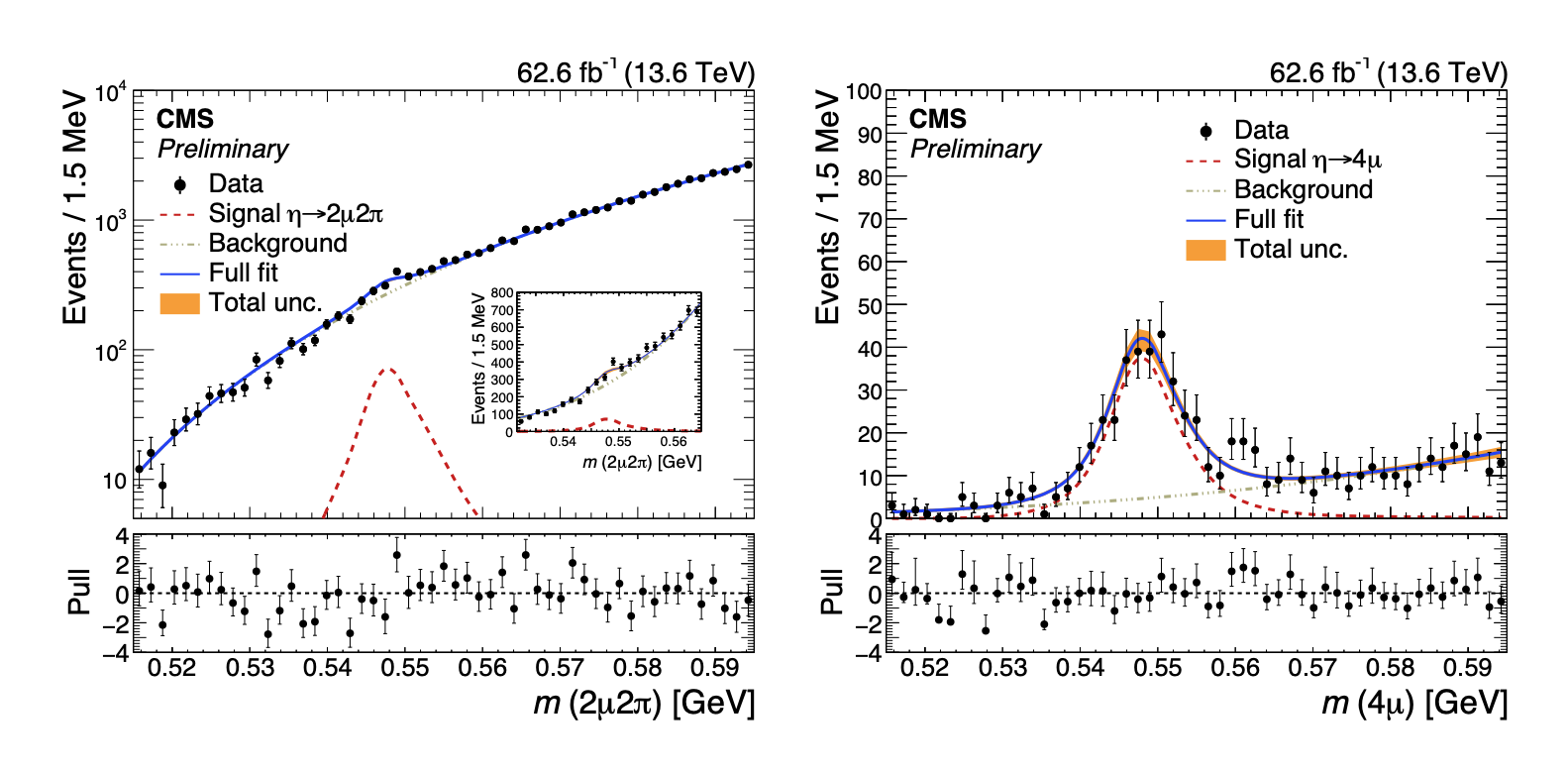
Figure 2: Invariant-mass distributions for η → μ⁺μ⁻π⁺π⁻ (left) and η → μ⁺μ⁻μ⁺μ⁻ (right) showing the signal and background contributions.
CMS has now observed three rare decay modes of the η meson, marking an important step toward a more precise exploration of its properties, in a regime where SM predictions remain particularly challenging to calculate. As CMS analyzes the remainder of the Run 3 dataset and prepares for the High-Luminosity LHC, these measurements will become increasingly powerful probes to test our understanding of the fundamental particles and search for physics beyond the SM.
Written by: Yihui Lai, for the CMS Collaboration
Edited by: Haifa Rejeb Sfar
Read more about these results:
-
CMS Physics Analysis Summary (BPH-26-004): "Observation of η → μ⁺μ⁻π⁺π⁻ and improved measurement of the branching fraction for η → 2μ⁺2μ⁻ "
-
@CMSExperiment on social media: Bluesky - Facebook - Instagram - LinkedIn - TikTok - Twitter/X - YouTube