
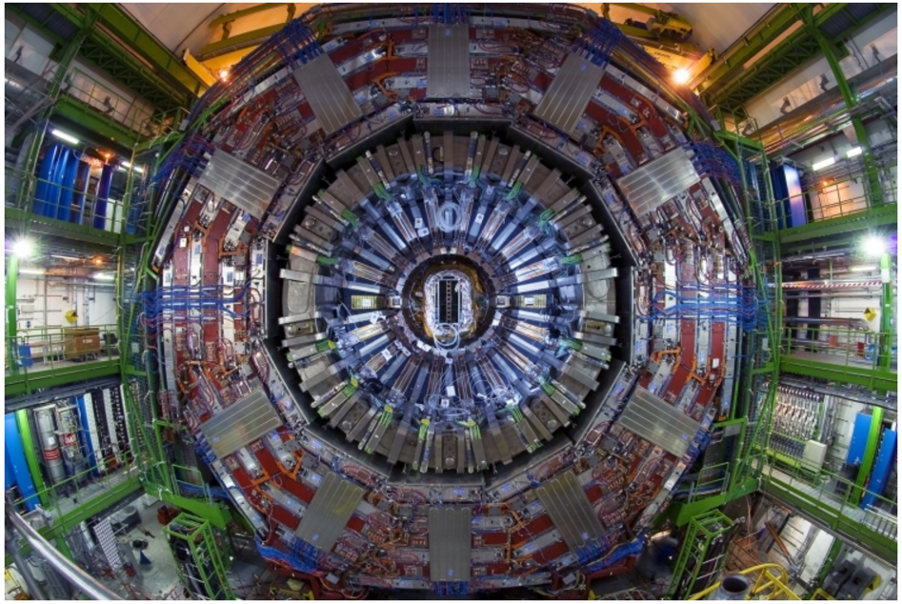
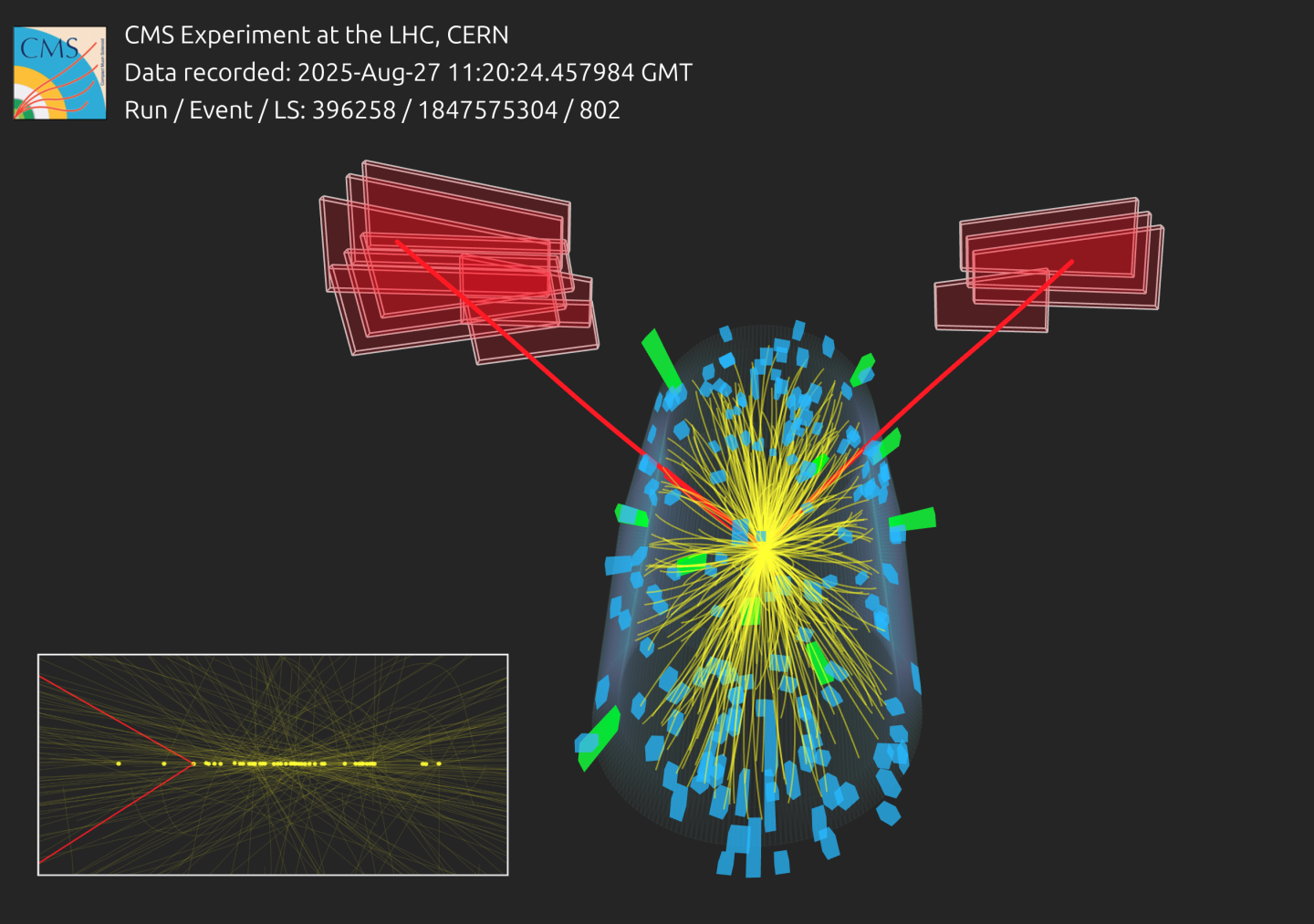
The CMS experiment uses data collected between 2016 and 2026 to observe, for the first time, leptons (electrons and muons) emitted from protons scattering off one another.
Since the first high-energy proton colliders began operating more than half a century ago, physicists have studied the interaction of quarks and gluons inside protons. Although protons are the particles accelerated and brought into collision, it is their constituents – called partons – that actually interact. These collisions typically break apart the protons, producing a spray of strongly interacting particles and dozens of tracks emerging from a single interaction vertex.
It also happens, however, that the protons pass close to one another without directly colliding. In this case, each proton can emit a photon, and the photons interact while the protons remain intact, producing a remarkably clean interaction.
Although the photon content of the proton has been measured at the LHC in recent years, an even more elusive possibility has remained unexplored – that protons can also give rise to leptons (electrons, muons, taus). Predicted by the standard model, these fleeting lepton constituents had never been observed experimentally before.
The CMS experiment has just confirmed this possibility by analysing a large amount of data – 440 fb–1 collected between 2016 and 2026 – to observe the scattering of two leptons originating from the protons (figure below).
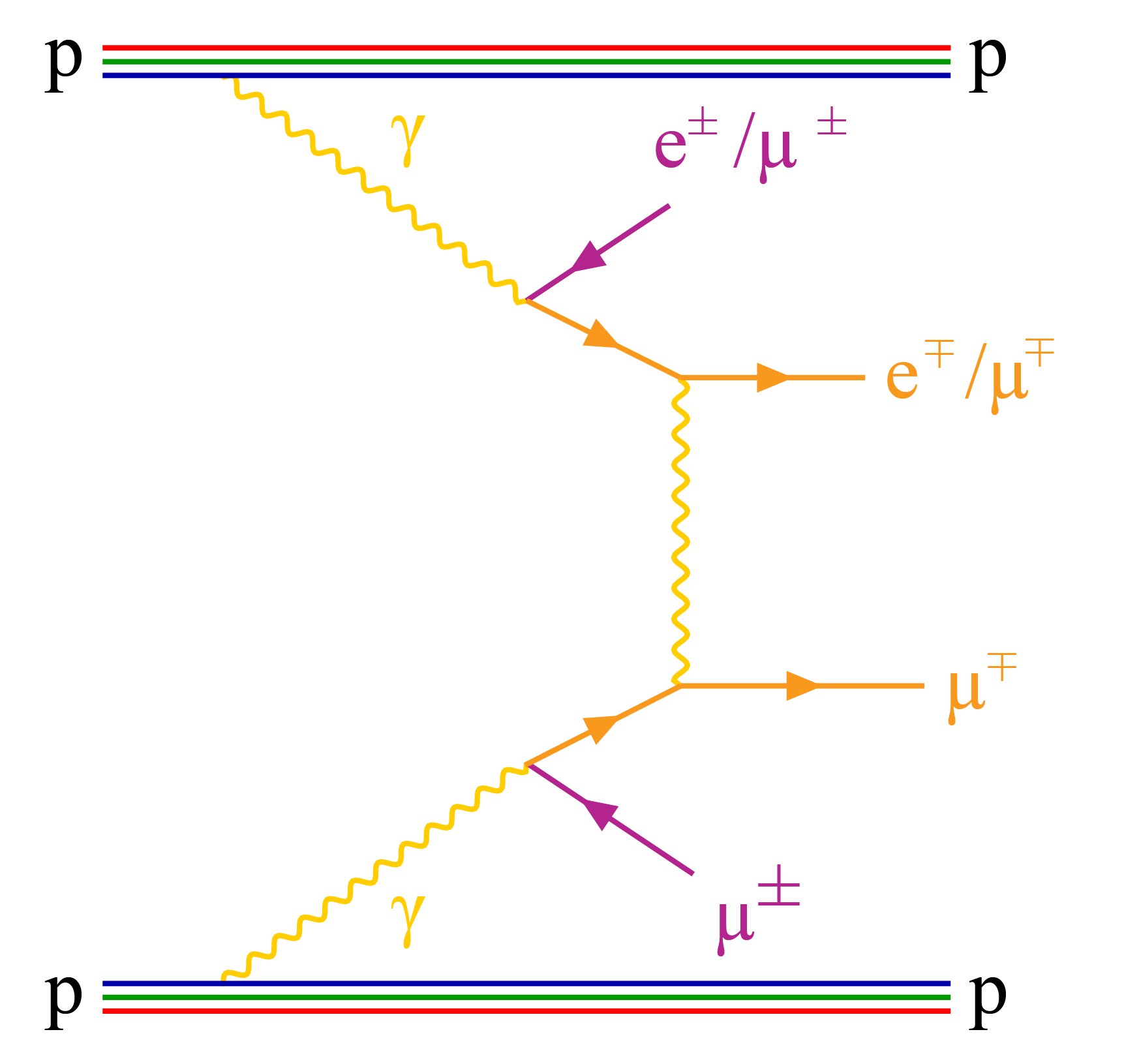
Above: Schematic diagram of leptons originating from protons and scattering off each other.
The lepton–lepton scattering was observed in events containing two electrons or muons with the same electric charge and no more than four tracks emerging from the interaction vertex, including the lepton tracks. This strikingly clean signature in the otherwise extremely crowded LHC environment could be isolated from the overwhelming background to prove that leptons can originate from the protons.
The figure below shows the distribution of the ratio of the vectorial to scalar sums of the transverse momenta of the leptons. The expected signal distribution (red) peaks at 0, and the observed data show a clear enhancement at these low values with respect to the standard model expectation.
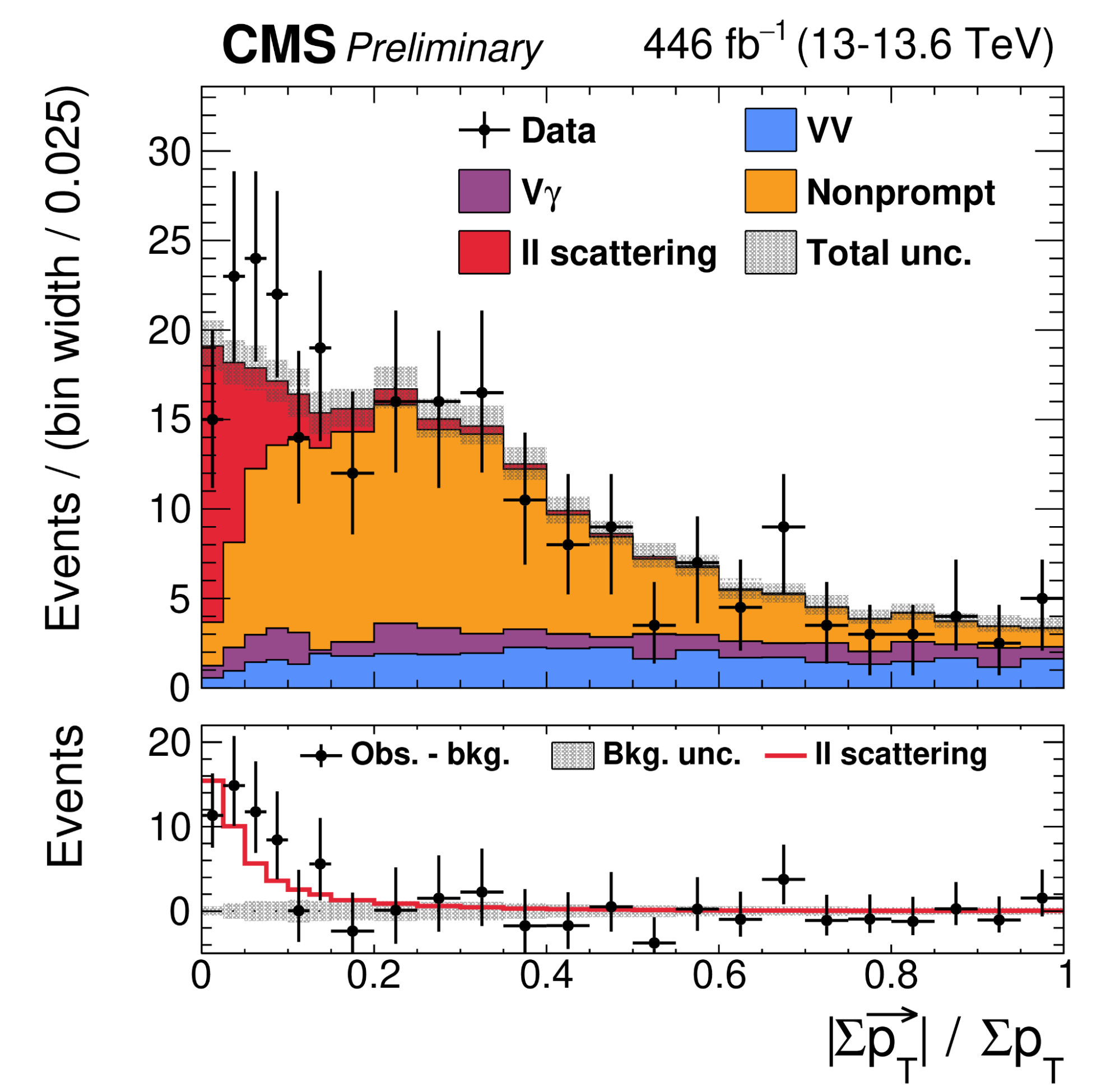
Above: Distribution of the ratio of the vectorial to scalar sums of the transverse momenta of the final-state leptons.
“This result sheds light on the lepton content of the proton and is a steppingstone towards searches for the lepton-induced production of physics processes beyond the standard model,” says Cécile Caillol, a researcher at CERN and part of the analysis team. “This is also the first strong evidence of muon–muon scattering, which was never probed before,” adds Jian Wang, a researcher at the University of Florida and also part of the analysis team.
Written by: Cécile Caillol and Jian Wang, for the CMS Collaboration
Edited by: Muhammad Ansar Iqbal
Read more about these results:
-
CMS Physics Analysis Summary (SMP-26-008): "Observation of lepton-lepton scattering in proton-proton collisions at √s = 13 and 13.6 TeV"
-
@CMSExperiment on social media: Bluesky - Facebook - Instagram - LinkedIn - TikTok - Twitter/X - YouTube