
For the first time at the LHC, W and Z bosons and TeV-scale jets are seen alongside a proton that survived the collision intact, reopening a chapter of forward physics that high pileup had closed.
In exploring the strong interaction at the highest collision energies, CMS has reached a well-hidden corner of hard diffraction: how often do high-energy collisions leave one proton intact? Theory is still not firmly established, while the story predates the theory of the strong force itself.
Before quantum chromodynamics (QCD) explained the strong interaction, physicists were trying to understand two striking features of hadrons: the patterns in their masses and spins, and their behaviour in high-energy scattering. Regge theory linked the two through curves known as Regge trajectories.
When two hadrons scatter, the trajectory appears as the exchanged object, a Reggeon. It represents a family of hadrons whose masses and spins follow a systematic relationship. Regge theory also describes diffractive processes in which momentum is exchanged while one of the incoming hadrons remains intact.
The first surprise came in 1968, when G. Veneziano found a formula connecting hadron resonances with the high-energy behaviour predicted by Regge theory. Its deeper meaning emerged only later: the formula could be understood as describing the excitation modes of a quantised vibrating string. String theory was born, originally as a theory of hadrons.
The electron–proton collider HERA brought diffraction into the QCD framework, showing that a parton inside the proton, either a quark or a gluon, can participate in a hard interaction while the proton as a whole survives the collision, and describing these processes using diffractive parton distribution functions.
A second surprise came from the Tevatron, a proton–antiproton collider: CDF observed roughly an order of magnitude fewer hard diffractive events than predicted from HERA data. Unlike HERA, both incoming particles at the Tevatron interact strongly, allowing additional interactions that can break up the outgoing proton or antiproton and destroy the diffractive signature. Nevertheless, CDF showed that diffraction could survive even in energetic collisions producing W and Z bosons: about 1% of these events contained a tagged intact antiproton. The low rate is a challenge, as it requires collecting large datasets.
The LHC added a second challenge: nominal running squeezes the bunches of protons so tightly that, on average, more than 60 collisions occur in each bunch crossing (pileup), and an unrelated proton may be wrongly matched to the hard scattering.
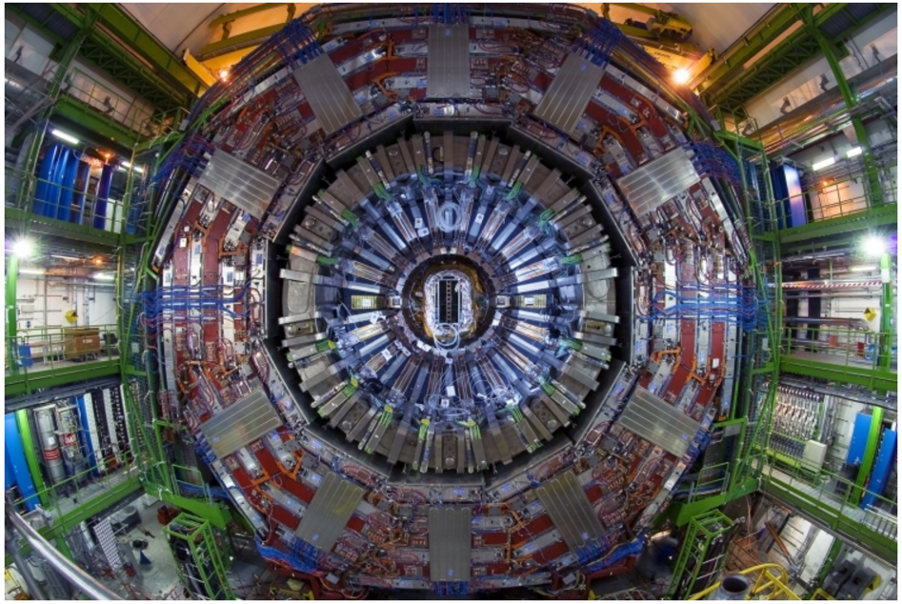
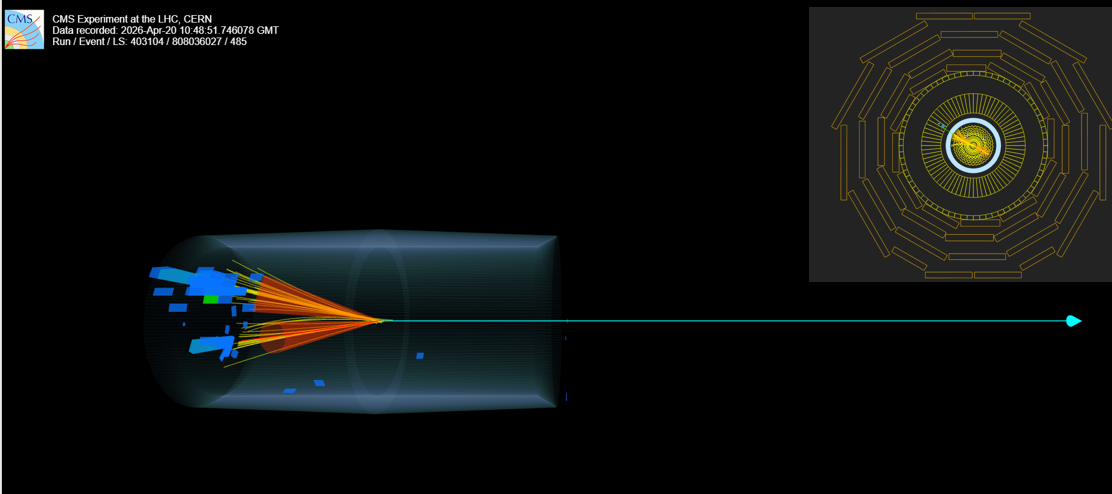
CMS addressed this challenge with the Precision Proton Spectrometer (PPS), a system of near-beam detectors housed in movable Roman pots. By matching forward-proton kinematics to the central collision even during standard high-pileup running, CMS enabled studies of central exclusive production processes. Recently, CMS also tackled hard diffraction with a dedicated low-pileup run that delivered an exceptionally large dataset. The PPS measured the protons, while the central detectors reconstructed the W bosons, Z bosons, and jets. An example of such an event is shown in Figure 1.
Figure 1: Event display of a proton-proton collision recorded by CMS. The event contains two nearly back-to-back high-energy jets (orange cones), with a dijet invariant mass of about 2 TeV, in association with a tagged intact proton (cyan arrow).
The analysis compares the observed rate of events with a tagged proton to the rate expected from an accidental background, determining how often the proton is correlated with the hard interaction. A correlation between the tagged proton direction and the direction of the centrally produced system, shown in Figure 2, confirms its association with the hard collision. The result is that about 1% of W and Z events, and 0.5% of jet events, contain a proton emitted from the same collision!

Figure 2: Multijet rapidity distributions for events with a proton tagged on either side of CMS (red and blue histograms in the top panel). The opposite trends seen for the two proton directions (blue and red points in the middle panel) reveal a clear correlation between the tagged proton and the hard collision (clearly seen in the bottom panel).
These are the first W and Z bosons with tagged protons observed at the LHC, and the first proton-tagged multijet events with invariant masses extending to the TeV scale. However, observing a forward proton does not, by itself, reveal how it was produced: it may come from a colourless exchange such as Pomeron or subleading Reggeon exchange or photon exchange, or from a leading proton emerging from proton dissociation. The Regge picture that opened this story is only partly constrained in today's simulations. The measured tagged-proton rates open a new testing ground. Time will tell if the Regge-inspired models of diffraction can explain the measurements or if the results point to a third surprise.
Written by: Martijn Mulders, Michael Pitt, and Carlos Lourenco for the CMS Collaboration
Edited by: Haifa Rejeb Sfar
Read more about these results: