
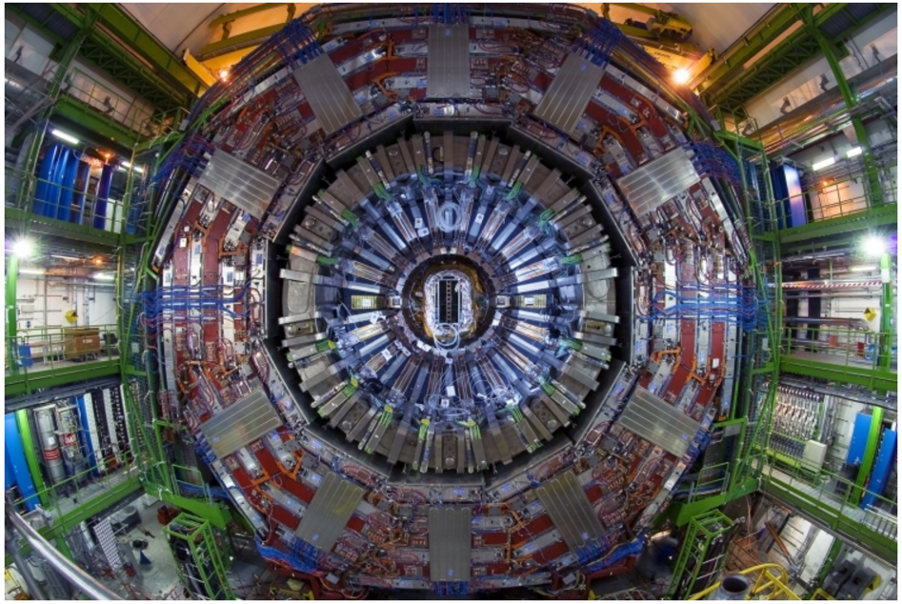
CMS sets the world’s most stringent constraints on anomalous interactions between the bosons that carry the electroweak force.
A key prediction of the Standard Model of particle physics is how the carriers of the weak force – the W and Z bosons – interact with one another. When protons are smashed together at extreme energies inside the LHC, they can produce pairs of these force carriers (also called gauge bosons), e.g. WW or WZ. Even the slightest deviation in how these bosons interact would indicate physics beyond the Standard Model, such as unseen forces.
To hunt for these subtle deviations, CMS physicists analyzed proton-proton collision data recorded at a center-of-mass energy of 13 TeV. The study focused on the lepton+jet decay channel, where one boson decays into a clean, easily identifiable charged lepton (an electron or a muon) and a neutrino, while the other decays into a quark-antiquark pair that manifest as a high-energy collimated spray of particles called “jet”, as depicted below.
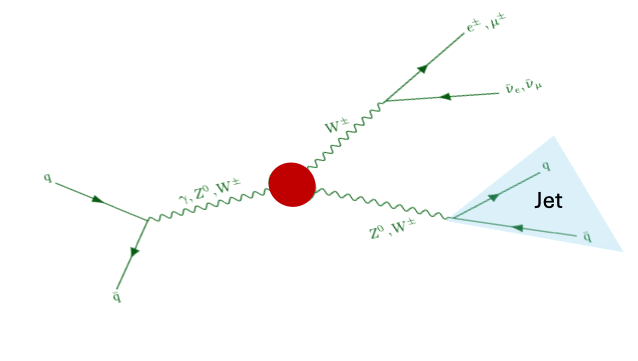
Above: Sketch of a collision producing a pair of W and Z bosons via anomalous coupling between three gauge bosons.
The team examined the high-invariant-mass region of the WW and WZ systems, where the effects of anomalous couplings are expected to appear as an excess of events, as illustrated below.
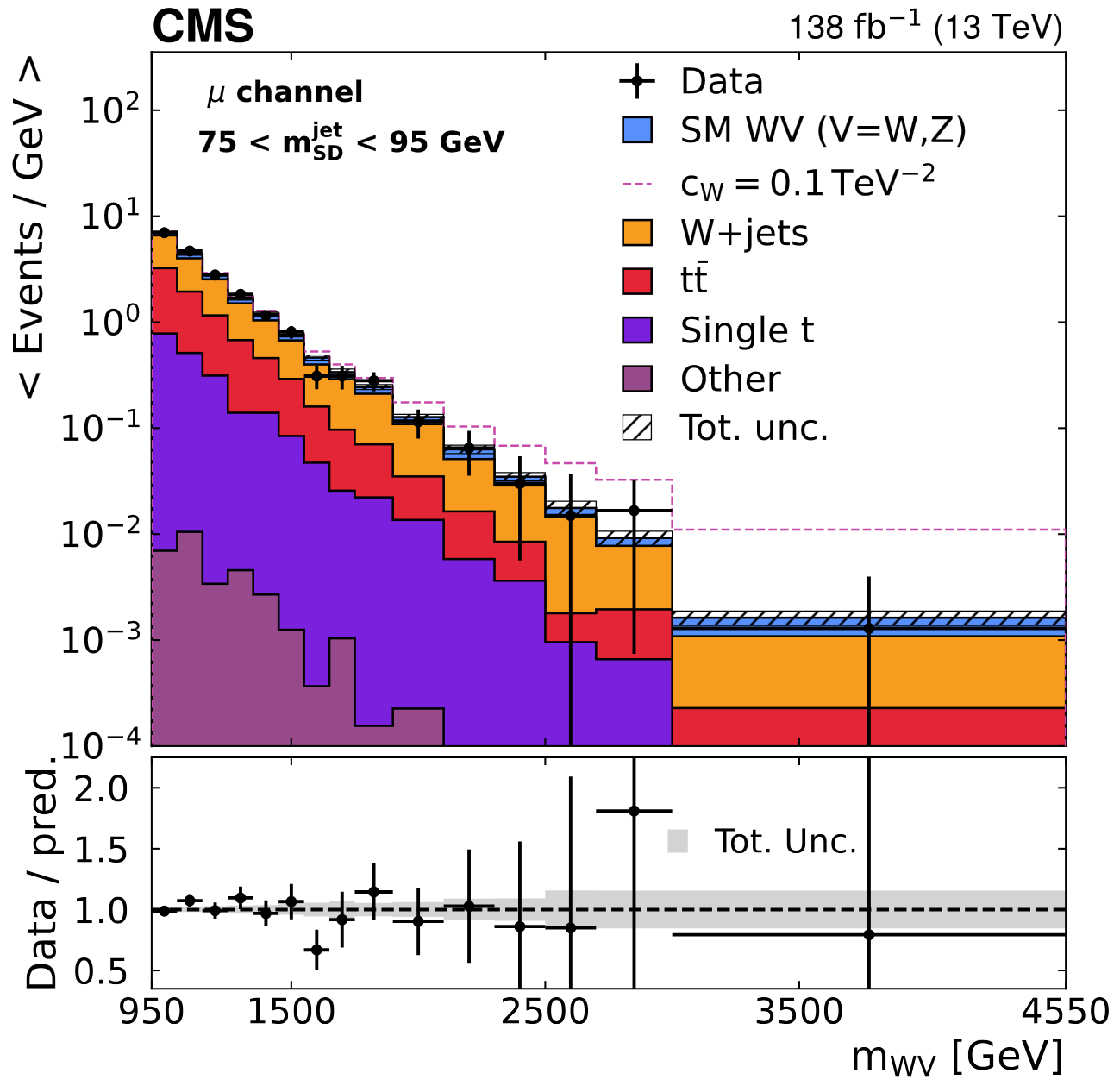
Above: The number of observed WW or WZ events as a function of their invariant mass. The black markers represent the observed data while the predicted backgrounds are shown by the filled histograms. The dashed line indicates the predicted signal distribution with anomalous couplings.
The data observed by the CMS detector aligned with Standard Model predictions, and no signs of anomalous couplings were detected. However, a null result in particle physics is far from empty handed. CMS scientists calculated precise constraints using an Effective Field Theory (EFT) framework.
“By setting strict limits on the parameters governing anomalous couplings with gauge bosons, CMS has effectively narrowed the parameter space where new physics can hide,” says Ankita Mehta, Postdoc at Ghent University and previously CERN and University of Hamburg. “These limits surpass previous constraints, ruling out an array of theoretical models that predicted larger, macroscopic modifications to weak force interactions.”
By precisely defining where new physics does not appear, CMS continues to chart the boundaries of our current understanding of the subatomic world. While the Standard Model remains remarkably successful in this regime, the search for physics beyond it is far from over. As the LHC continues its high-luminosity upgrades, the influx of new data will allow CMS to probe these fundamental couplings with unprecedented precision.
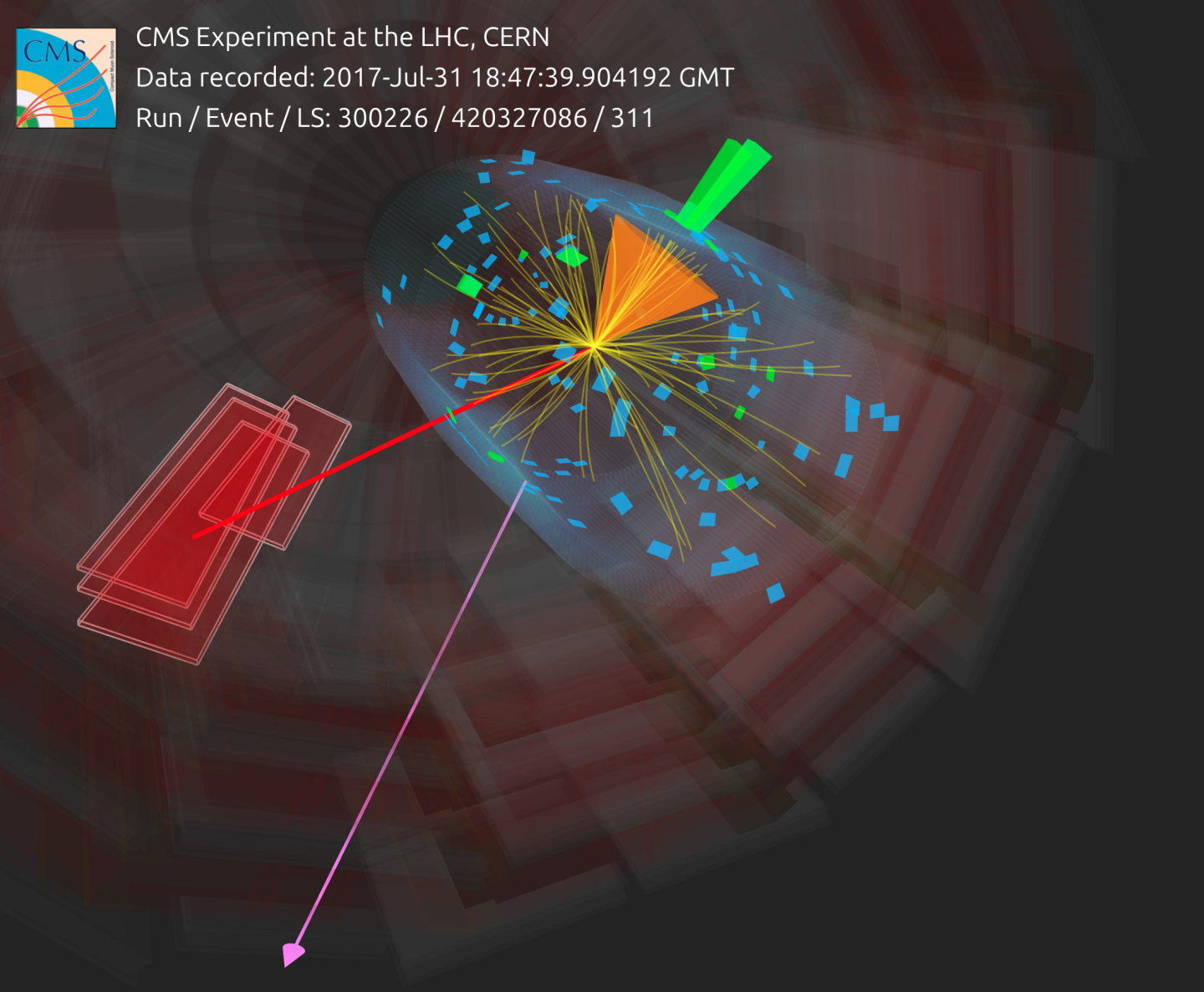
Above: An event recorded by the CMS detector in 2017, likely corresponding to WW or WZ production in the lepton+jet channel. The red trajectory shows the final-state muon and the jet is represented by the orange cone. The purple arrow indicates missing momentum in the transverse plane, likely from the escaping neutrino, which is not detected by CMS. The display is interactive and can also be viewed on a full, interactive page here.
Written by: Andreas Hinzmann, for the CMS Collaboration
Edited by: Muhammad Ansar Iqbal
Read more about these results:
-
CMS Publication (SMP-25-001): "Search for anomalous couplings in WW and WZ production with single-lepton final states at √s = 13 TeV"
-
@CMSExperiment on social media: Bluesky - Facebook - Instagram - LinkedIn - TikTok - Twitter/X - YouTube