
The CMS Collaboration reports the first measurement of coherent ϕ meson photoproduction, establishing a powerful new tool to explore the dense nuclear matter in the transition regime from perturbative to nonperturbative QCD.
The CMS Collaboration has reported the first observation of coherent ϕ(1020) vector meson photoproduction off heavy nuclei, using ultraperipheral lead–lead (PbPb) collisions at the Large Hadron Collider. The results have been recently published in Physical Review Letters 135, 262301 (2025), marking an important milestone in the study of the gluonic structure of atomic nuclei under ultra-dense conditions.
At very high energies, atomic nuclei become densely packed with gluons—the carriers of the strong force that bind quarks. As energy increases, gluon densities grow rapidly until reaching a balance due to effects from nonlinear quantum chromodynamics (QCD). As we approach this threshold, a novel regime known as gluon saturation emerges. “Studying this regime provides key insights into the collective behavior of gluons and the strong force under extreme conditions, helping us to understand the early evolution of the universe.” says Prof. Wei Li of Rice University, supervisor of Dr. Jiazhao Lin, one of the lead analysts of the study.
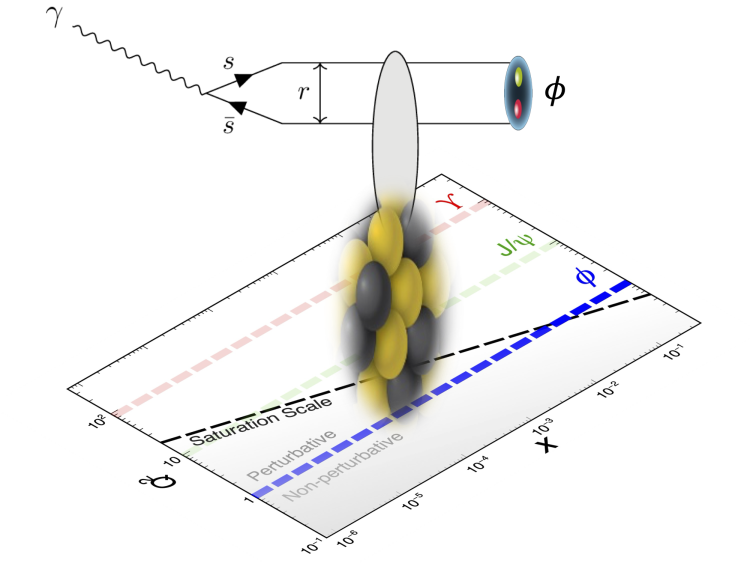
In ultraperipheral collisions, lead nuclei pass each other without directly colliding. Instead, their intense electromagnetic fields act as powerful sources of photons. A photon from one nucleus can interact with the other nucleus, producing a particle known as a vector meson. Studying this process provides a clean way to explore how gluons are distributed inside nuclei.
“The ϕ meson fills a niche in the study of the internal structure of nuclei,” says Prof. Zaochen Ye from South China Normal University. “With a mass of about 1.02 GeV/c² and composed of a strange–antistrange quark pair, it lies between lighter mesons such as the ρ and heavier ones like the J/ψ. Lighter mesons act like low-resolution probes, revealing large-scale features of nuclei, while heavier mesons provide a much sharper view, sensitive to very small distances. The ϕ meson sits in between, allowing us to examine nuclear structure at an intermediate level of detail.”
“The potential to bridge these two regimes makes coherent ϕ photoproduction particularly valuable,” explains Dr. Andre Stahl from CERN. “It allows us to observe how the strong force changes as we move from larger to smaller distance scales.”
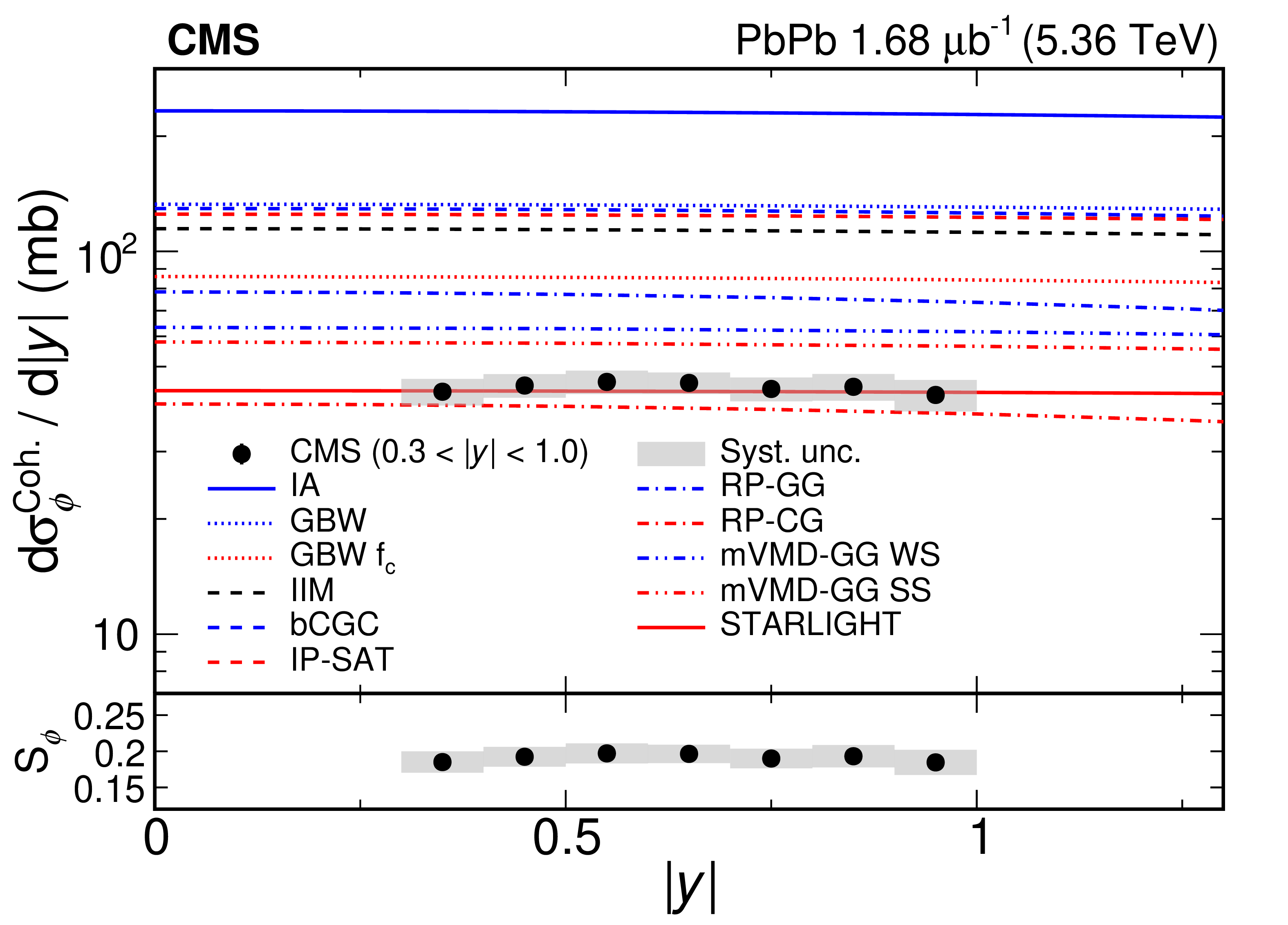
Figure 1: Differential cross section as a function of rapidity for ϕ-meson production in coherent photon–lead interactions, compared with modern theoretical predictions.
Using lead–lead collision data from Run 3 of the LHC, the CMS Collaboration reports the first observation of coherent ϕ meson photoproduction off heavy nuclei. As shown in Fig. 1, the measured cross section as a function of the ϕ meson rapidity is strongly reduced—by about a factor of five—compared with baseline expectation that treat nuclei as simple collections of free nucleons, signaling strong nuclear modifications of the gluon distribution at small nucleon’s momentum fractions (x ≈ 10⁻⁴). The observed suppression is about a factor of 2-3 larger than the state-of-art theoretical models, which consider gluon saturation effects, motivating possible new physics mechanisms at extremely high densities.
The new study expands the experimental landscape of nuclear gluonic structure, as well as the search for gluon saturation at extremely high densities. It also provides valuable guidance for future measurements at the LHC and for upcoming facilities such as the Electron–Ion Collider, a next-generation accelerator designed to collide electrons with heavy ions.
Written by: Zaochen Ye, for the CMS Collaboration
Edited by: Andrés G. Delannoy
Read more about these results:
-
CMS Publication (HIN-24-009): "Observation of coherent ϕ(1020) meson photoproduction in ultraperipheral PbPb collisions at √sNN = 5.36 TeV"
-
@CMSExperiment on social media: Bluesky - Facebook - Twitter - Instagram - LinkedIn - TikTok - YouTube