
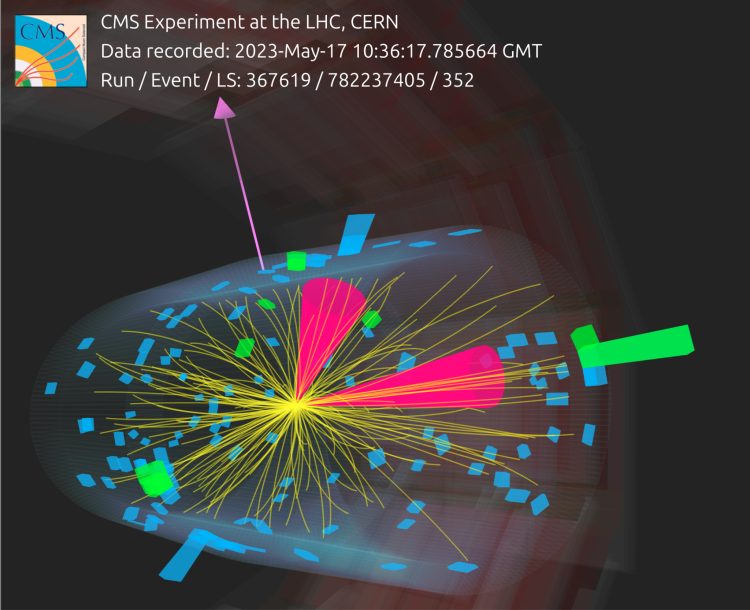
The CMS experiment has performed a new search for Charge-Parity violation in Higgs boson decays to tau leptons, shedding light on the origin of matter.
Since its discovery in 2012, the Higgs boson has helped scientists explore some of the Universe’s biggest mysteries.
One such mystery is the very existence of matter itself. Matter particles have counterparts called antimatter, which are almost identical except for having opposite electric charges. Matter and antimatter should have been created in equal amounts after the Big Bang. Yet, the visible Universe is made almost entirely of matter. So where did all the antimatter go?
This suggests that the laws of physics treat matter and antimatter slightly differently. This can happen if a symmetry of nature—charge-parity (CP) symmetry—is violated. CP-violation implies that a process would look different if viewed in a special mirror that swaps left↔right, up↔down, and positive↔negative charges.
While some weak nuclear processes violate CP-symmetry, it’s extremely rare, and about ten billion times too small to explain the matter–antimatter imbalance.
"The Higgs boson violating CP-symmetry is an exciting possibility that we can test by studying how the Higgs boson decays into pairs of tau leptons. Taus are heavier cousins of electrons, and are unstable, decaying into particles such as pions and neutrinos" explains Lucas Russell, a PhD student at Imperial College London. While the neutrinos escape the detector without leaving a signal behind, the other particles still carry information about CP. In this case, the key observable is the angle ϕCP between the “decay planes” of the taus, defined by the directions of their decay products.
In 2020, CMS searched for CP-violation in Higgs decays using LHC “Run-2” data. No CP-violation was observed, but the measurement did not rule it out either. CMS has now released a new CP-study using data from 2022–2023.
“In the previous analysis, the decay planes could only be approximated because of the missing neutrinos. In the new measurement, decay planes for taus decaying into three charged pions and a neutrino are estimated with an updated method. It reconstructs the tau direction from its decay point—the intersection of three pion trajectories—and provides an estimate of the neutrino’s direction” notes Stepan Zakharov, a PhD student at DESY. The trajectory of the neutrino is estimated by looking at how the pions were deflected at the decay point. Figure 1 shows an example decay: the red circle indicates the decay point where the three pion trajectories (orange lines) intersect. This method enabled CMS to perform a more precise measurement.
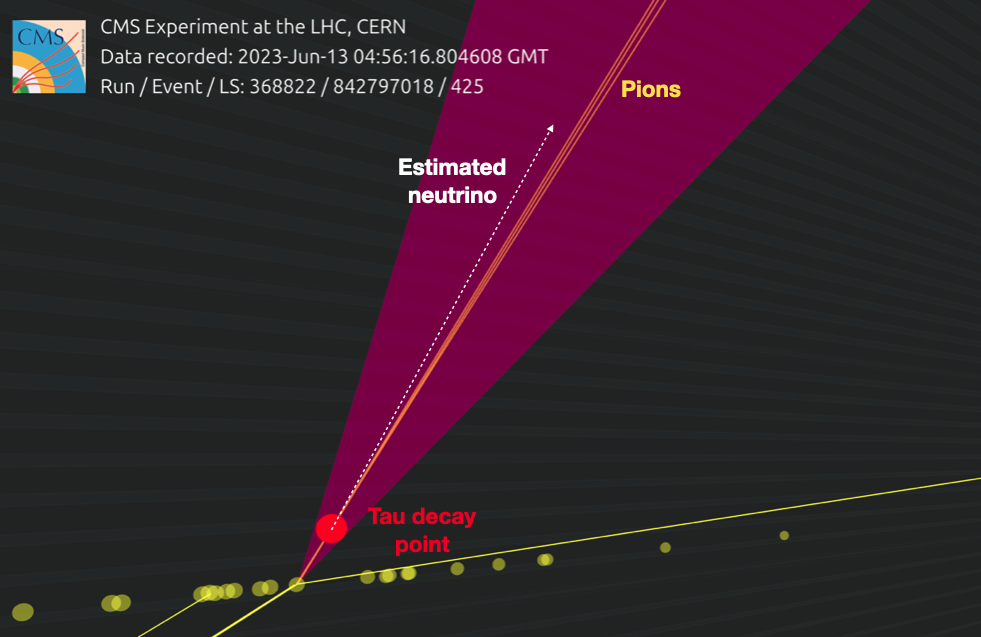
Figure 1: An example of a tau decay illustrating the tau decay point, where the three pion trajectories originate from.
The ϕCP angle was measured for many events and aggregated, as shown in Fig. 2. The shape of the distribution tells us about the decay’s CP-nature, which is parameterised by an angle, αHττ. A value αHττ = 0° (red line) corresponds to a “CP-even” decay, whereas 90° is “CP-odd” (blue). Both these cases imply no CP-violation. But for other values, the Higgs has both CP-even and CP-odd parts, meaning CP-symmetry is violated (green).
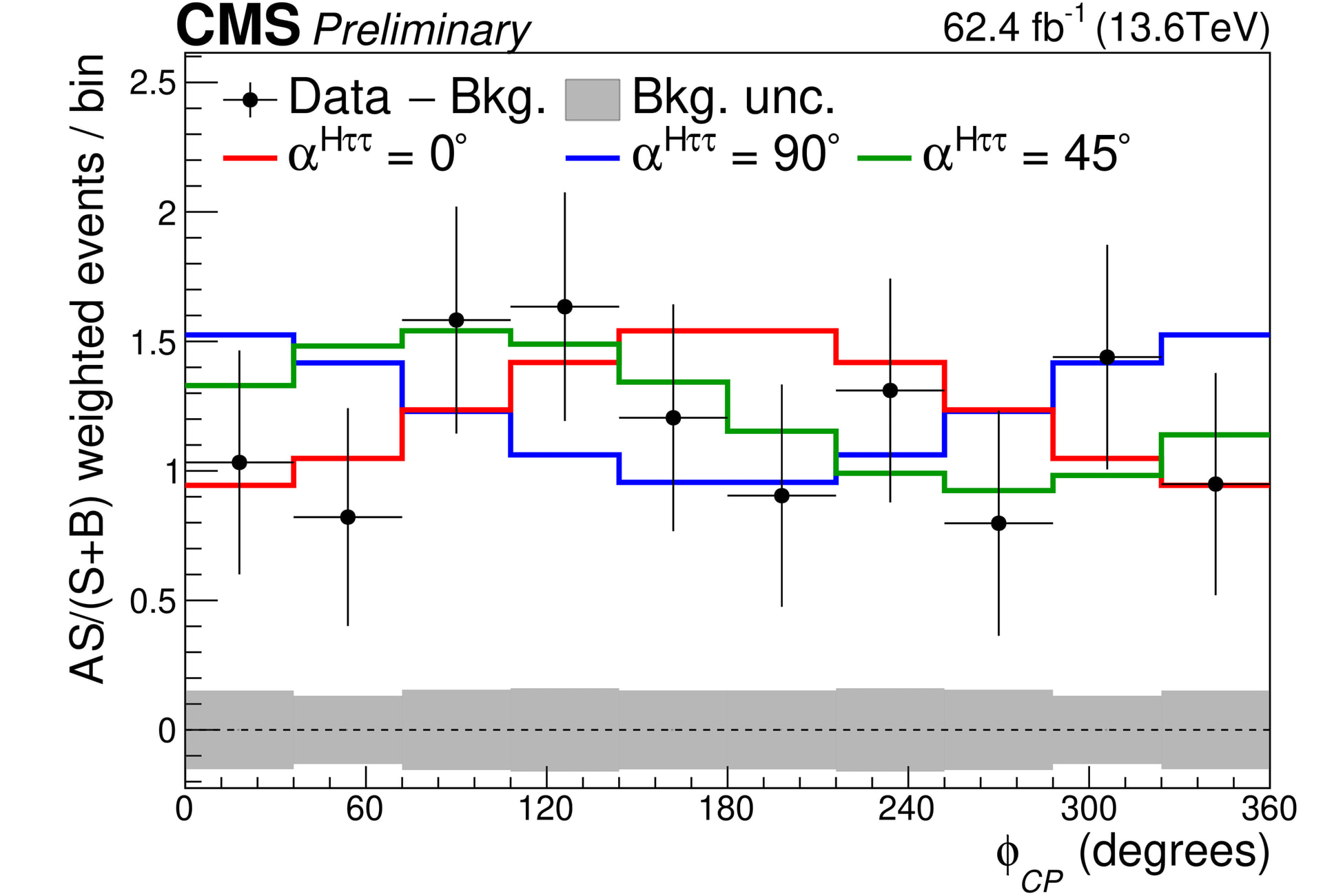
Figure 2: The ϕCP distribution with the measurement indicated as black dots. The red and blue lines correspond to the expected distribution in the absence of CP-violation. The green line indicates the expectation from decays which violate CP-symmetry.
“What makes this result exciting is that CP violation in the Higgs sector remains possible. Even more interestingly, the data show a slight favour for the CP-violating scenario — in other words, the Higgs boson may be looking a little CP-odd.” remarks Dr Océane Poncet, who was awarded her PhD from the University of Strasbourg for her work on this measurement. However, the measured αHττ is (36+33-30)°, which is still consistent with 0° within uncertainties, meaning we cannot yet claim evidence for CP-violation. Furthermore, when the new data and Run-2 data are combined (see Fig. 3), the results move even closer to 0°.
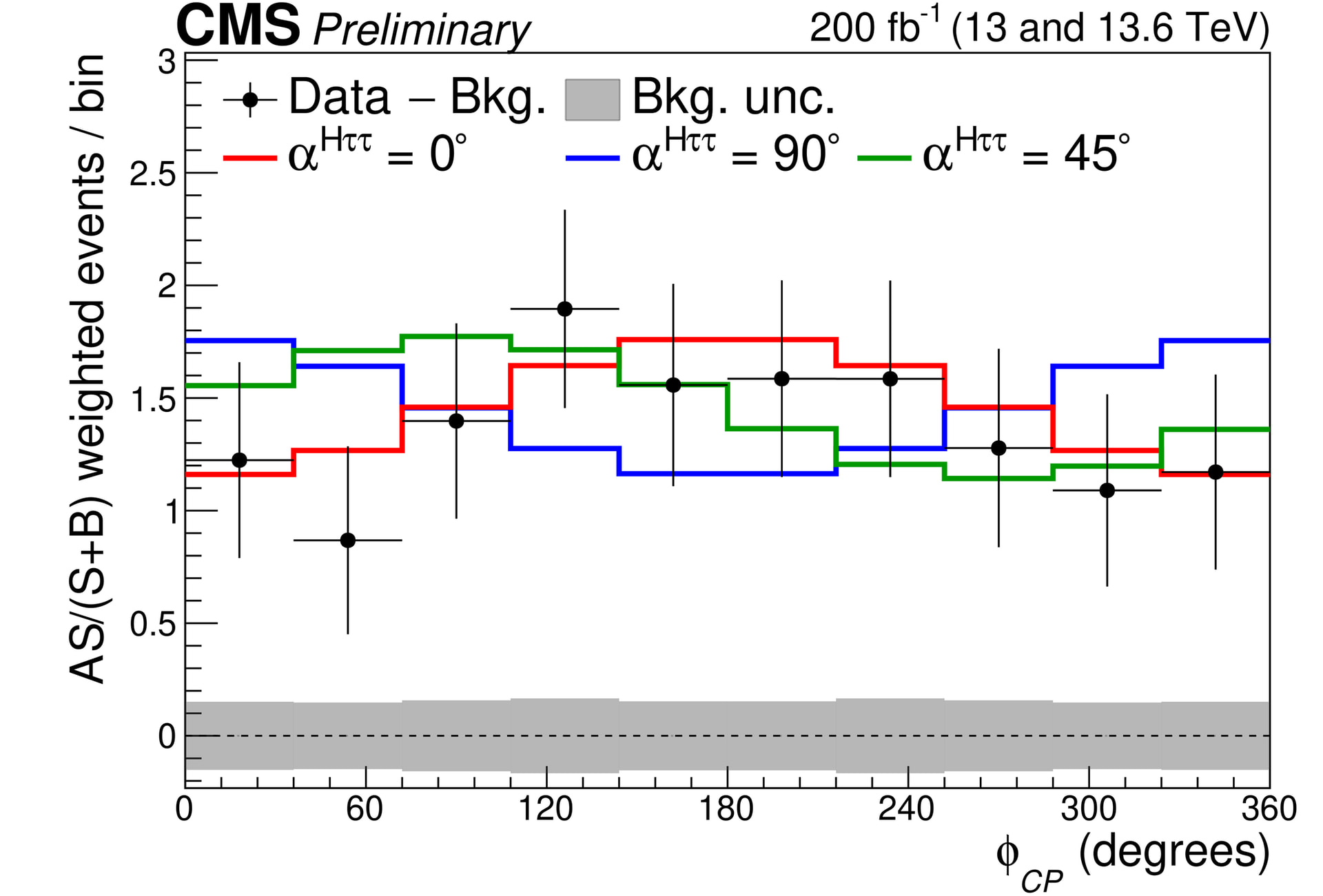
Figure 3: The ϕCP distribution for Run-2+2022+2023 data.
To reach a more decisive result, we plan to repeat the measurement with more data. Fortunately, CMS has been busy recording data recently so you can expect an improved measurement soon!
Written by: Daniel Winterbottom, for the CMS Collaboration
Edited by: Andrés G. Delannoy
Read more about these results:
-
CMS Physics Analysis Summary (HIG-25-012): "Analysis of the CP structure of the Yukawa coupling between the Higgs boson and tau leptons in proton-proton collisions at √s = 13.6 TeV"
-
@CMSExperiment on social media: Bluesky - Facebook - Twitter - Instagram - LinkedIn - TikTok - YouTube