
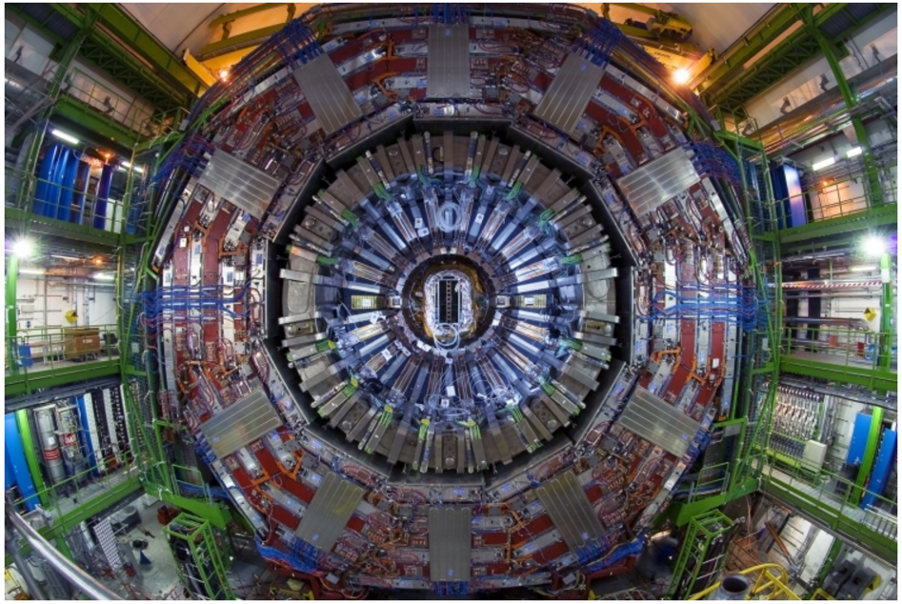
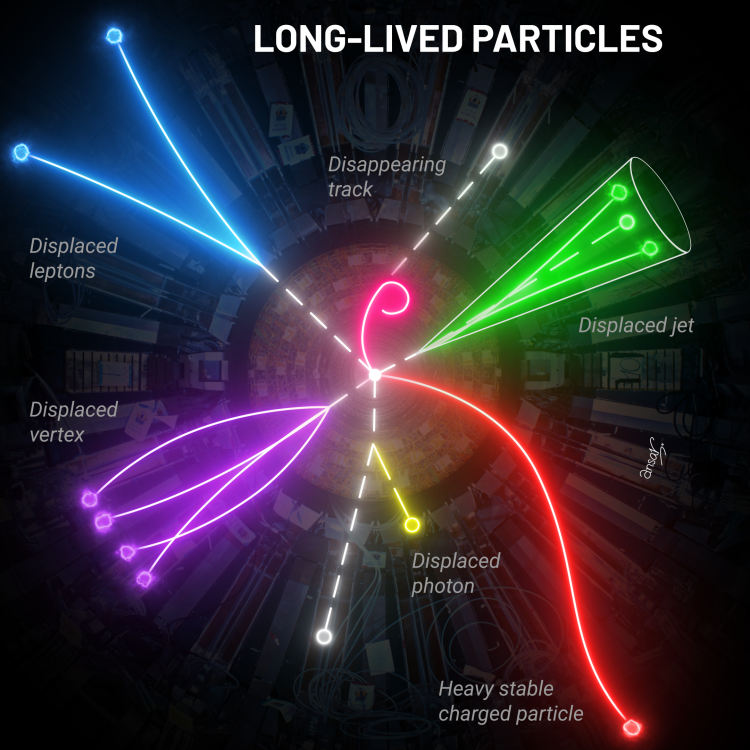
In Run 3, CMS expanded its trigger program to enhance capturing long-lived particles that decay far away from the point of collision – broadening the search for physics beyond the Standard Model.
Imagine a high-security vault. Most intruders trip the alarm the moment they break in. But what if an intruder slips inside without triggering the alarm at the entrance? A truly secure system should rely on additional alarms deeper inside – ready to detect suspicious activity wherever it occurs.
This challenge is well known to the CMS Collaboration. In proton-proton collisions, most particles appear and decay almost instantly, leaving tracks that point back to the collision point. The Standard Model – our best theory of fundamental particles and forces – predicts this behavior with remarkable precision.
However, many extensions of the Standard Model predict long-lived particles: new particles that travel measurable distances – between millimeters and meters – before decaying. Their decay products leave tracks that emerge away from the detector’s center, forming a secondary, or displaced, vertex. The figure below illustrates what such an event looks like in the CMS detector.
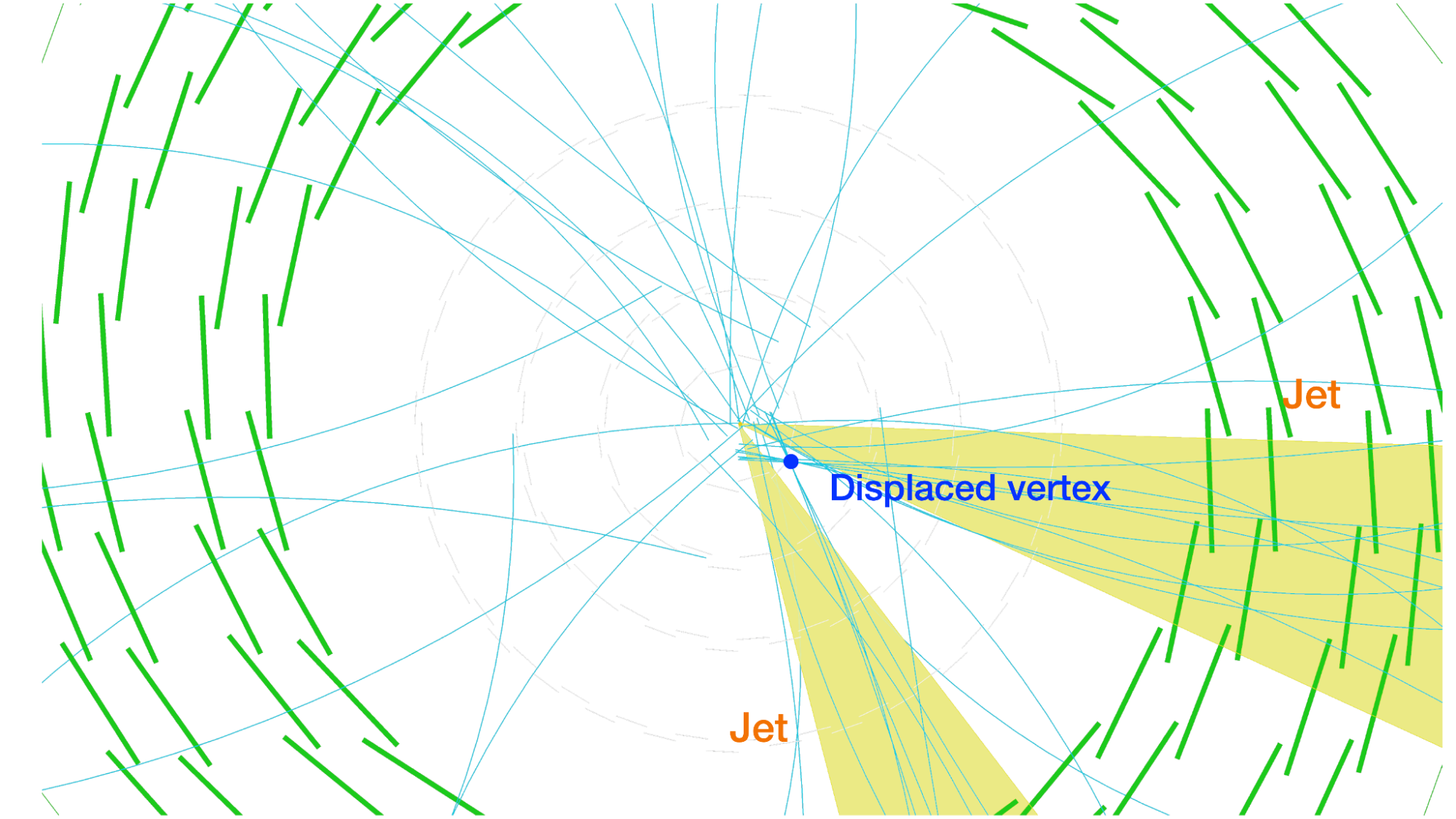
Above: A displaced decay inside the CMS detector.
At the LHC, billions of collisions occur every second, and CMS cannot record them all. Instead, it relies on a fast decision-making system called a trigger – an electronic alarm that rapidly selects the most interesting events to keep and discards the rest. Traditional triggers are optimized to recognize particles that decay immediately at the collision point, and displaced decays can be missed without dedicated strategies.
During Run 3, the CMS Collaboration significantly expanded its trigger program for long-lived particles, improving both the hardware and software of the trigger system. Although these upgrades have not yet revealed a new particle, they greatly enhance CMS’s ability to capture such unusual events, if they occur. With improved real-time tracking, new artificial-intelligence (AI) trigger algorithms running on graphics processing units (GPUs), and specialized triggers designed to recognize displaced decays, the CMS detector can now better identify signatures that appear far from the original collision point.
“Long-lived particles force us to rethink how we trigger,” says Dr. Sai Neha Santpur, a member of the CMS trigger team. Another team member, Dr. Kiley Kennedy, adds, “If we only look where particles usually appear, we might miss entirely new phenomena.”
CMS strengthened its long-lived particle program using complementary triggers that are sensitive to decays at different distances from the collision point. Improved real-time tracking identifies displaced particle sprays close to the interaction region. Precision timing and calorimeter-based triggers capture unusual energy deposits at intermediate distances. Dedicated triggers in the outer muon chambers detect activity even farther from the detector’s center. Together, these tools form a coordinated strategy that monitors far beyond the detector’s center.
This is illustrated in the figure below, which shows the fraction of long-lived particle events recorded as a function of decay distance. No single trigger is effective everywhere. Some dominate near the center; others take over at intermediate or large distances. Together, these triggers provide broad coverage across much of the detector volume. Without them, large gaps would remain, reducing the ability of the CMS detector to detect long-lived particles.
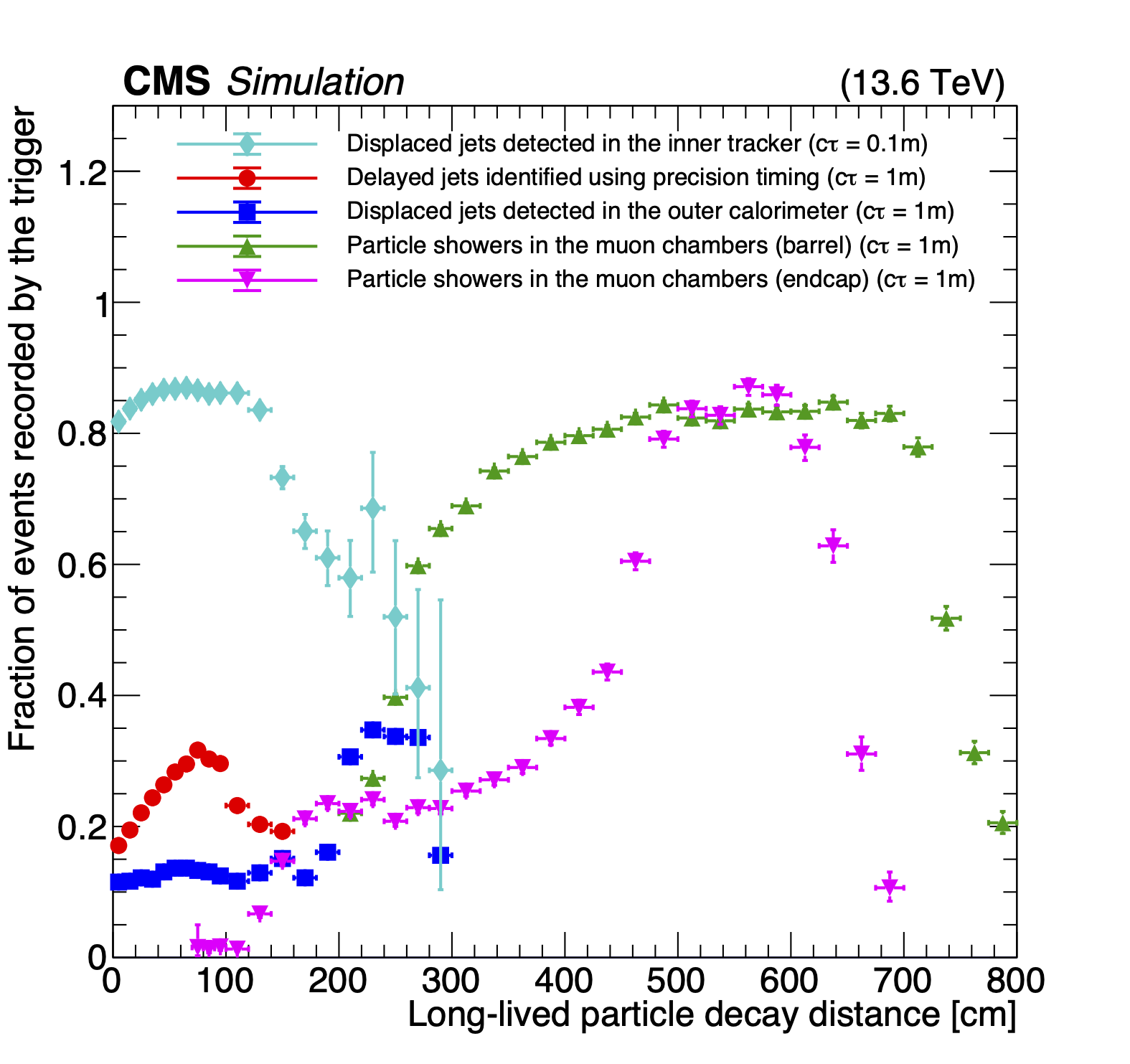
Above: Fraction of long-lived particle events recorded by different CMS trigger strategies as a function of the particle’s decay distance from the collision point. Each curve corresponds to a different trigger type and is shown for a representative particle lifetime (denoted cτ), which sets how far the particle typically travels before decaying.
As the LHC continues to deliver more data, these expanded trigger strategies ensure that unusual, displaced signals, which could help explain open questions, including the nature of dark matter, will not be overlooked. By extending its search beyond the collision point, CMS is better equipped to explore this challenging frontier—and to detect the first signs if new physics appears as long-lived particles.
Written by: Juliette Alimena, for the CMS Collaboration
Edited by: Muhammad Ansar Iqbal
Read more about these results:
-
CMS Publication (EXO-23-016): "Strategy and performance of the CMS long-lived particle trigger program in proton-proton collisions at √s = 13.6 TeV"
-
@CMSExperiment on social media: Bluesky - Facebook - Instagram - LinkedIn - TikTok - Twitter/X - YouTube