
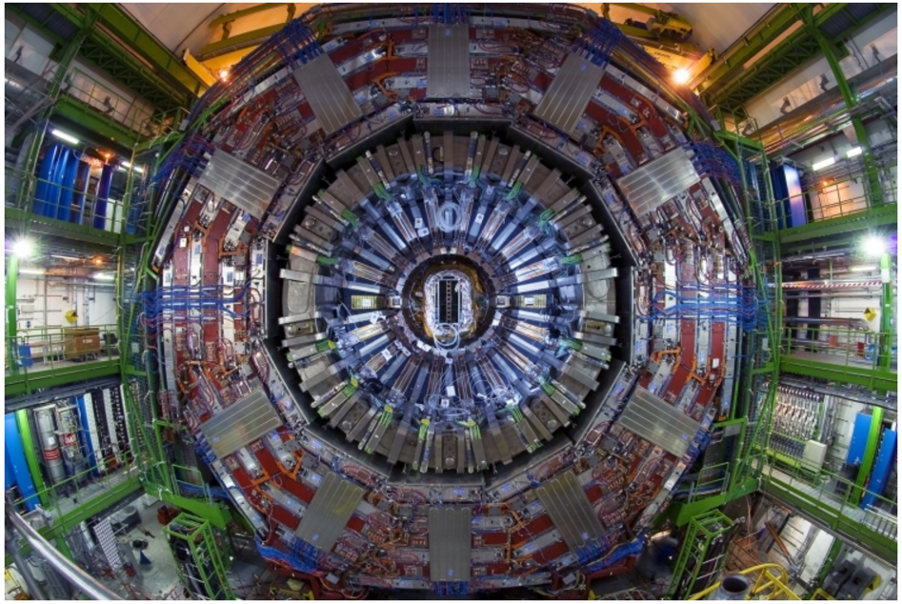
For the first time, the CMS experiment probes quantum entanglement in Higgs boson decays to a pair of Z bosons. The result is the most general analysis of kinematic distributions in the four-lepton final state, measuring spin correlations and providing a complete “Effective Field Theory” parameterization.
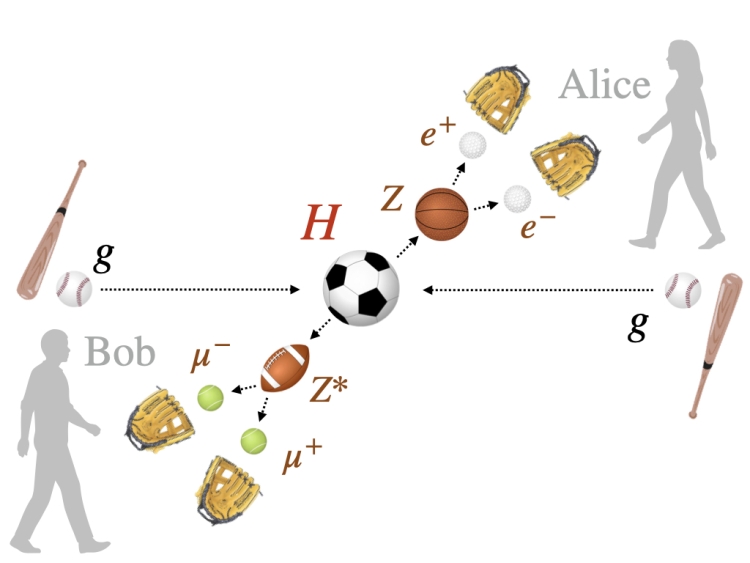
Imagine two friends, Alice and Bob, each measuring the spin of a ball thrown into the air. In everyday life, the way each ball is thrown already determines its spin. But in certain decays of the Higgs boson into a pair of Z bosons, the situation is very different. Each Z boson can occupy one of three possible spin states, what physicists call a qutrit. When considered individually, the spin measured for each boson appears random. However, once the spin of one Z boson is measured, the spin of the other becomes immediately determined!
To test whether these correlations could be explained by “local hidden variables,” or whether they require genuine quantum entanglement, physicists can apply a method called a generalized Bell test. Carrying out this test directly would require measuring the spin polarization of the Z bosons themselves. “We cannot measure the spin polarization of the Z bosons directly,” explains Zhiyuan Huang, a graduate student at Johns Hopkins University and a data analyst with the CMS experiment. “But by studying the angles at which the leptons from the Z boson decay emerge, we can reconstruct their average spin polarization states, or the polarization density matrix.”
Using this technique, researchers found that the two Z bosons populate all three polarization combinations (++ , −− , and 00). They also observe no evidence of CP violation in these polarization states. Even though a true Bell test cannot be performed, these results offer the first clear evidence that the Z-boson pair produced in Higgs boson decays forms an entangled quantum system.
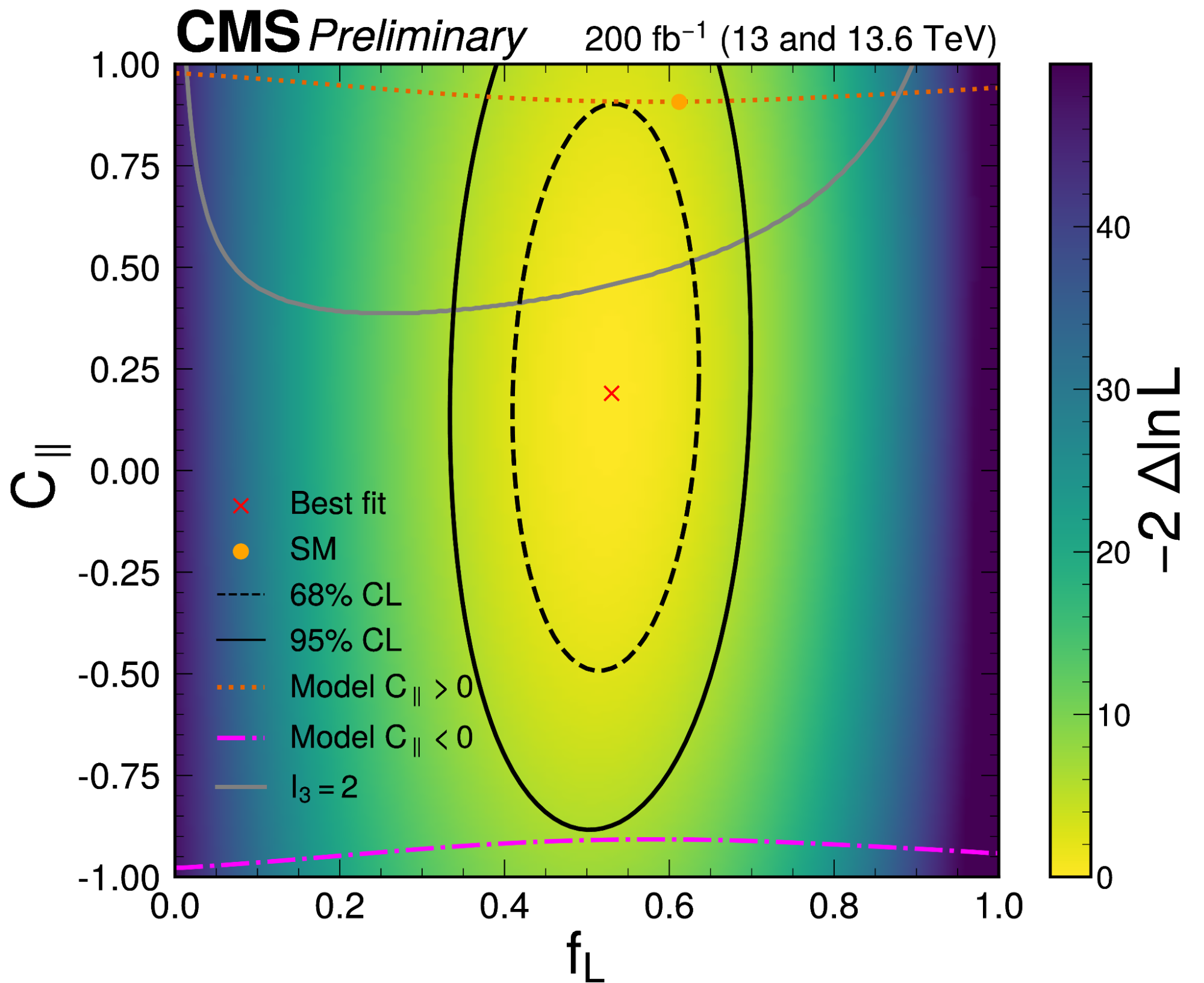
Above: The figure shows confidence regions for two parameters that describe how the Z bosons are polarized in Higgs boson decays. The yellow dot marks the Standard Model prediction. The grey curve is a threshold: points above it satisfy the condition needed to challenge simple "hidden variable" explanations, while points below do not. The measured polarization fraction fL shows that all three polarization states contribute, confirming that those Z-boson states are entangled.
Now imagine again two balls flying apart, but this time each ball shatters into two smaller pieces while in flight, and Alice and Bob observe the fragments. In everyday situations, it is easy to determine which fragments came from which ball. The Higgs boson can decay in a similar way: it produces two Z bosons, and each Z boson subsequently decays into a pair of leptons. If one Z boson produces an electron–positron pair and the other produces a muon–antimuon pair, the origin of each pair is clear.
However, when the Higgs boson decays into two identical lepton pairs, either two electron-positron pairs or two muon-antimuon pairs, the situation becomes ambiguous. Although the detected particles can be labeled (1, 2, 3, 4), two pairings are possible: (1,2) with (3,4), or (1,4) with (3,2). The detectors cannot determine which pairing corresponds to the original Z bosons. “This permutation of identical leptons is another manifestation of entanglement,” explains Nicholas Pinto, another graduate student at Johns Hopkins University. “The two Z bosons’ states are linked, meaning one cannot be described independently of the other.”
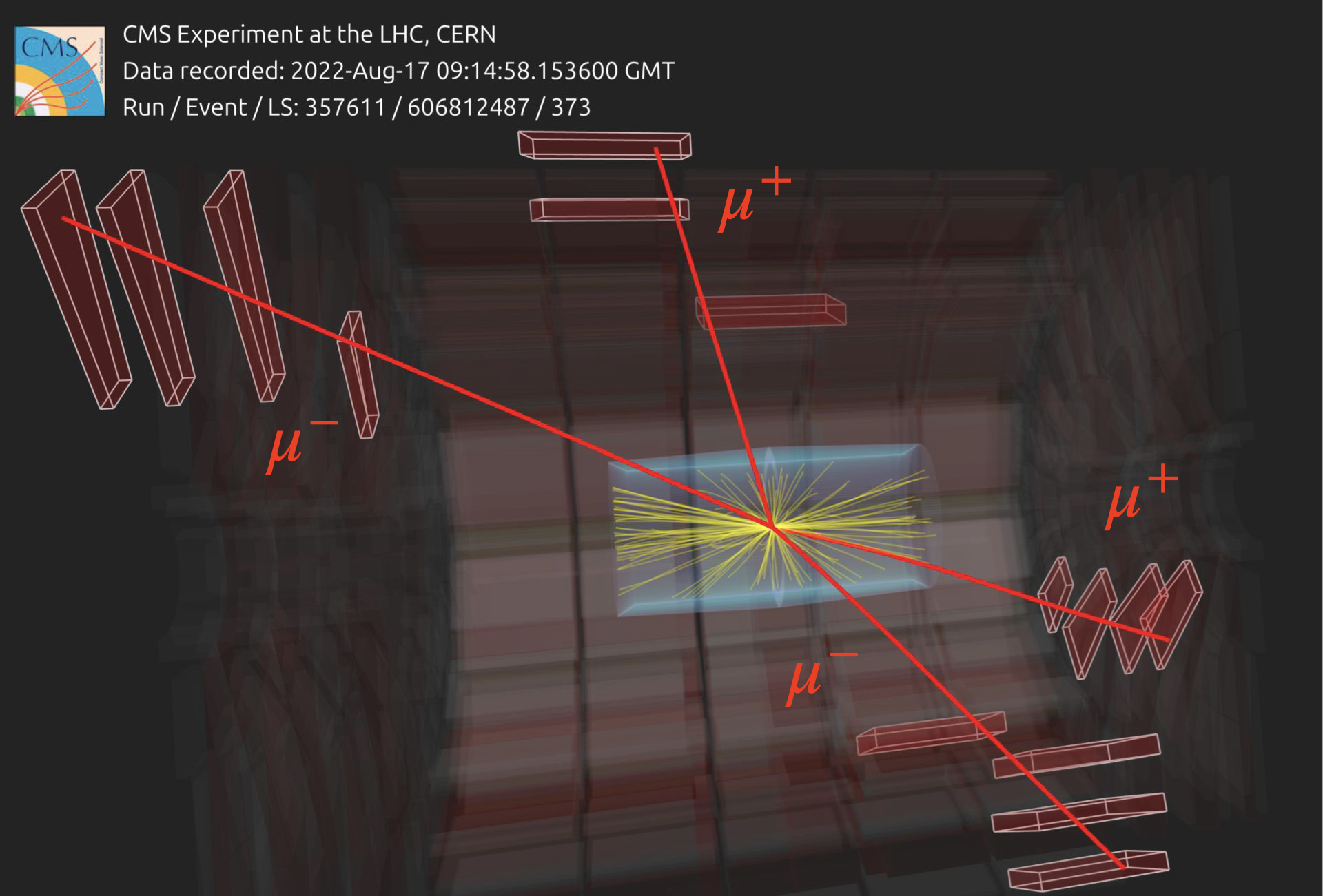
Above: The figure shows an event display in the CMS detector with two identical muons and two identical antimuons reconstructed as a candidate Higgs boson decay.
We study the spin correlations in the Higgs boson decays to four leptons as a precise test of the Standard Model. Even a small deviation from the model's prediction could signal new, exciting physics. Effective Field Theory provides a framework to link these measurements to heavy particles or forces that may lie beyond the reach of current colliders. Although those states may be too massive to produce directly, their virtual effects can subtly alter the Higgs boson's interactions. These measurements capture all the effects discussed above. To make this possible, the team developed advanced analytical and computational tools that extract the maximum amount of information from each event.
“The Higgs boson is our microscope into the unknown: tiny deviations in its behavior could reveal whole new layers of physics,” says Jeffrey Davis, a postdoctoral fellow at Hopkins. “If there is any hope of discovering new physics, I expect the Higgs sector will be the first place we will see it.” For the first time, a simultaneous and direct measurement of eight Higgs boson couplings to electroweak vector bosons has been carried out within the framework of Effective Field Theory in this golden channel.
Written by: Andrei Gritsan, for the CMS Collaboration
Edited by: Muhammad Ansar Iqbal
Read more about these results:
-
CMS Physics Analysis Summary (HIG-25-011): "Study of spin correlations in Higgs boson decays to four leptons at CMS"
-
@CMSExperiment on social media: Bluesky - Facebook - Instagram - LinkedIn - TikTok - Twitter/X - YouTube