
For the first time, the CMS experiment has observed the rare electroweak production of two Z bosons in association with two jets. This achievement completes the observation of all electroweak productions of vector boson pairs (WW, WZ, and ZZ), fulfilling a powerful test of the Standard Model.
Why this matters?
The Standard Model describes how fundamental particles interact through forces. One of its most subtle predictions is how the force carriers themselves, the W and Z bosons, interact with each other. These self-interactions are directly linked to the mechanism of electroweak symmetry breaking, the phenomenon responsible for the Higgs boson.
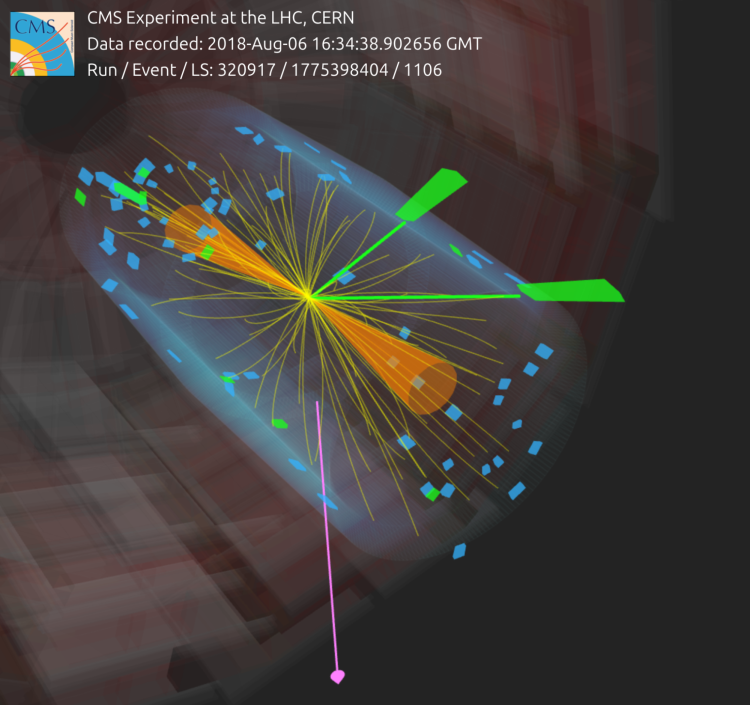
Vector boson scattering provides a unique window into this mechanism. In these events, two incoming quarks each emit a force-carrying boson, which then scatter off one another to produce a pair of Z bosons. The quarks themselves continue in the forward direction, leaving two energetic jets separated by a large gap in the detector – a distinctive experimental signature.
The production of two Z bosons via this purely electroweak interaction is extremely rare. Observing it required not only the full Run-2 dataset (138 fb⁻¹ of proton-proton collisions at 13 TeV) but also advanced analysis techniques capable of isolating the tiny signal from much larger background processes.
How CMS found it?
We selected events where one Z boson decays into a pair of oppositely charged same-flavor leptons (electrons or muons), another decays into neutrinos, which escape detection and appear as missing momentum; and two energetic jets, widely separated in pseudorapidity. A schematic (Feynman) diagram demonstrating this is shown below.
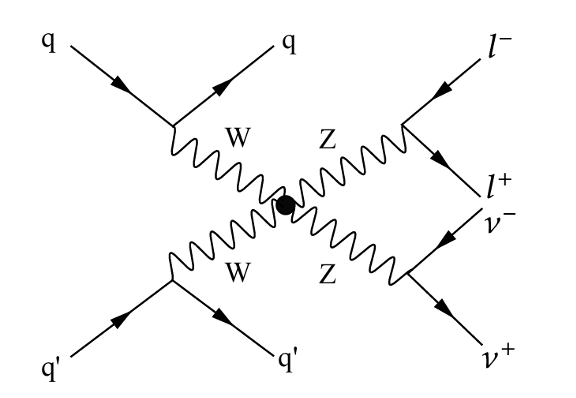
Above: Diagram showing vector boson scattering in this search.
Even after these selections, background processes mimic the same final state. To enhance the separation, our team used a Graph Neural Network (GNN), a machine-learning technique that represents particles in each event as interconnected objects. The GNN learns subtle correlations among jets, leptons, and missing momentum that help distinguish the signal from background.
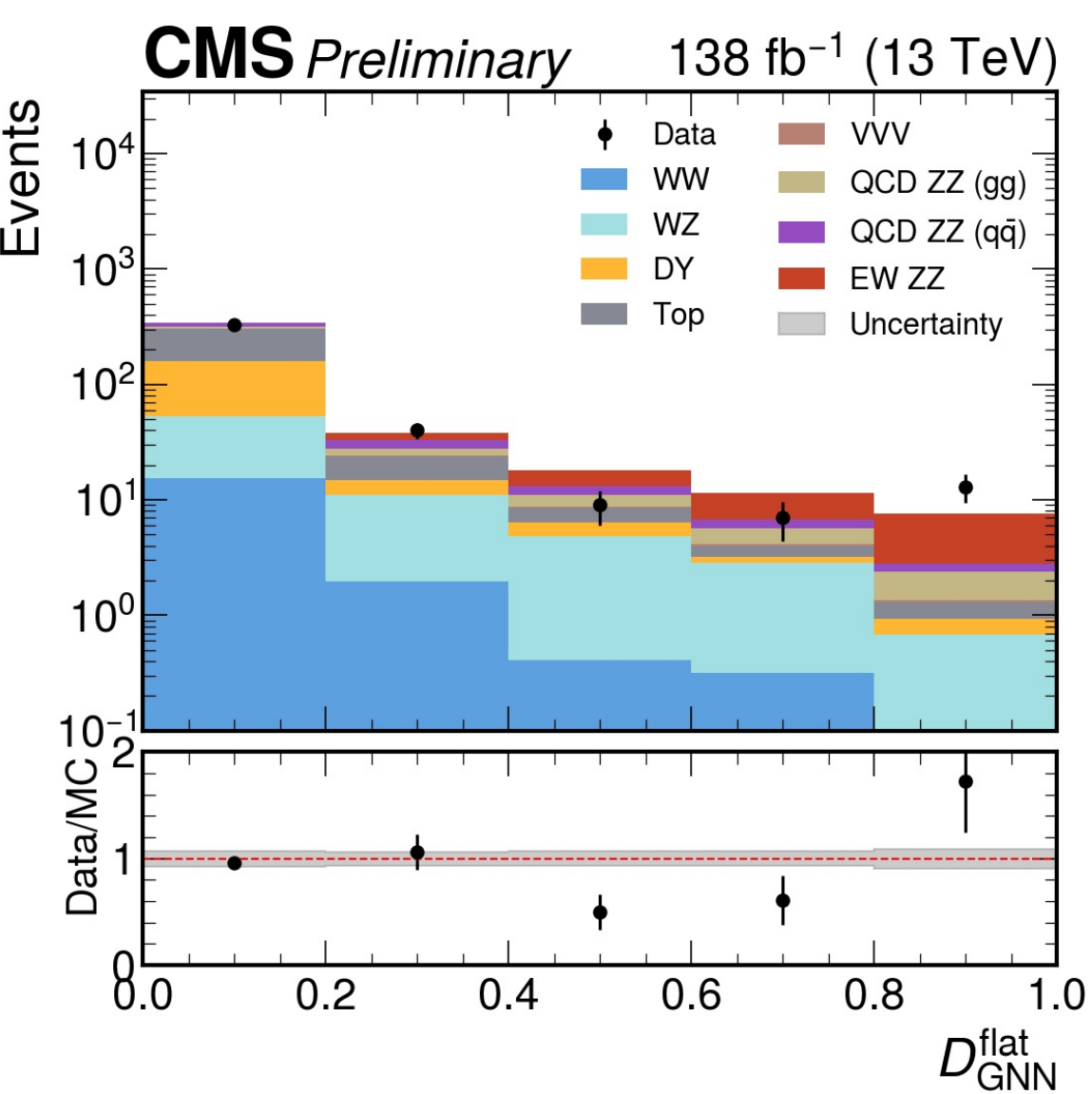
Above: Distribution of GNN event scores between 0 and 1. Events with scores close to 1 are more “signal-like”. As shown in the figure, the electroweak ZZ contribution becomes more prominent in the high GNN region.
A statistical fit to the GNN output reveals evidence for the electroweak ZZ signal with a significance of 3.1 standard deviations in this channel alone. When combined with the previously measured four-lepton channel, the overall significance reaches 5.0 standard deviations, the threshold required to claim observation.
Searching for new physics
Because vector boson scattering directly probes interactions among force carriers, it is also highly sensitive to possible new physics. The analysis tests for signs of “anomalous quartic gauge couplings,” which would signal interactions beyond the Standard Model.
Physicists focus on events with very high transverse mass, where possible signs of new physics would be most pronounced. “Our searches at the LHC have not yet produced direct evidence of physics beyond the Standard Model,” says Northeastern University postdoctoral researcher Nick Manganelli. “So we must be more creative in how we look for it. By using Effective Field Theory, we can systematically search for indirect hints.”
A major milestone
“With this analysis we achieved the first evidence for VBS ZZ production in the 2ℓ2ν channel,” says lead analyst Hong Gao, a PhD student at Beihang University. “A key ingredient was a fully data-driven estimation of the Drell Yan background, allowing a precise determination of the high-MET tail where the signal is most sensitive. This approach could serve as a reference method for future analyses with similar signatures. Hong carried out the analysis together with fellow Beihang University PhD student Longsheng Tan and collaborators from Northeastern University, including former PhD students Yixiao Han and Bingran Wang, as well as postdoctoral researchers Yacine Haddad and Nick Manganelli, and former PhD student Vitor dos Santos Sousa from the Universidade do Estado do Rio de Janeiro.
As data from Run 3 and future upgrades become available, even more precise tests will be possible, potentially revealing subtle cracks in the Standard Model or guiding us toward new physics.
Written by: Longsheng Tan, for the CMS Collaboration
Edited by: Muhammad Ansar Iqbal
Read more about these results:
-
CMS Physics Analysis Summary (SMP-23-001): "Observation of electroweak production of pairs of Z bosons in proton-proton collisions at 13 TeV with the CMS detector"
-
@CMSExperiment on social media: Bluesky - Facebook - Instagram - LinkedIn - TikTok - Twitter/X - YouTube