
The CMS experiment provides the first confirmation of the excess observed in top quark-antiquark production that is consistent with the short-lived bound state – toponium – decaying to a lepton + jets final state.
Most matter around us is made of atoms, where negatively charged electrons are bound to positively charged protons by the electromagnetic force. A similar idea appears in particle physics. Quarks – the fundamental constituents of protons and many other particles – can bind with their antimatter counterparts, antiquarks. In this case, the binding force is not electromagnetic but the strong nuclear force, which dominates at the typical distance scale of a pair of quarks. As a result, quarks are usually found in such bound states known as hadrons.
There is however a notable exception: the top quark, the heaviest known elementary particle. Because of its extremely large mass, the top quark quickly decays. Even if a top antiquark is produced nearby, the pair typically does not have enough time to form a bound state before both particles decay into lighter ones. With its extremely short lifetime, the top quark – first discovered more than 30 years ago at the Tevatron accelerator near Chicago – provides a unique probe for studying the behavior of elementary particles. More recently, experiments at the LHC even demonstrated quantum entanglement between the top quark and antiquark.
However, quantum mechanics tells us that processes that are not forbidden will occur if enough opportunities are available. The LHC has produced hundreds of millions of top quark-antiquark pairs, effectively turning it into a “top-quark factory.” With such a large dataset, we can search for extremely rare phenomena.
By carefully analyzing the large CMS dataset, we have observed an excess rate of top quark pairs produced at the threshold, i.e. where the relative velocities of the two top quarks are very small. This excess rate is consistent with predictions for a bound top quark-antiquark state, referred to as toponium. This theoretically proposed short-lived state, known as toponium, had proven difficult to observe experimentally.
The first hints of toponium appeared in searches for heavy Higgs-boson-like particles that could decay into a top quark-antiquark pair. An unexpected excess of events was observed at a mass close to twice the mass of the top quark, which is more characteristic of a bound state rather than a new fundamental particle. Detailed studies by the CMS and ATLAS experiments confirmed this excess using events in which both top quarks decay into leptons (electrons or muons).
In a new study, the CMS Collaboration searched for the same phenomenon in a different type of events containing only one lepton. “Isolating the signal in this channel was challenging,” said Otto Hindrichs, a researcher at the University of Rochester who developed a new AI-assisted event reconstruction technique.
Yu-Heng Yu, a graduate student involved in the analysis, explained the key innovation: “Instead of reconstructing the mass of the top quark-antiquark pair directly, we focused on the relative velocity of the top quark and antiquark. If they form a bound state, their relative velocity should be much smaller than when they are produced independently.”
These new techniques proved highly effective. The observed excess has a statistical significance of greater than five standard deviations – the gold standard for a discovery in high-energy physics. This result provides an important statistically independent confirmation of toponium production.
Regina Demina, leader of the University of Rochester group, noted the broader significance: “Toponium is heavier than the heaviest known atomic nucleus, Oganesson, making it the most massive (quasi-) bound state ever observed. Its discovery deepens our understanding of the strong nuclear force and its ability to bind the fundamental constituents of matter.”
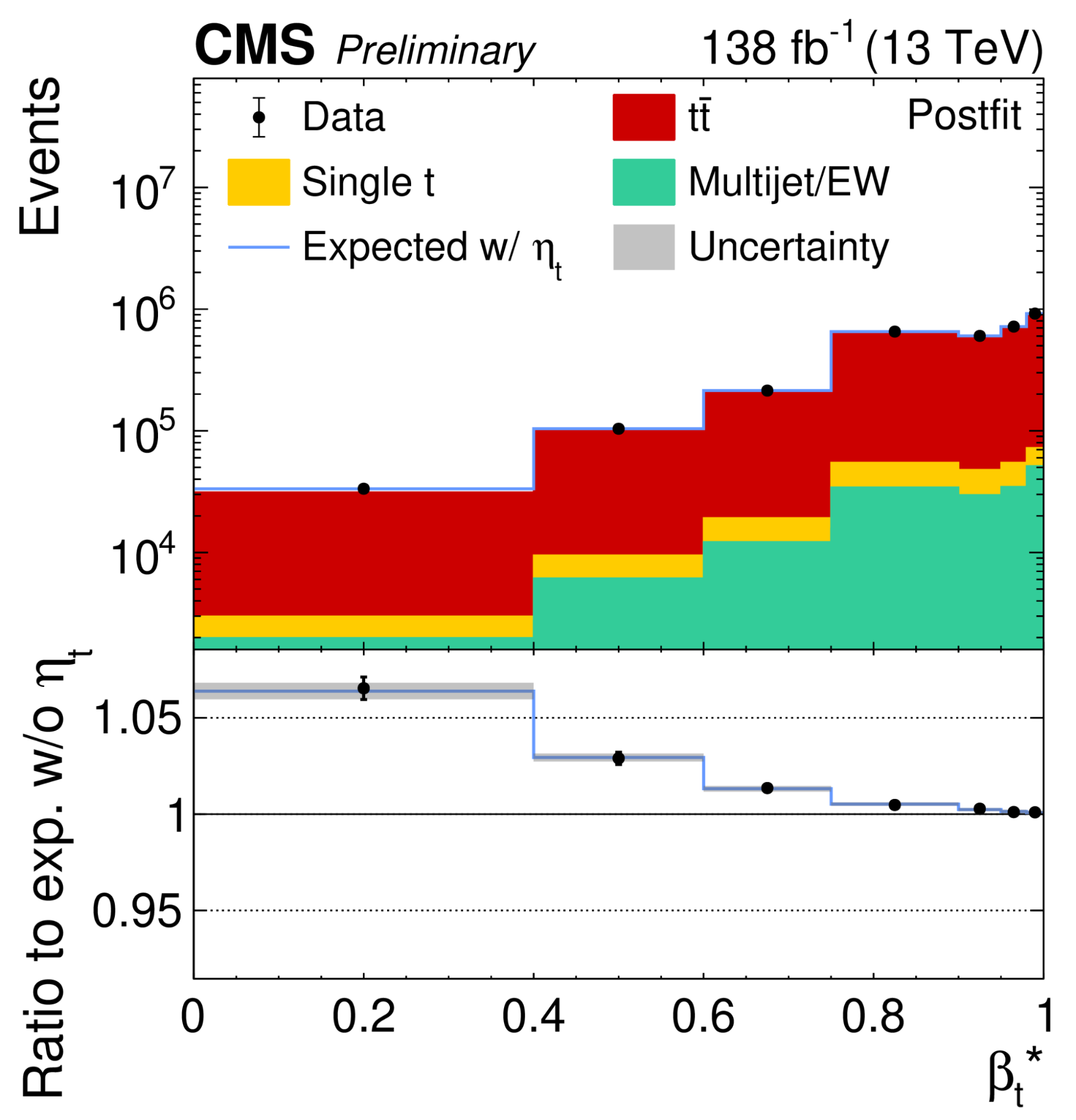
Above: Distribution of the relative velocity of the top quark and antiquark. The upper panel shows the data (points) compared to the predictions without toponium (stacked histograms) and those including it (blue line). The lower panel shows the ratio to the predictions without the toponium.
Written by: Regina Demina, for the CMS Collaboration
Edited by: Muhammad Ansar Iqbal
Read more about these results:
-
CMS Physics Analysis Summary (TOP-25-002): "Observation of a pseudoscalar excess at the top quark pair production threshold in the single lepton channel"
-
@CMSExperiment on social media: Bluesky - Facebook - Instagram - LinkedIn - TikTok - Twitter/X - YouTube