
The CMS experiment reports a new measurement of the Higgs boson mass in the decay into two photons, improving the precision of this result over earlier measurements by refining detector calibration and new analysis techniques.
The mass of the Higgs boson is a key parameter in the Standard Model. Although its value is not predicted by theory, it plays a crucial role in theoretical calculations. A precise determination of the Higgs boson mass is essential not only for predicting many of the particle’s other properties, but also for testing the internal consistency of the model as a whole.
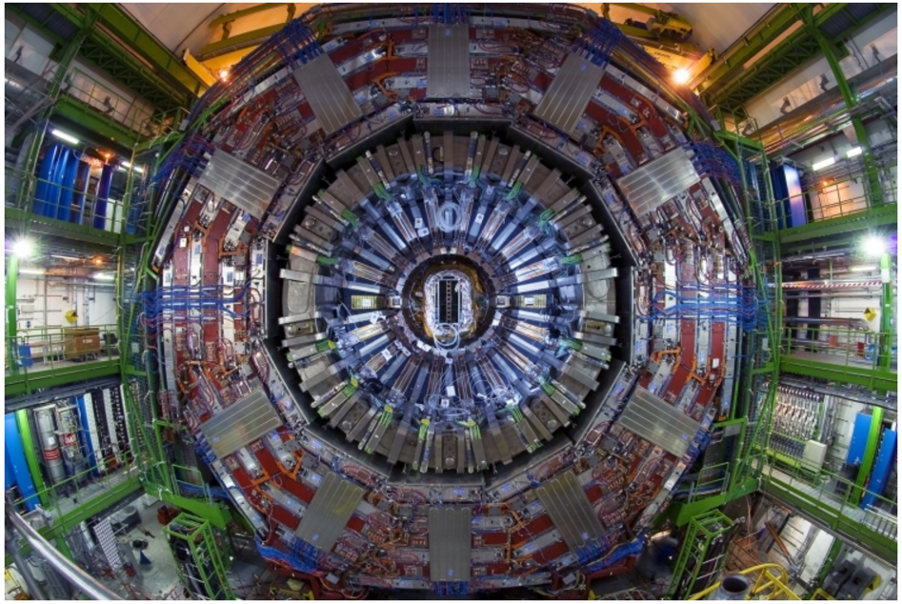
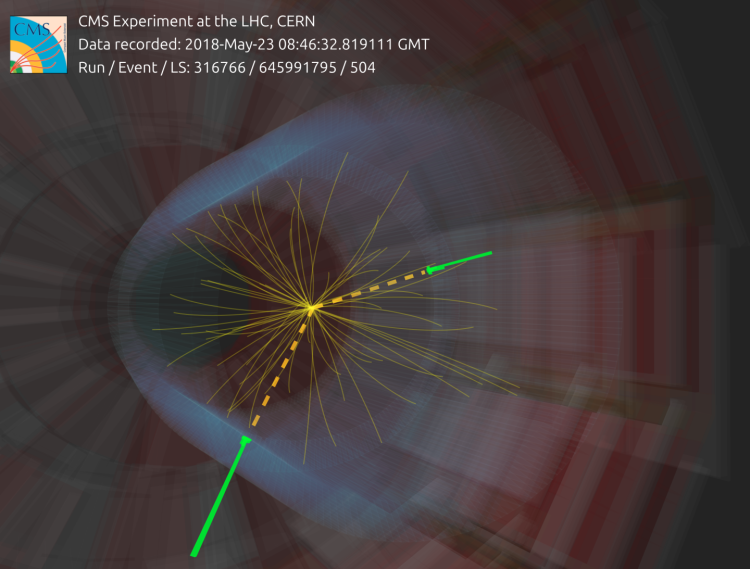
CMS physicists have recently announced a precise measurement of the Higgs boson mass using the decay channel in which the particle transforms into two photons. The result is based on data collected between 2016 and 2018 at the Large Hadron Collider. This decay mode provides an exceptionally clean experimental signature, as both photons are directly measured in the CMS electromagnetic calorimeter, as shown in the figure above.
“Among the many parameters of the Standard Model, the Higgs boson mass can be measured with high precision through the so-called golden channels, one of them being the diphoton decay channel. Thanks to the excellent photon calibration and identification efficiency of the CMS detector, the diphoton final state provides a particularly clean signature, with a narrow peak over a smooth background,” says Dr. Badder Marzocchi, a postdoctoral researcher from the University of Minnesota.
A key element of this measurement is the precise calibration of the approximately 72,000 lead tungstate crystals in the CMS detector used to reconstruct photons. For the first time, this analysis introduces new techniques that calibrate the photon energy directly from data. “Achieving an extremely precise calibration of the detector was the main challenge of this analysis. It required thinking outside the box to develop new methods to improve the photon energy measurement,” says Paul Gaigne, a PhD student at CEA Saclay. These advances made it possible to mitigate, among other effects, the gradual degradation of the detector response due to ageing.
Moreover, CMS physicists made extensive use of machine-learning techniques to discriminate the signal events, where a Higgs boson decays to a pair of photons, from background events mimicking the diphoton signature. “Machine learning has become integral to data analysis in high-energy physics. By significantly improving the ability to disentangle signal events from dominant background processes at the LHC, these methods directly enhance our analysis sensitivity.” says Dr. Zhenxuan Zhang, a former PhD student from the Institute of High Energy Physics (IHEP) of the Chinese Academy of Sciences (CAS).
These advances, combined together with several years of detailed detector studies, have significantly improved the sensitivity of the analysis and reduced the systematic uncertainties that previously limited the precision of the measurement, leading to a measured Higgs boson mass of 125.14 ± 0.15 GeV. This result can be combined with Run 1 (2010–2012) diphoton measurements from CMS and compared to the independent Higgs boson mass measurements in the four-lepton channel, as summarized in the figure below.
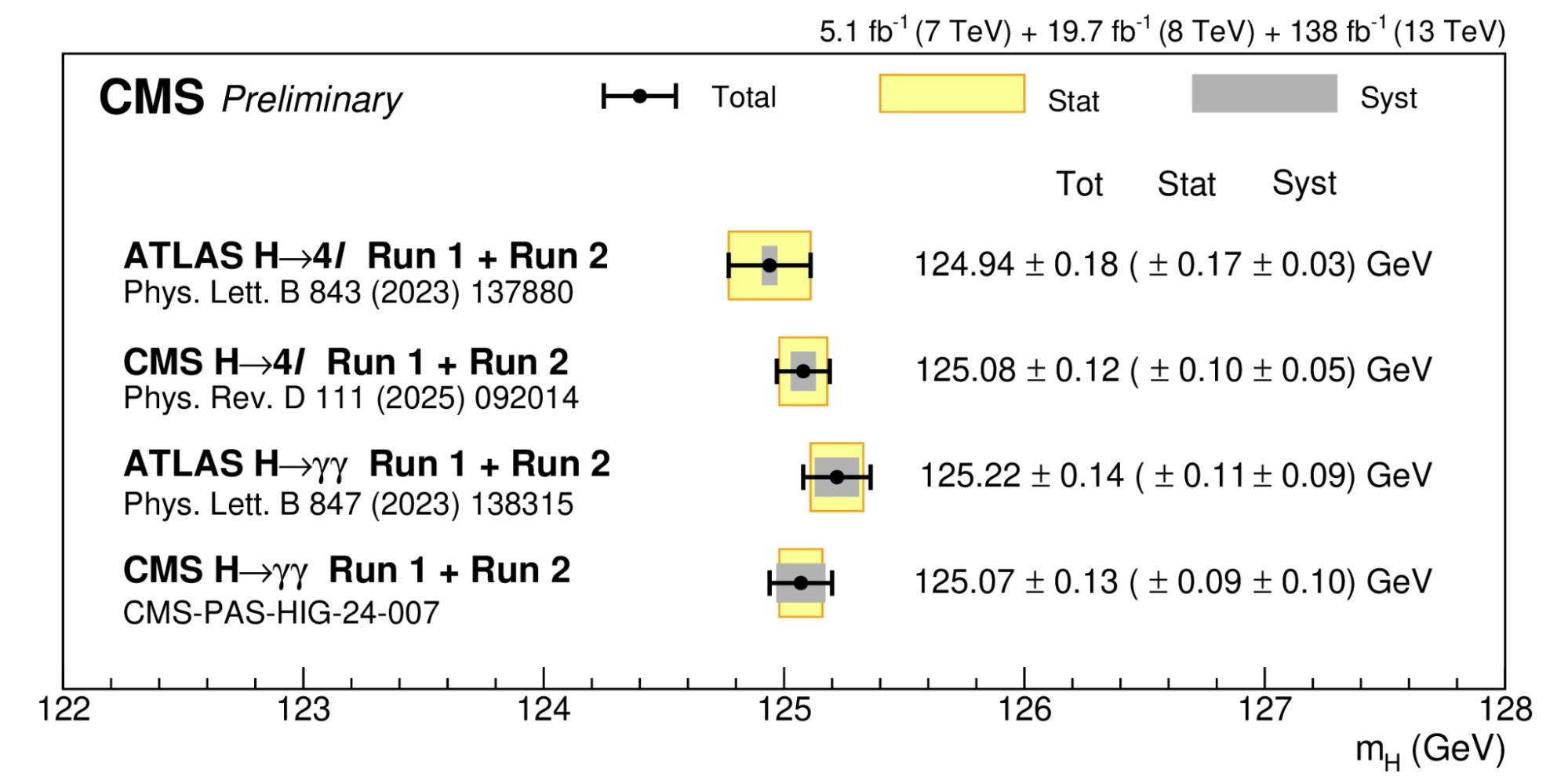
Above: Precision measurements of the Higgs boson mass by the ATLAS and CMS Collaborations.
“In the future these results – together with similar measurements in the diphoton and four-lepton channels by the ATLAS Collaboration – will be combined to yield the most precise determination of the Higgs boson mass to date, a benchmark that may stand for many years.” says Fabio Iemmi, a postdoctoral researcher from IHEP-CAS and leading the analysis. “In addition, reaching this level of precision required years of work to understand the CMS detector at an exceptional level of detail. This expertise will be invaluable for future analyses.”
Written by: Fabio Iemmi, for the CMS Collaboration
Edited by: Muhammad Ansar Iqbal
Read more about these results:
-
CMS Physics Analysis Summary (HIG-24-007): "A measurement of the Higgs boson mass in the diphoton decay channel with the CMS detector"
-
Display of collision events: CERN CDS
-
@CMSExperiment on social media: Bluesky - Facebook - Instagram - LinkedIn - TikTok - Twitter/X - YouTube