
Could there be more particles like the Higgs boson? For the first time, the CMS experiment has searched for the decay of the Higgs boson into two more Higgs-boson-like particles with unequal masses.
Some theories suggest that the Higgs boson might occasionally decay into particles that have never been seen before and have Higgs-boson-like properties. These new particles are unstable and quickly decay to known Standard Model particles in the CMS detector. While past CMS results have explored scenarios where the Higgs boson decays to such short-lived particles of identical masses, in this study we searched for a new possibility: what if the Higgs boson decays into two different new particles instead of two identical ones?
Calling the new particles ɸ1 and ϕ2 (ϕ2 is the heavier one), we consider cases where one of the ɸ decays to two bottom quarks, and the other decays to two 𝜏 leptons. This final state is favourable, since it has a relatively large probability of occurring and can be used to select interesting signal-like events from our datasets.
If the ϕ2 particle is at least twice as heavy as ϕ1, it could decay into an intermediate state with two ϕ1 before these decay into Standard Model particles. “We call this ‘cascade’ decay,” says Ashling Quinn, a PhD student working on the analysis, “since the extra step makes it resemble a waterfall.” So the decays can look like: H→ ɸ1ϕ2 → 2𝜏2b (non-cascade) or H→ ɸ1ϕ2 → 2𝜏4b (cascade). These are shown in the figure below.
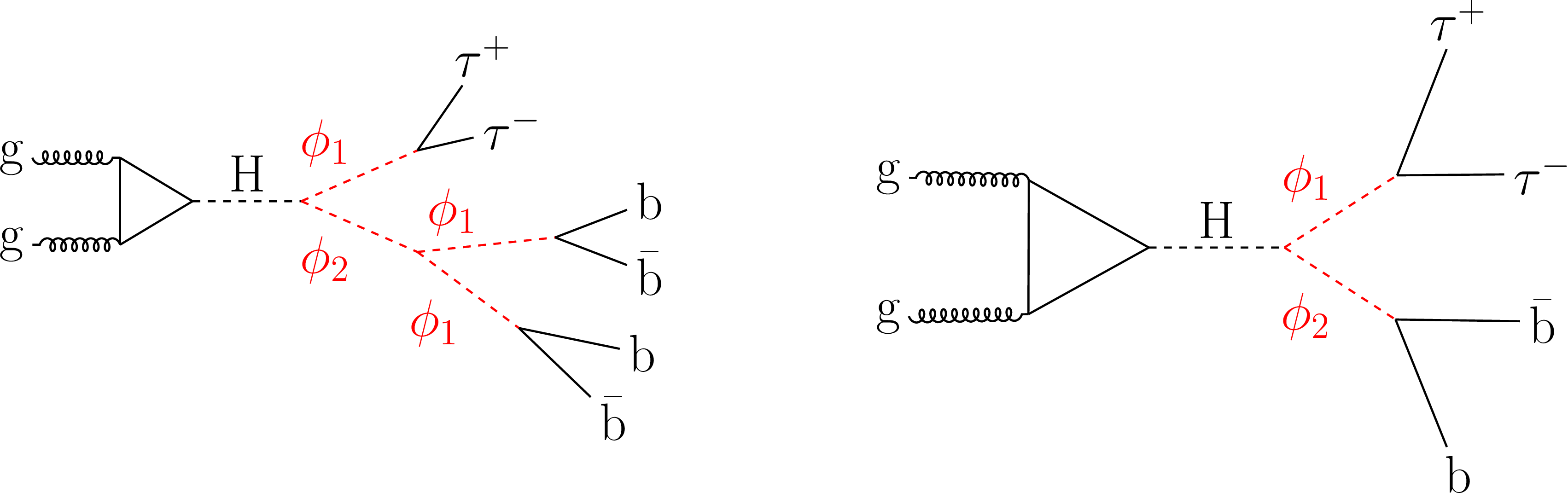
Above: Schematic (Feynman) diagrams depicting cascade (left) and non-cascade (right) decays of the Higgs boson into new Higgs-boson-like particles.
The strategy of this search is to reconstruct the decay of the ɸ1 boson into two 𝜏 leptons and to obtain the ɸ1 mass distribution. The presence of the ɸ1 signal is expected to appear as a peak on top of a flat background distribution.
To enhance the separation between signal and background events, we trained a machine learning model with several kinematic distributions as input. Another PhD student, Anagha Aravind, describes how this works: “Since the ɸ bosons have relatively low mass, their final state will be collimated in a narrow cone. The machine learning model exploits this feature, along with other subtle differences, to classify events as either signal or background.”
No significant excess of events was observed in the mass distribution. Upper limits were extracted on the rates – or “cross section” – of the considered processes for a range of ɸ1, ϕ2 boson masses. These results provide valuable constraints on theoretical models predicting such signatures and help guide future theoretical and experimental efforts.
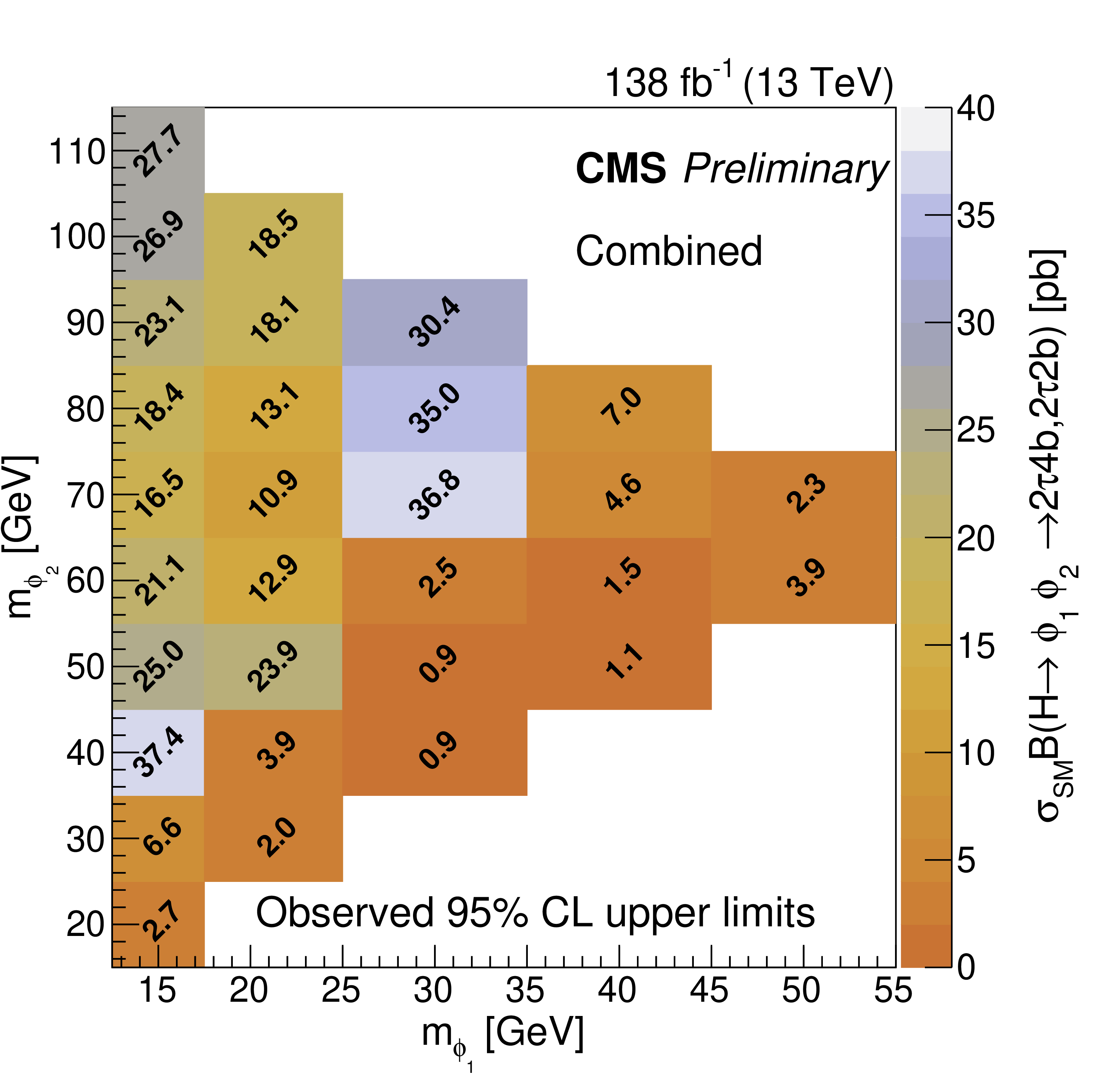
Above: Upper limits on the rates – or “cross section” – of the considered processes. Mass of the lighter new particle ɸ1 on the x-axis and the heavier ɸ2 on the y-axis.
This was the first search within the CMS Collaboration for Higgs boson decays into two Higgs-boson-like particles with unequal masses. The results pave the way for a promising future: the dominant source of uncertainty was statistical, which means more data from Run 3 and the High-Luminosity LHC will improve the sensitivity. If we think of ourselves as detectives hunting for new particles, more data means more clues to solve the mystery.
Written by: Ashling Quinn and Anagha Aravind, for the CMS Collaboration
Edited by: Muhammad Ansar Iqbal
Read more about these results:
-
CMS Physics Analysis Summary (NPS-25-003): "Search for Higgs boson decays into two neutral scalars with unequal masses in final states with b quarks and tau leptons"
-
Display of collision events: CERN CDS
-
@CMSExperiment on social media: Bluesky - Facebook - Instagram - LinkedIn - TikTok - Twitter/X - YouTube