
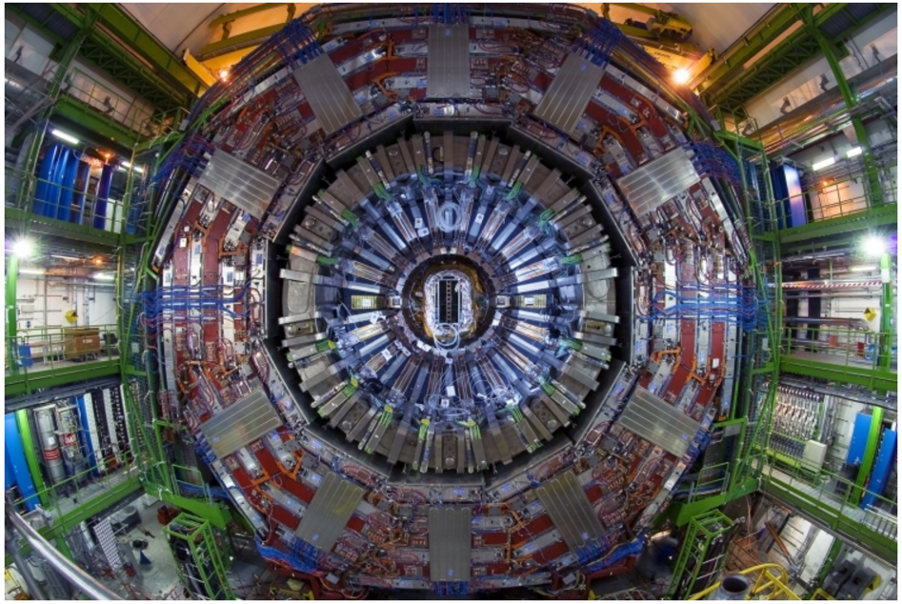
The CMS experiment presents a first study of the ϒ mesons (bound states of a bottom quark and antiquark) produced within jets. The results reveal significant discrepancies between the observed data and current theoretical predictions, offering important guidance for refining and improving these models.
One of the central challenges of high-energy physics is to understand how quarks and gluons form the wide variety of particles we observe. A particularly powerful probe of this process is provided by quarkonia, a class of composite particles containing one heavy quark and its antiquark bound together by the strong interaction.
The polarization puzzle
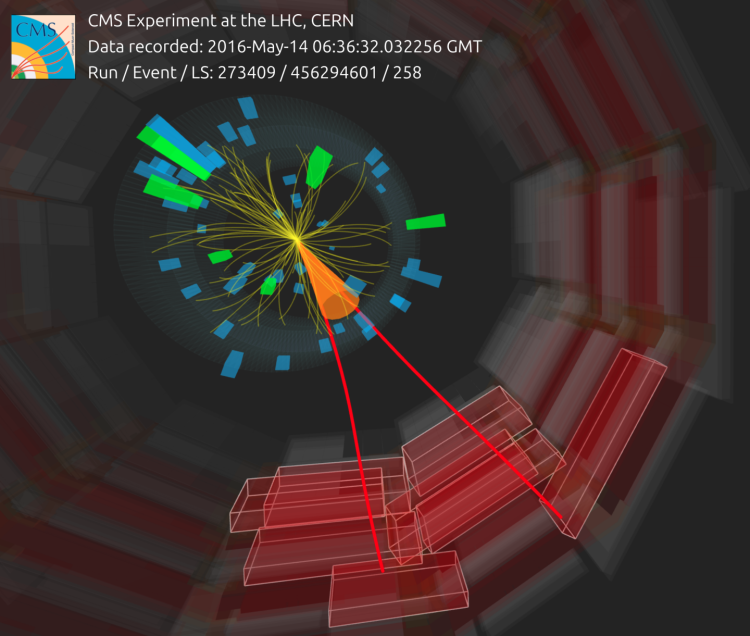
A prominent example is the family of ϒ mesons, which consist of a bottom quark and its antiquark – we collectively call the ground state (1S) and first two excited states (2S, 3S) the ϒ(nS) system. These states can be efficiently reconstructed in the CMS detector using their decays to two muons, as illustrated in the figure below.
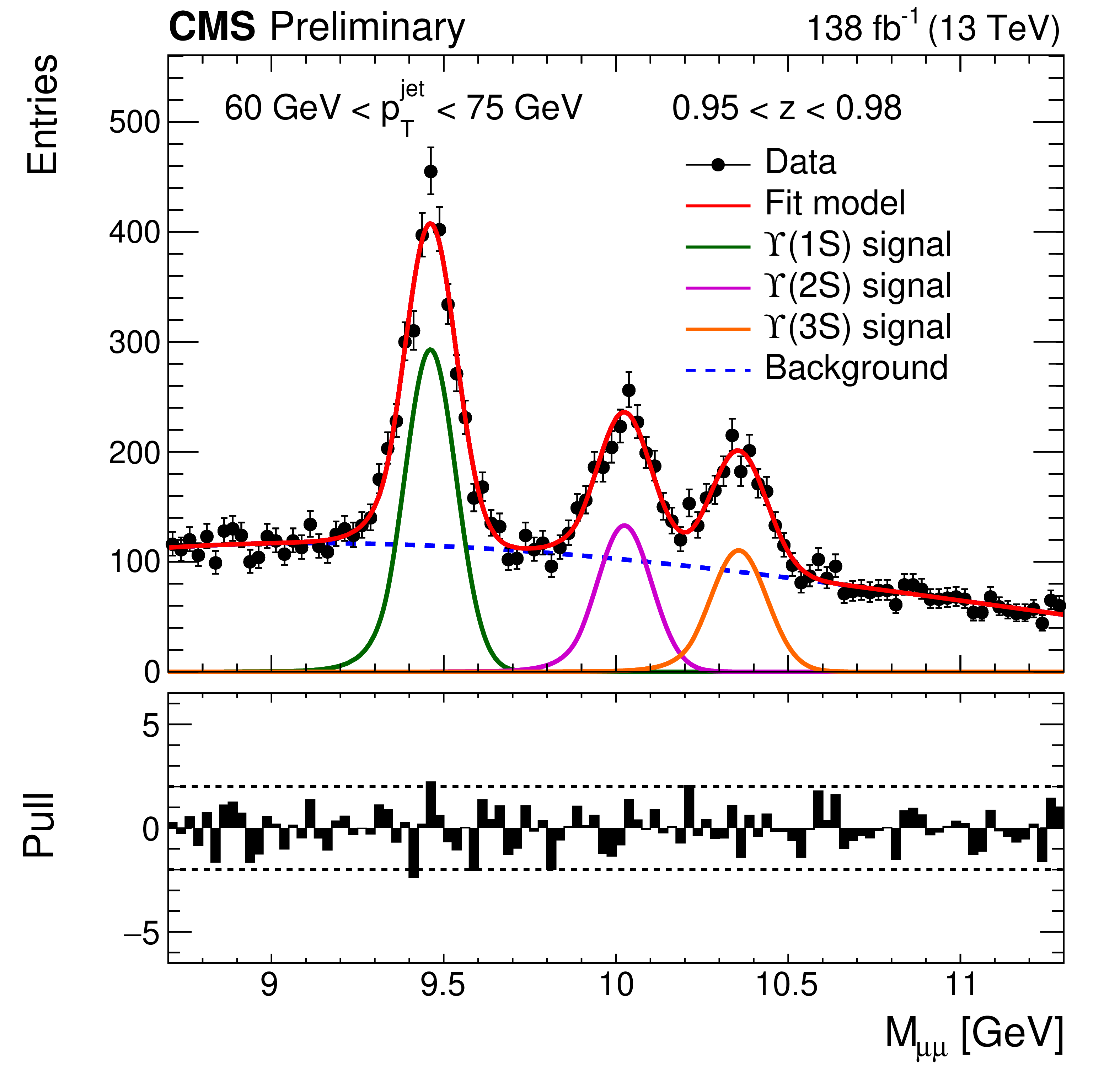
Above: The distribution of the invariant mass of the two muons from the decay of ϒ(nS) particles, showing three consecutive peaks at 9.46, 10.02 and 10.35 GeV, corresponding to the 1S, 2S and 3S states.
The three particles can be produced with different orientations of their spin with respect to their directions of motion. Our current theoretical model, called nonrelativistic quantum chromodynamics (NRQCD), predicts that most of the spins would be oriented perpendicular to the particle direction – “transverse polarization” – at high transverse momentum. Data taken by the CMS and LHCb Collaborations, however, have shown that this is not really the case – the effect was found to be very mild.
Quarkonia production in jets: an alternative point of view
Jets are collimated sprays of particles resulting from the fragmentation and hadronization of a quark or a gluon, which have well-defined energies and momenta. These objects usually contain many hadrons that carry only a fraction of the total energy of the jet. NRQCD predicts that the statistical distribution of this fraction for the ϒ(nS) particles is closely related to their polarization. Hence, the tension observed in the polarization measurements described above could be studied by considering the distribution of energy fractions inside jets.
This idea was first tested by the LHCb Collaboration by considering the production of the “lighter cousin” of the ϒ particle, the J/ψ meson, inside jets. More specifically, the fraction of momentum carried by the J/ψ with respect to the jet containing it was observed to be significantly smaller than what is predicted. Since the J/ψ meson is composed of a charm quark and its antiquark, its behaviour is expected to be similar to that of the ϒ, with the important difference that the significantly larger mass of the ϒ would allow for testing NRQCD in a different range of applicability.
In analogy with the J/ψ case, the CMS measurement shows striking differences between the data and the theoretical predictions. This includes recent improvements aiming to solve this discrepancy by incorporating ϒ production from parton showers. While these developments reduce the tension to some extent, their effect is not enough to cover the full difference with the data, as illustrated in the figure below.
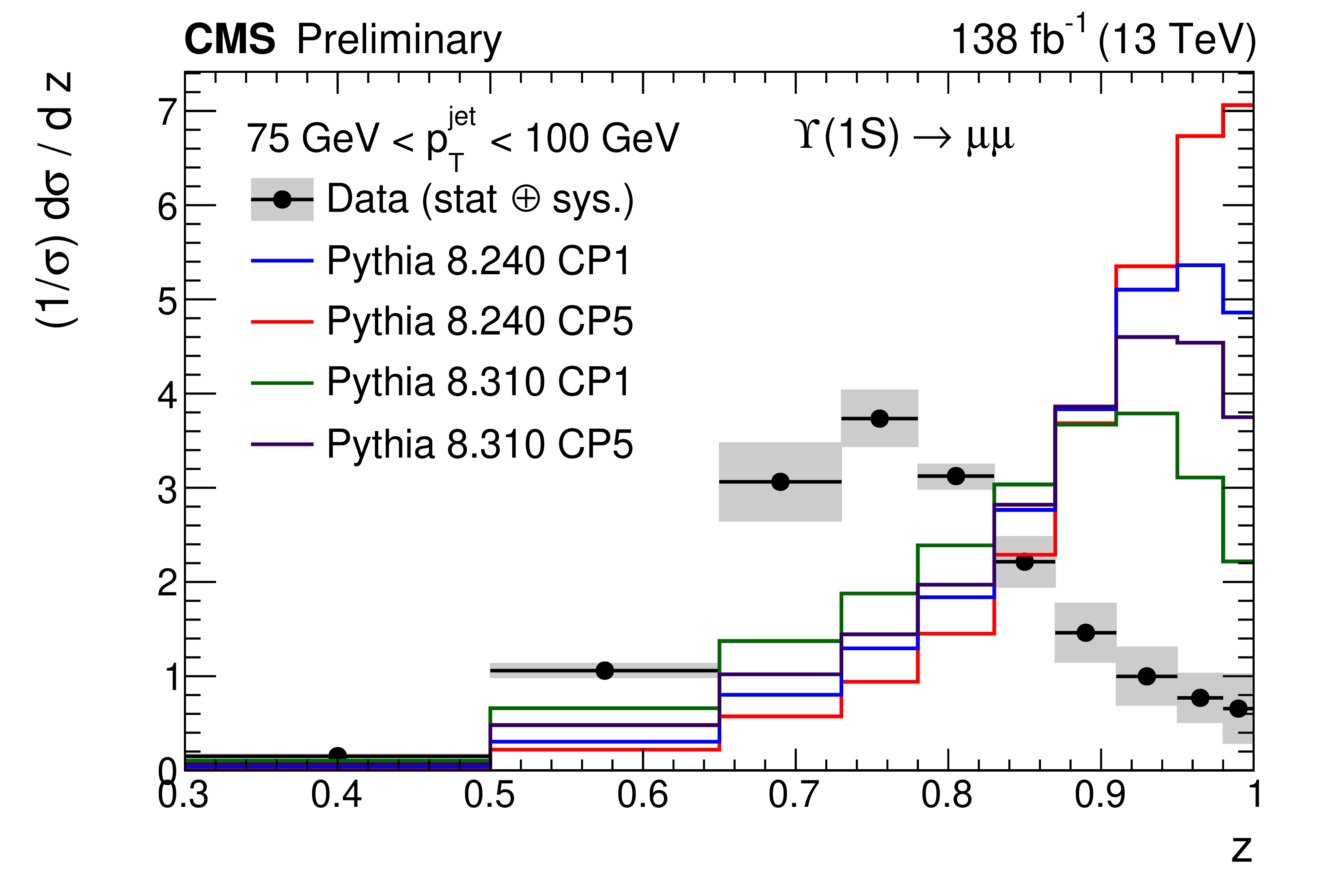
Above: Distribution of the fraction of momentum carried by ϒ(1S) particles with respect to the jets, demonstrating the difference between the data (black markers) and theory (colored lines).
This new result, which measures ϒ mesons produced in jets for the first time, is expected to provide fresh insights. The observed discrepancies highlight the need for improved theoretical tools and better calculations of quarkonia fragmentation, which may eventually help solve the quarkonia polarization puzzle.
Written by: Javier Llorente, for the CMS Collaboration
Edited by: Muhammad Ansar Iqbal
Read more about these results:
-
CMS Physics Analysis Summary (SMP-25-005): "Measurement of the fragmentation properties of Υ(nS) mesons inside jets in pp collisions at √s = 13 TeV"
-
Display of collision events: CERN CDS
-
@CMSExperiment on social media: Bluesky - Facebook - Instagram - LinkedIn - TikTok - Twitter/X - YouTube