
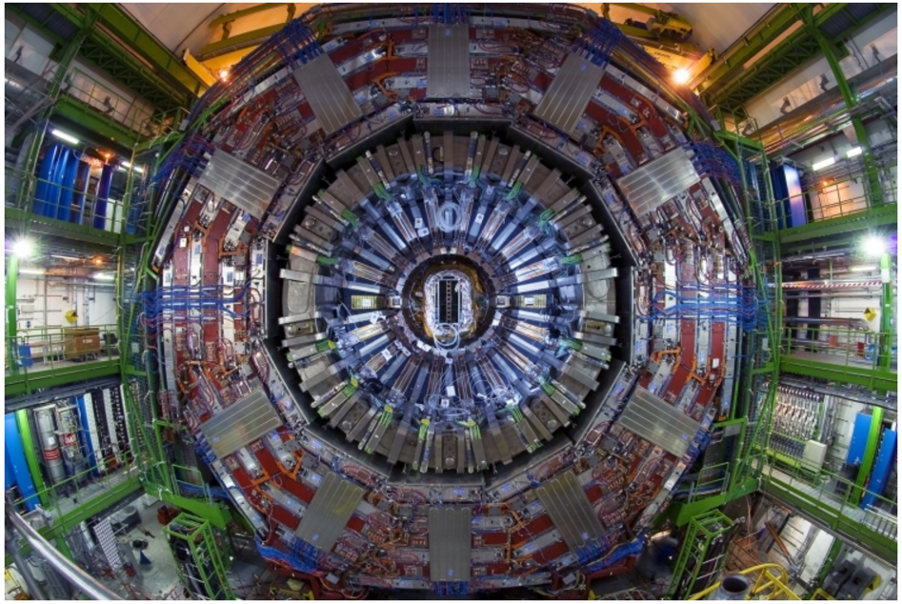
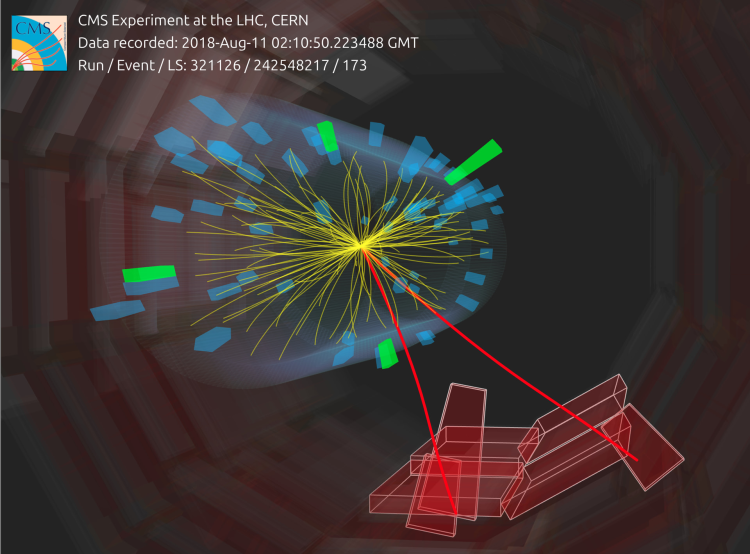
The CMS experiment reports the observation of a peaking structure in the Υ(1S)ϕ(1020) channel in proton-proton collisions at 13 TeV.
Using the Run 2 proton-proton collision dataset collected at the LHC between 2016 and 2018, the CMS Collaboration has observed a pronounced structure in the invariant mass spectrum of Υ(1S)ϕ(1020). The measured mass is consistent with the known χb1(3P) bottomonium state, which had previously been observed only through radiative decays. However, the absence of the expected χb2(3P) partner in the same channel makes the interpretation especially intriguing. This result opens a new avenue for exploring the spectroscopy of heavy-quark bound states and may provide fresh insight into the possible existence of exotic forms of hadronic matter beyond the conventional quark–antiquark picture.
Much like electrons in atoms, quarks can form families of bound states with different excitation levels. In the case of bottomonium (particles composed of a bottom quark and its antiquark), these states provide an important laboratory for studying the strong interaction, the fundamental force that binds quarks inside hadrons. Over the past decades, experiments at colliders around the world have mapped much of the bottomonium spectrum, including several excited χb states. Yet, important questions remain open, particularly for highly excited states and for decay modes that are still poorly explored experimentally. As shown in Fig. 1, the bottomonium family contains several excited states whose properties help physicists test the strong interaction. While many states have been observed through radiative decays, some decay channels remain largely unexplored.
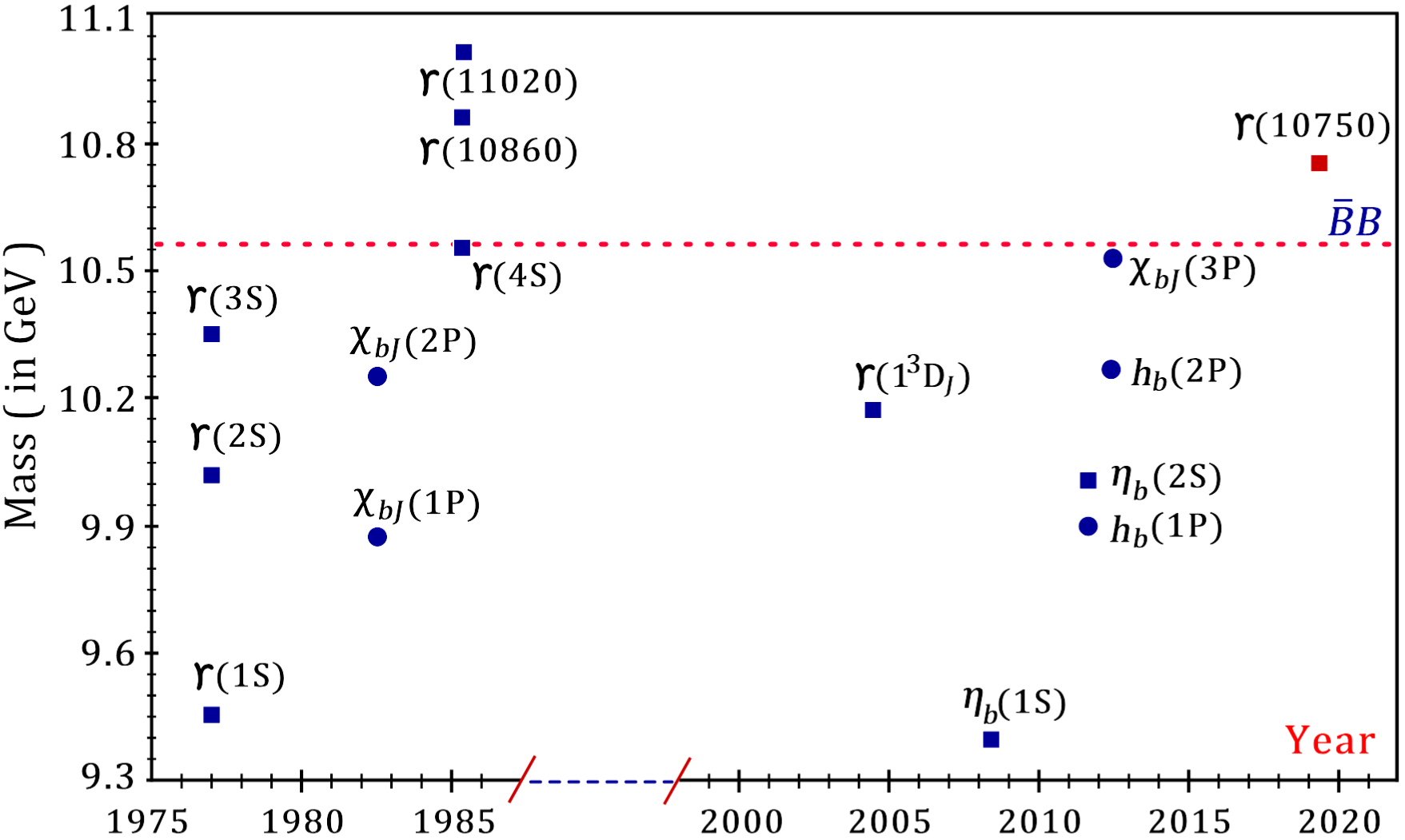
Figure 1: The mass and first year of observation for the bottomonium states [Phys. Rev. D 101, 014020 (2020)].
Most bottomonium states have traditionally been studied through radiative transitions involving the emission of photons. In this analysis, CMS analyzed a much less studied type of process: a hadronic decay involving a Υ(1S) meson and a ϕ(1020) meson. The Υ(1S) was reconstructed through its decay into two muons, while the ϕ(1020) was identified through its decay into two charged kaons. Thanks to the large dataset collected during Run 2 of the LHC, CMS was able to investigate this rare final state with unprecedented sensitivity.
When the invariant mass of the Υ(1S)ϕ(1020) system was reconstructed, shown in Fig. 2, CMS observed a pronounced peak structure near 10.51 GeV. The measured mass is compatible, within uncertainties, with the known χb1(3P) state. However, the interpretation is not entirely straightforward. If the observed structure originates from conventional bottomonium, a corresponding signal from the closely related χb2(3P) state would also be expected in the same decay channel. No significant evidence for such a contribution is observed in the data. Although the signal may correspond to the first observation of a hadronic decay of the χb1(3P), the possibility that the structure could instead arise from a more exotic hadron state — such as a tetraquark or a hybrid meson — cannot yet be excluded.
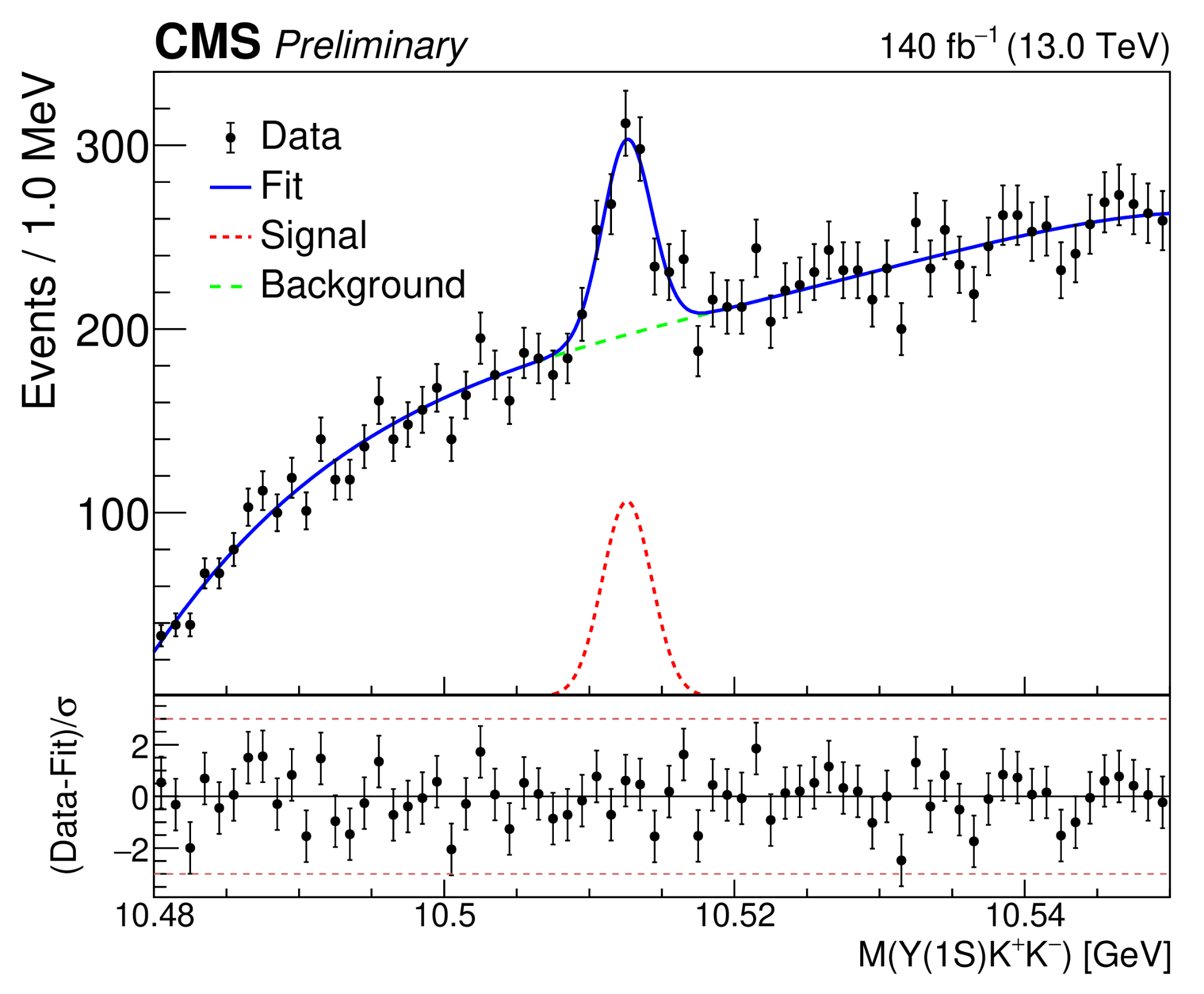
Figure 2: The Υϕ invariant mass distribution in data (black points) with a fit (solid blue line), including signal (dashed red line) and background (dashed green line). The lower panel shows the pull distribution, defined as the difference between the data and the fit value in each bin, divided by the combined uncertainty. The peaking structure at around 10.51 GeV corresponds to the χb1(3P) state.
By exploring bottomonium through an unusual hadronic decay channel, CMS has demonstrated a powerful new approach for studying the spectroscopy of heavy-quark bound states. The data from Run 3 of the LHC and the High-Luminosity LHC era will help clarify the nature of the observed structure and determine whether it can be fully explained within the conventional bottomonium picture, or if it points toward more exotic forms of hadronic matter. As experimental sensitivity continues to improve, the rich bottomonium spectrum may still hold unexpected surprises about how quarks bind together through the strong interaction.
Written by: Jhovanny Andres Mejia Guisao, for the CMS Collaboration
Edited by: Andrés G. Delannoy
Read more about these results:
-
CMS Physics Analysis Summary (BPH-25-009): "Observation of a peaking structure in the Υ(1S) ϕ(1020) channel in proton-proton collisions at √s = 13 TeV"
-
@CMSExperiment on social media: Bluesky - Facebook - Twitter - Instagram - LinkedIn - TikTok - YouTube