
The CMS experiment uses its largest sample of B mesons to date to perform a high-precision test of subtle differences between matter and antimatter.
One of the greatest mysteries in physics is why our universe is made almost entirely of matter. According to our best theories, the Big Bang should have produced matter and antimatter in nearly equal amounts. Yet, almost no antimatter remains today. One ingredient that could explain this imbalance is a subtle difference between matter and antimatter, known as charge-parity (CP) violation.
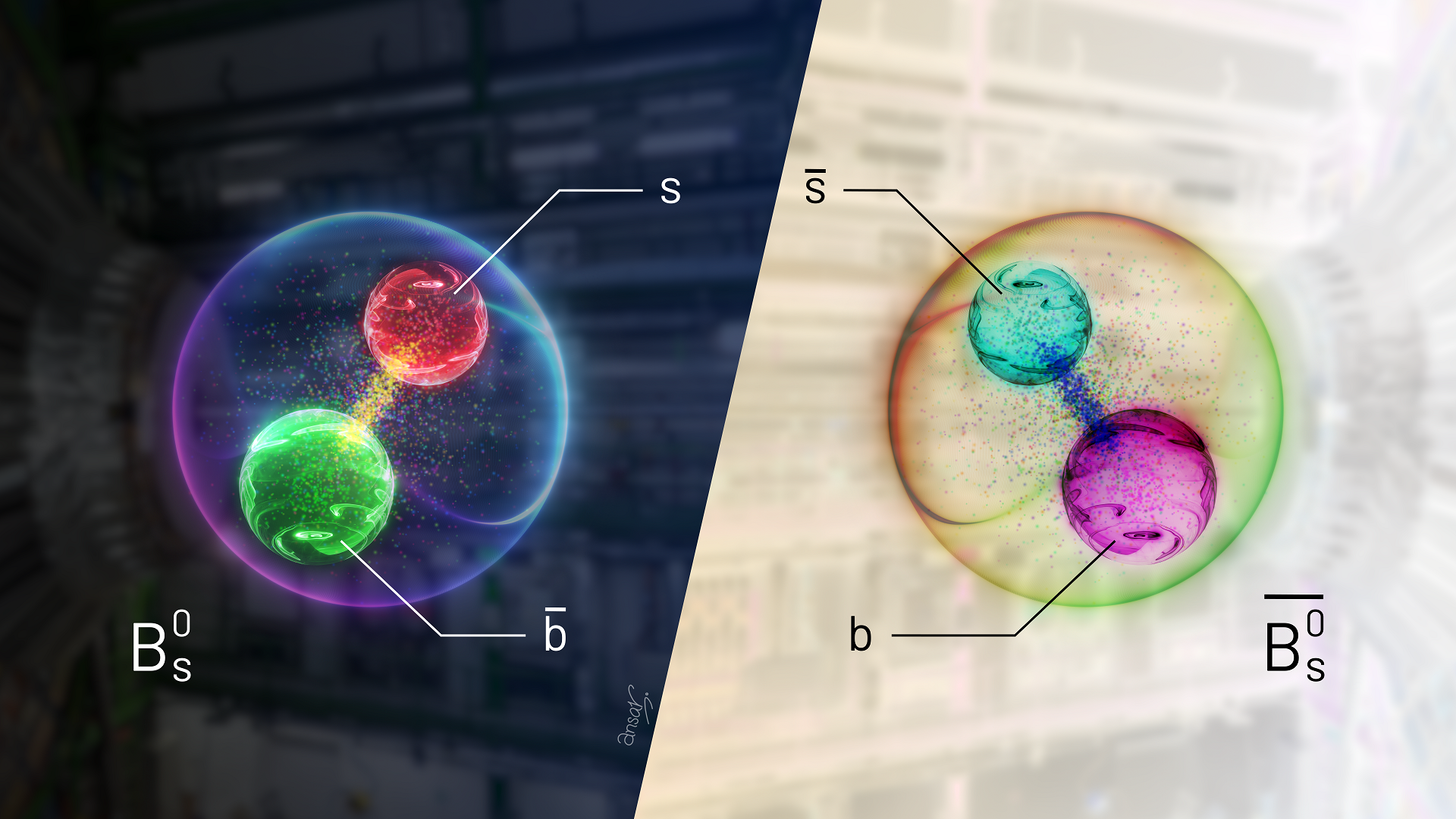
One of the best systems to study CP violation is in particles containing a bottom quark, called B mesons. Neutral B mesons have a remarkable property – they can spontaneously transform into their own antiparticles, and back again. By comparing how often matter and antimatter versions of these particles decay over time, we can measure tiny differences that test the Standard Model with unprecedented precision.
In this study, the CMS experiment analysed proton-proton collision data collected between 2022 and 2025, reconstructing about 1.4 million B0 mesons and 16 thousand B0s mesons decaying into a J/ψ particle and a neutral kaon. A key challenge was determining the flavour of each meson at the moment it was produced. To achieve this, CMS employed a tagging framework based on state-of-the-art artificial intelligence. The system combines information from muons, electrons, jets, and, for the B0s meson, nearby particles produced in the collision, significantly improving the experiment's ability to identify the meson’s initial state.
The measured CP-violating parameters agree with the predictions of the Standard Model. For the B0s meson, CMS reports the most precise measurement of CP violation in B0s → J/ψ K0S decays to date, whilst the accompanying study of the B0 decay provides an important complementary test of the same underlying physics (see figure below). Together, these results deepen our understanding of CP violation in the bottom-quark sector and place tight constraints on possible contributions from new particles.
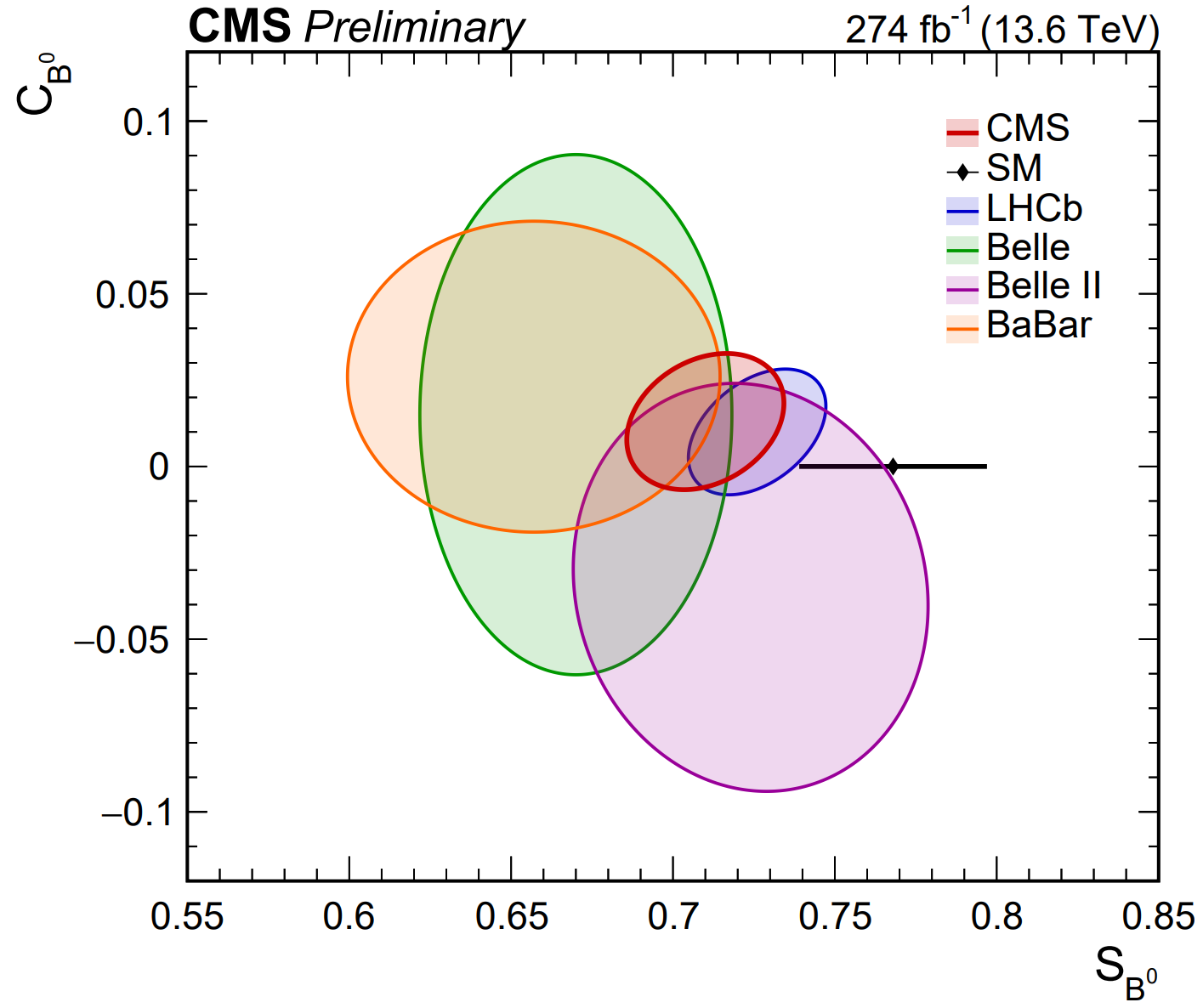
Above: Constraints (shaded regions) at 68% confidence level on the two parameters characterising CP-violation – values outside the shaded regions are excluded by the corresponding results. The CMS result is compared with the latest measurements from the BaBar, Belle, Belle-II, and LHCb experiments. The Standard-Model-based prediction is indicated by the black diamond marker.
As the LHC continues to deliver ever larger datasets during the High-Luminosity LHC era, such measurements will become even more precise. Whether they continue to confirm the Standard Model or uncover subtle deviations, they will bring us closer to understanding why our universe came to be dominated by matter rather than antimatter.
Written by: Muhammad Ansar Iqbal, for the CMS Collaboration
Edited by: Muhammad Ansar Iqbal
Read more about these results:
-
CMS Physics Analysis Summary (BPH-26-005): "Measurement of time-dependent CP violation in B0(s) → J/ψ K0S decays with the CMS detector"
-
@CMSExperiment on social media: Bluesky - Facebook - Instagram - LinkedIn - TikTok - Twitter/X - YouTube