
Using Z bosons, the CMS experiment reveals new details of how the Quark-Gluon Plasma drains energy from energetic quarks and challenges current theoretical descriptions.
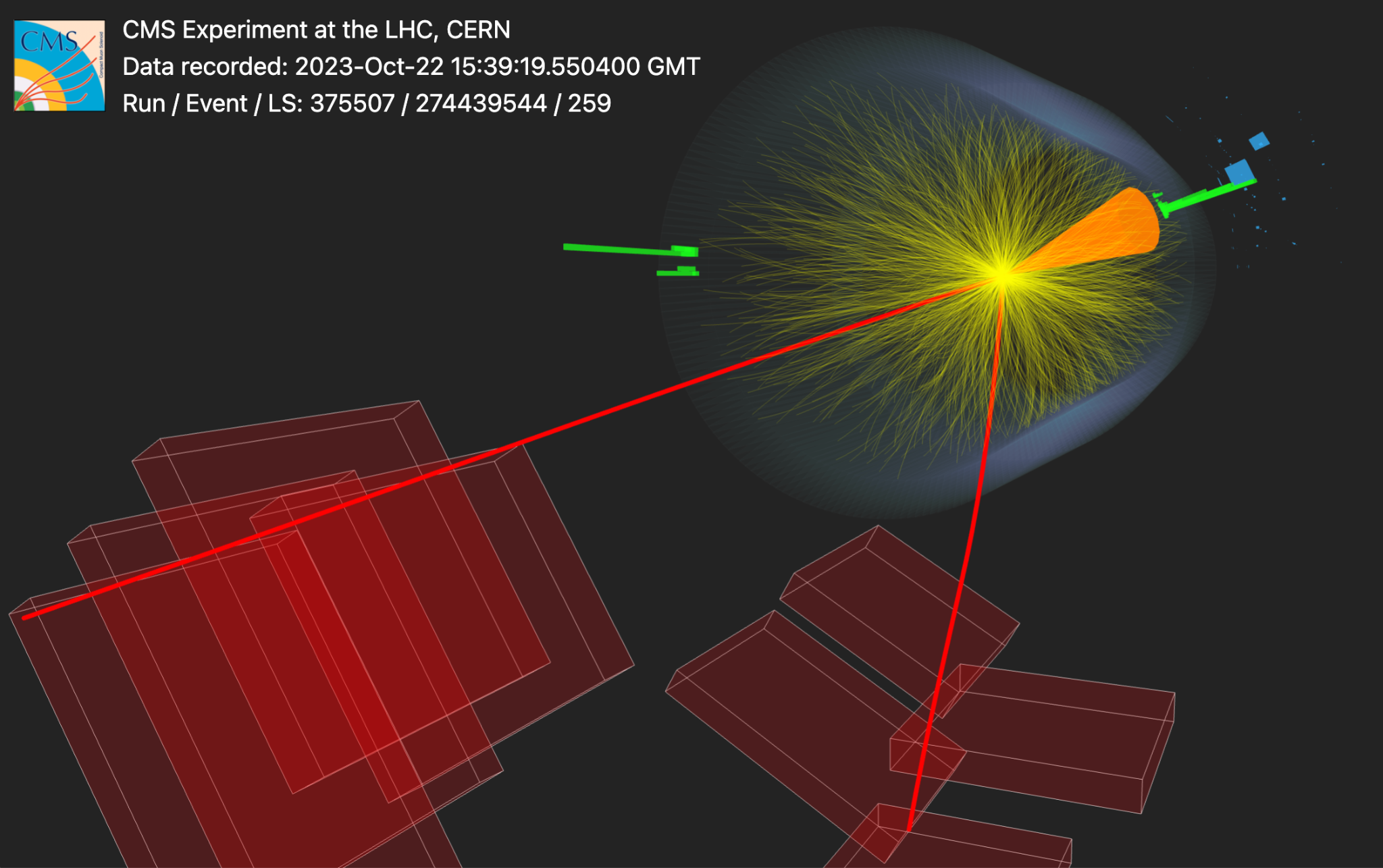
To understand the Quark-Gluon Plasma (QGP), the hottest matter in the Universe which filled the cosmos during the first microseconds after the Big Bang, physicists need a messenger that passes through it essentially unaffected: the Z boson. Recreated for only an instant in lead-nuclei collisions at the Large Hadron Collider (LHC), the QGP is impossible to observe directly. Instead, physicists can study how it affects energetic quarks produced in association to a recoiling Z boson in the collision. As they traverse the plasma, these quarks lose energy before forming sprays of particles called jets.
Unlike quarks, the Z boson does not interact with the QGP. It escapes unscathed, preserving an accurate record of the original hard scattering. Identified with high precision through its decays into muons, the Z boson acts as a clean probe, allowing physicists to compare its momentum with that of the recoiling jet and determine how much energy the quark lost traversing the plasma.
This work presents the first-ever unfolded measurement of the momentum imbalance xZj, the ratio of the leading recoiling jet’s transverse momentum to the Z boson, in proton-proton and central lead-lead collisions at a centre-of-mass energy of 5.36 TeV, using the full Run 3 data collected by CMS. Thanks to unfolding, a statistical technique that removes the distortions introduced by the detector, the measurement can access the underlying particle-level physics. This technique allows for a direct comparison with the state-of-art theoretical predictions to understand how the QGP works with unprecedented precision.
The result, as summarized in Fig.1, shows that quarks crossing the QGP lose a substantial fraction of their energy. Compared with proton-proton collisions, where no QGP is formed, many fewer Z bosons are accompanied by a high-energy jet after the quark has traversed the plasma. Those jets that do survive also emerge with significantly reduced momentum, providing one of the clearest pictures yet of the effect known as jet quenching.
The improved precision allows CMS to not only observe jet quenching, but also begin testing how accurately theoretical models describe how the QGP reacts to the jet crossing it. One of today's leading models successfully reproduces the behaviour of moderately modified jets but predicts that the most strongly quenched jets lose too much energy when compared to the measurement.
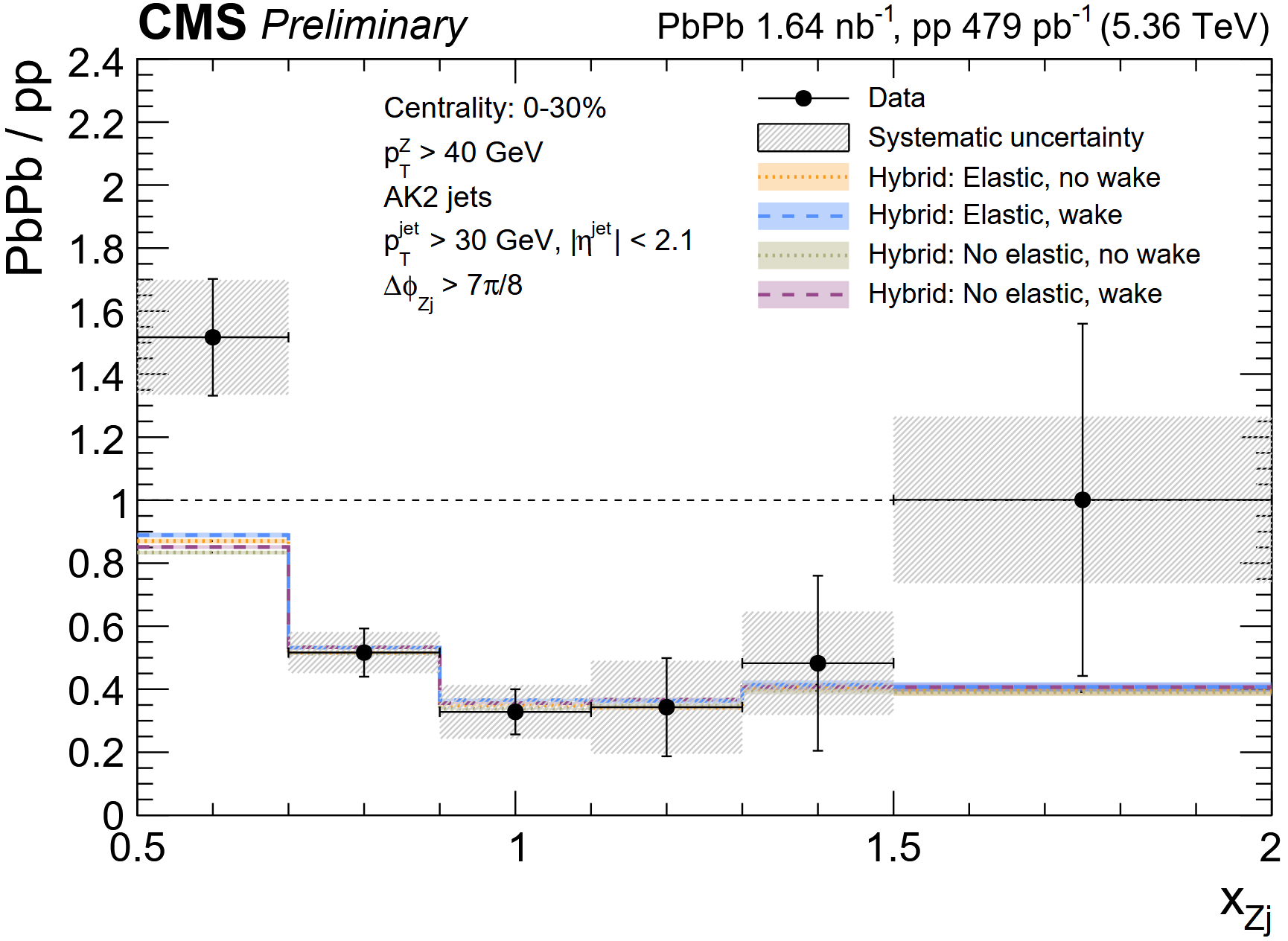
Figure 1: The measured fraction of the jet momentum over the Z boson momentum (xZj ) shown as a ratio in lead-lead collisions with respect to proton-proton collisions after the unfolding (black dots), compared to the state-of-the-art theory predictions of the Quark-Gluon Plasma effects (colored dashed lines). The plot shows a strong jet quenching effect and the need of more study on the theory side to better describe the data.
Highlighting these findings, Raffaele Delli Gatti, PhD student at University of Trieste, points out: “Because the Z boson passes through the plasma untouched, we know how much energy the recoiling quark started with. The surprise is that these highly quenched quarks survive more often than our best models predict. Clearly, we are still missing a crucial piece of how the plasma actually transfers energy to quarks in current theoretical descriptions.”
This result establishes a new benchmark for studying the quark-gluon plasma with Z bosons. Future measurements at the High-Luminosity LHC, combining much larger data samples with complementary studies of jet substructure and different jet sizes, will provide an even more detailed picture of how quarks lose and redistribute energy while traversing the hottest and densest matter ever created in the laboratory, deepening our understanding of the fundamental interactions that shaped the early Universe.
Written by: Vieri Candelise and Raffaele Delli Gatti, for the CMS Collaboration
Edited by: Andrés G. Delannoy
Read more about these results:
-
CMS Physics Analysis Summary (HIN-25-017): "Measurement of the jet quenching effect with Z + jet events in pp and PbPb collisions at 5.36 TeV"
-
@CMSExperiment on social media: Bluesky - Facebook - Twitter - Instagram - LinkedIn - TikTok - YouTube