
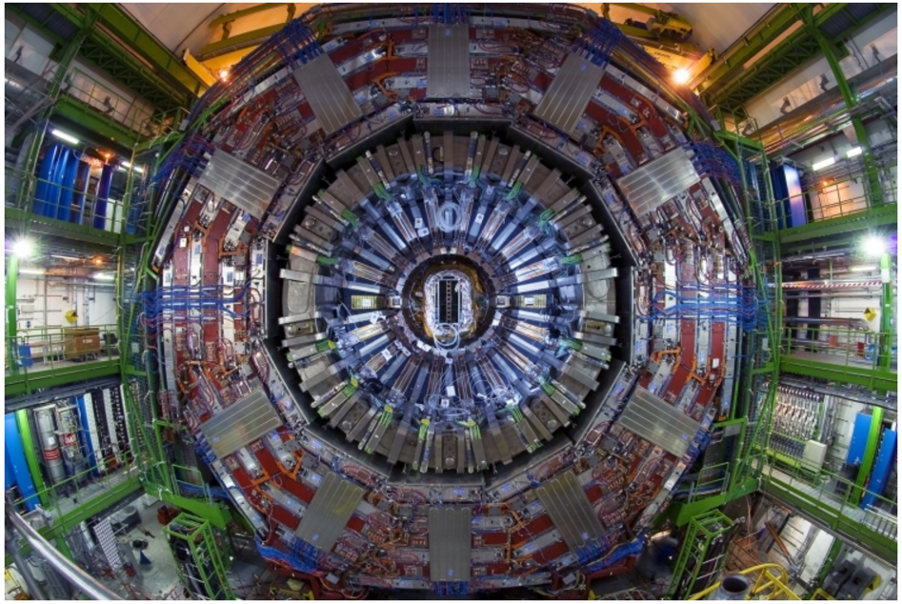
CMS advances the study of Higgs boson’s self-interaction by searching for Higgs boson pairs decaying into bottom quark–antiquark and tau lepton–antilepton pairs in collisions recorded between 2022 and 2024.
Is the Standard Model (SM) the ultimate theory of particle physics? How did galaxies, clusters, and cosmic filaments form in the early universe? Is the vacuum of our universe stable? Clues to answer these questions can be obtained by studying the production of pairs of Higgs bosons (HH). In a recent result, the CMS experiment reports the next chapter of the HH search, significantly improving the constraints on the parameters characterising Higgs boson’s self-interaction using data collected between 2022 to 2024.
Since the Higgs boson’s observation in 2012, the CMS and ATLAS collaborations have been measuring the interaction between the Higgs boson and other standard model particles. So far, all measurements are consistent with the predictions given by the SM. One interaction which still remains to be confirmed experimentally is that between multiple Higgs bosons – the Higgs boson “self-coupling”.
At the LHC, Higgs boson pairs are produced in two primary ways – a description of the production mechanisms and an account of previous HH searches by CMS can be found at: A tale of two Higgs. The gluon–gluon fusion (ggF) mode allows us to study the Higgs boson self-coupling, whilst the vector-boson fusion (VBF) mode allows us to also study the interaction between two Higgs bosons and two vector (W or Z) bosons. The distinct topologies of the two production modes allow us to distinguish the events originating from each, and hence constrain these two interactions separately.
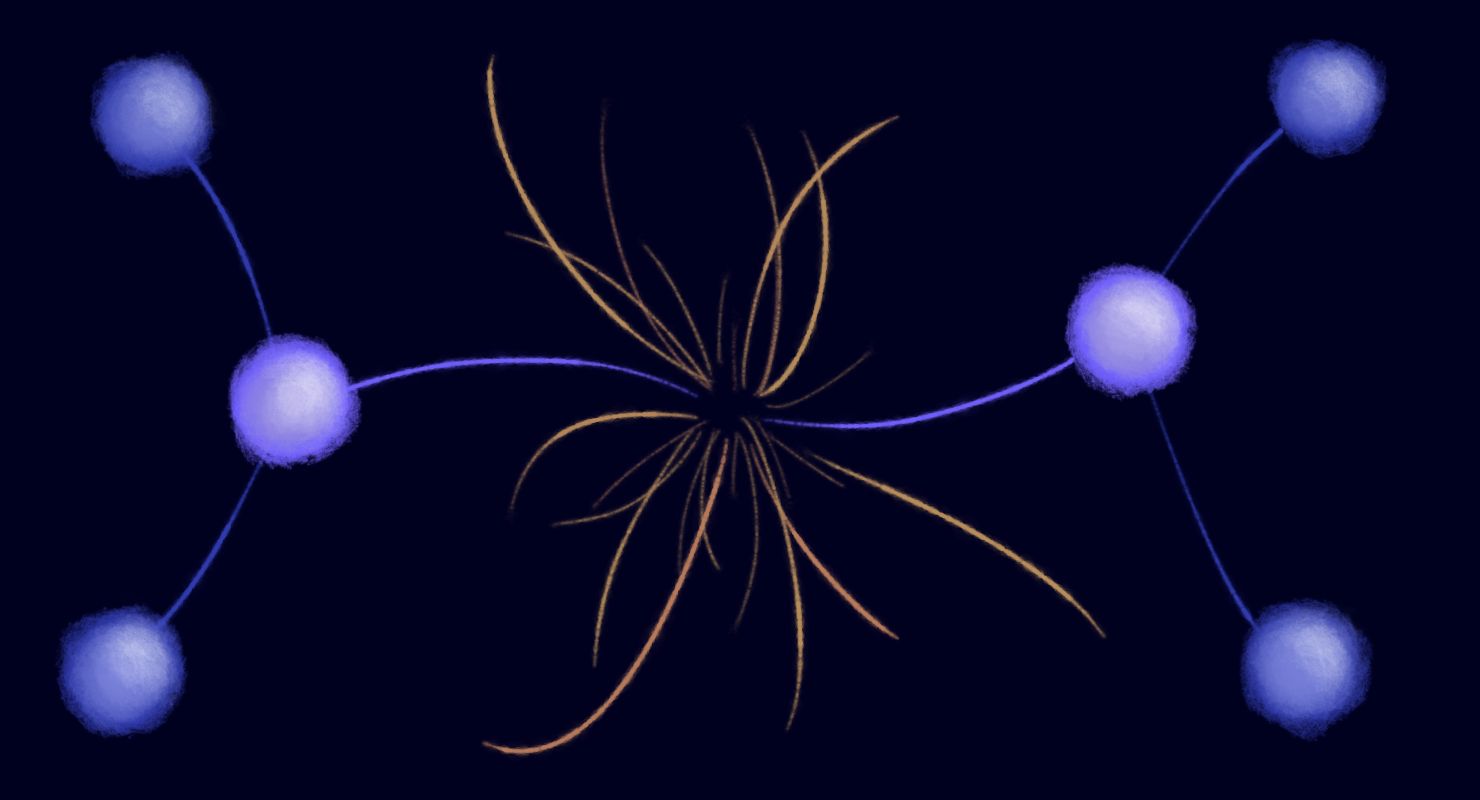
The Higgs boson pair can decay in a variety of ways. The channel where one Higgs boson decays into a bottom quark and antiquark and the other decays into a tau lepton and antilepton (HH→bbττ, figure below) has a sizeable probability to occur among all possible combinations, whilst also having a clean experimental signature, which helps distinguish it from background processes. This makes bbττ one of the three most sensitive channels to search for double Higgs boson production.
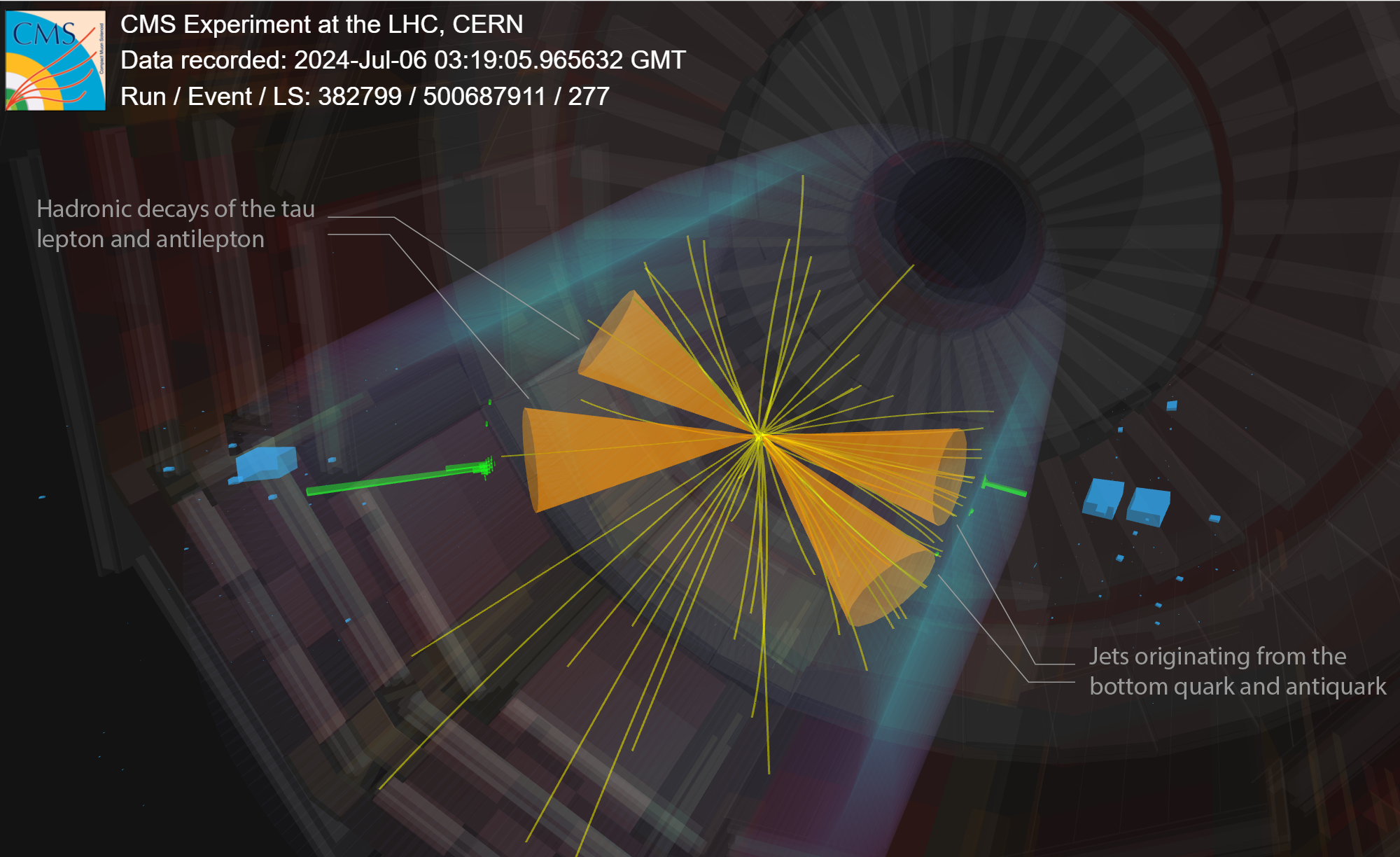
Above: A HH→bbττ candidate event recorded by the CMS experiment during 2024 data taking.
Being a 1000 times rarer than single Higgs boson production, Higgs boson pair production presents an exceptional experimental challenge, requiring a tremendous amount of data to be studied. To exploit the full potential of the data available, several improvements have been made since the previous analysis of data collected from 2016 to 2018. Major improvements include the introduction of new trigger algorithms with increased efficiency and the use of novel machine learning algorithms.
Analysing 172 fb–1 of data collected from 2022 to 2024 at a center-of-mass energy of √s = 13.6 TeV, the latest result sets observed upper limits at 95% confidence level (CL) to 6.6 times the SM prediction for the HH production rate and 81 times the SM prediction for the VBF HH production rate.
Combining these results with the ones previously obtained with 138 fb–1 of data collected at √s = 13 TeV in the period 2016–2018, the observed upper limits on the cross section at 95% CL are set to 4.0 times the SM prediction for HH production and 62 times the SM prediction for the VBF HH production. The Higgs boson self-coupling is constrained to be between –2.5 and 9.4 with a 95% CL, and the coupling of two Higgs bosons to two vector bosons is constrained to be between 0.02 and 2.1 with a 95% CL.
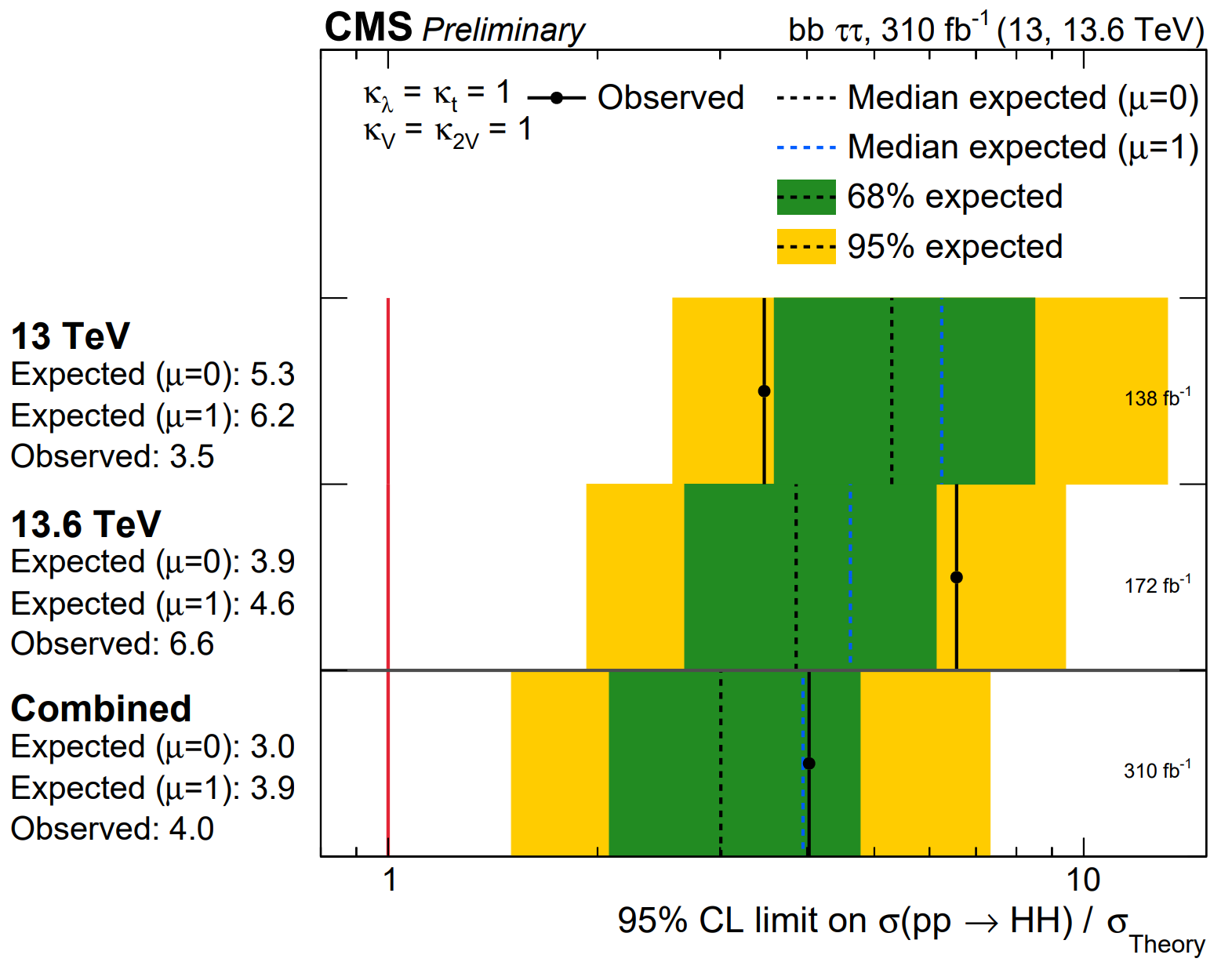
Above: Observed and expected limits on the HH production at 95% CL.
The search remains limited by the amount of the collected data, and the quest for HH production is far from over. More data recorded in 2025 and 2026, and statistical combination with other decay channels will improve the sensitivity of the search significantly. With the upcoming High-Luminosity LHC, which is planned to start operating around 2030, CMS is expected to record six times the current data sample, taking it ever closer to observing the elusive Higgs boson pair production. In the words of Shakespeare, “the game's afoot!”
Written by: Léa-Maria Rabour, for the CMS Collaboration
Edited by: Muhammad Ansar Iqbal
Read more about these results:
-
CMS Physics Analysis Summary (HIG-25-008): "Search for nonresonant HH production in the bbττ final state in proton-proton collisions at √s = 13.6 TeV"
-
@CMSExperiment on social media: Bluesky - Facebook - Instagram - LinkedIn - TikTok - Twitter/X - YouTube