
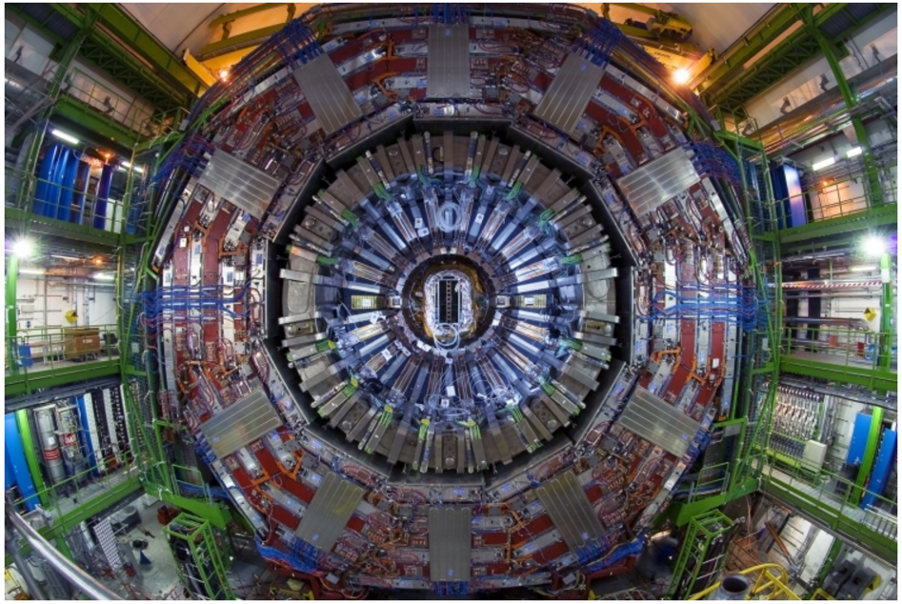
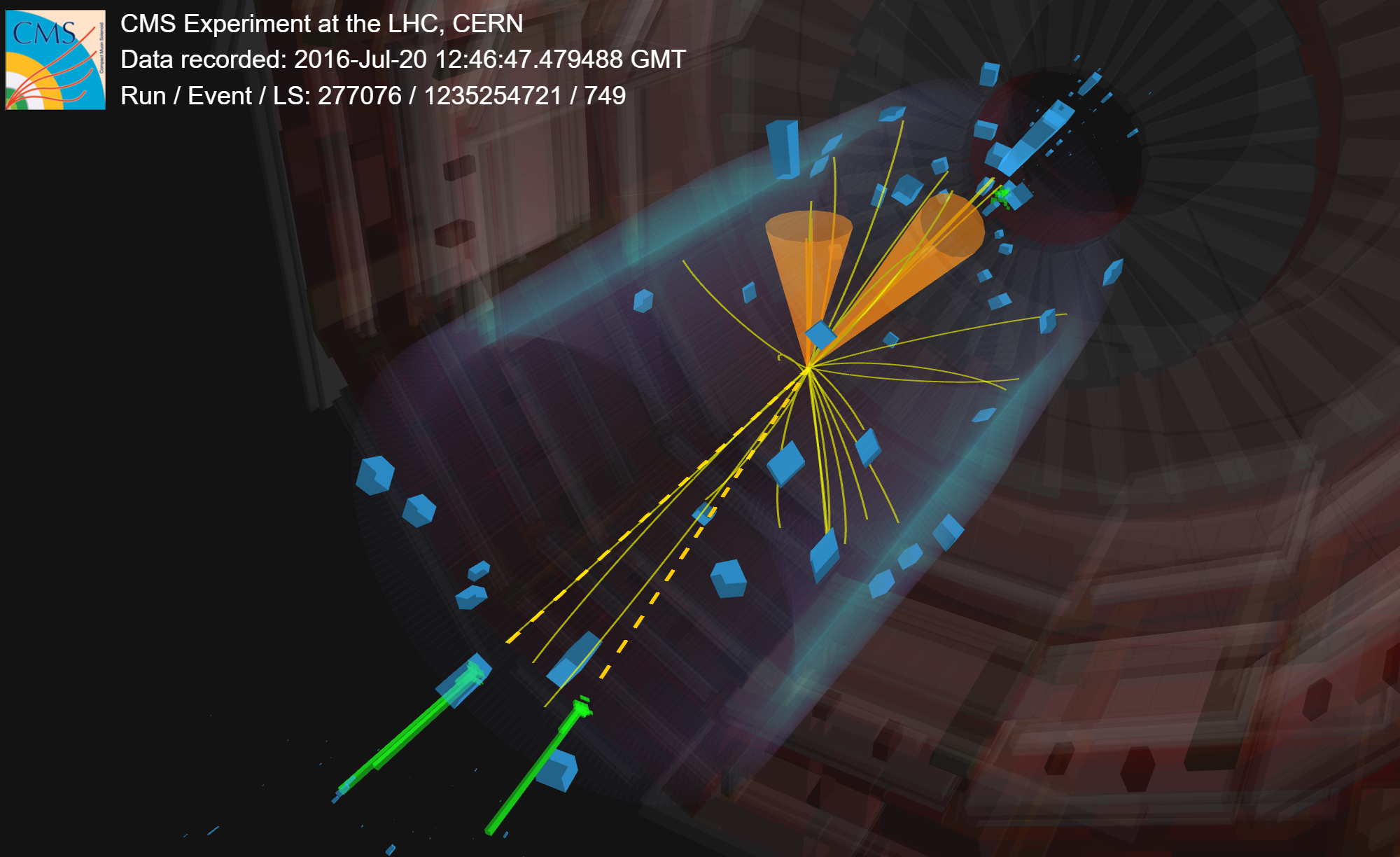
CMS has made the first search in the two-photon and two-bottom-quark final state for a heavy particle with masses from one to four trillion electronvolts.
In a first of its kind, CMS has carried out a search for a heavy particle, X, with masses beyond one trillion electronvolts (TeV), decaying into the known Higgs boson and a new scalar particle, Y, in events containing two photons and two bottom quarks (see Fig. 1). No significant excess over the Standard Model prediction was found, but the result examines a previously unexplored area of the search for a broader Higgs sector.
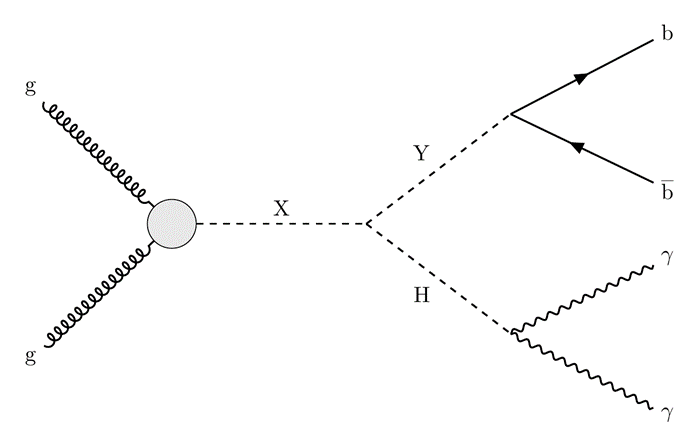
Figure 1: The process targeted by the search: two gluons from the colliding protons produce a heavy particle X, which then decays into the known Higgs boson (H) and a new particle (Y); the H produces two photons, while the Y produces a bottom quark and antiquark.
The Standard Model predicts one Higgs boson and describes the known elementary particles with remarkable precision, yet it does not explain neutrino masses, dark matter, or the universe's matter-antimatter imbalance. Many theories beyond the Standard Model predict an extended Higgs sector. In some, a heavy state would decay more readily into the Higgs boson and a lighter scalar than it would decay into two identical Higgs bosons.
Only about two in every thousand Higgs bosons decay into two photons, but CMS reconstructs the photon pair’s mass with excellent resolution. A small signal could therefore appear as a narrow peak above the smooth background from ordinary collisions. The channel trades event yield for clarity.
Two decay scenarios are considered depending on the mass of Y relative to X. If Y is much lighter than X, the resulting two bottom quarks overlap into one large jet. If the masses of Y and X are comparable, the resulting jets are distinct. ParticleNet, a graph neural network, identifies the merged-jet signature. For the resolved topology, a mass-parameterized neural network adapts to the Y mass being tested.
“New physics may be hiding at a mass point or in a decay pattern we have not yet examined. The two-photon channel is one of our sharpest tools for resonance searches: the decay is rare, but its narrow mass peak can expose a small signal above a smooth background. Extending the heavy resonance searches beyond 1 TeV with this channel closes a distinct gap in the experimental map.”, remarks Jin Wang, CMS physicist at the Institute of High Energy Physics, Chinese Academy of Sciences
Using the full proton–proton collision dataset recorded by CMS from 2016 to 2018, the team searched over a broad mass range scenarios of the X and Y states. The data were found to be consistent with the expected background processes. Upper limits were therefore set on the rate of the process at each mass point, as shown in Fig. 2.
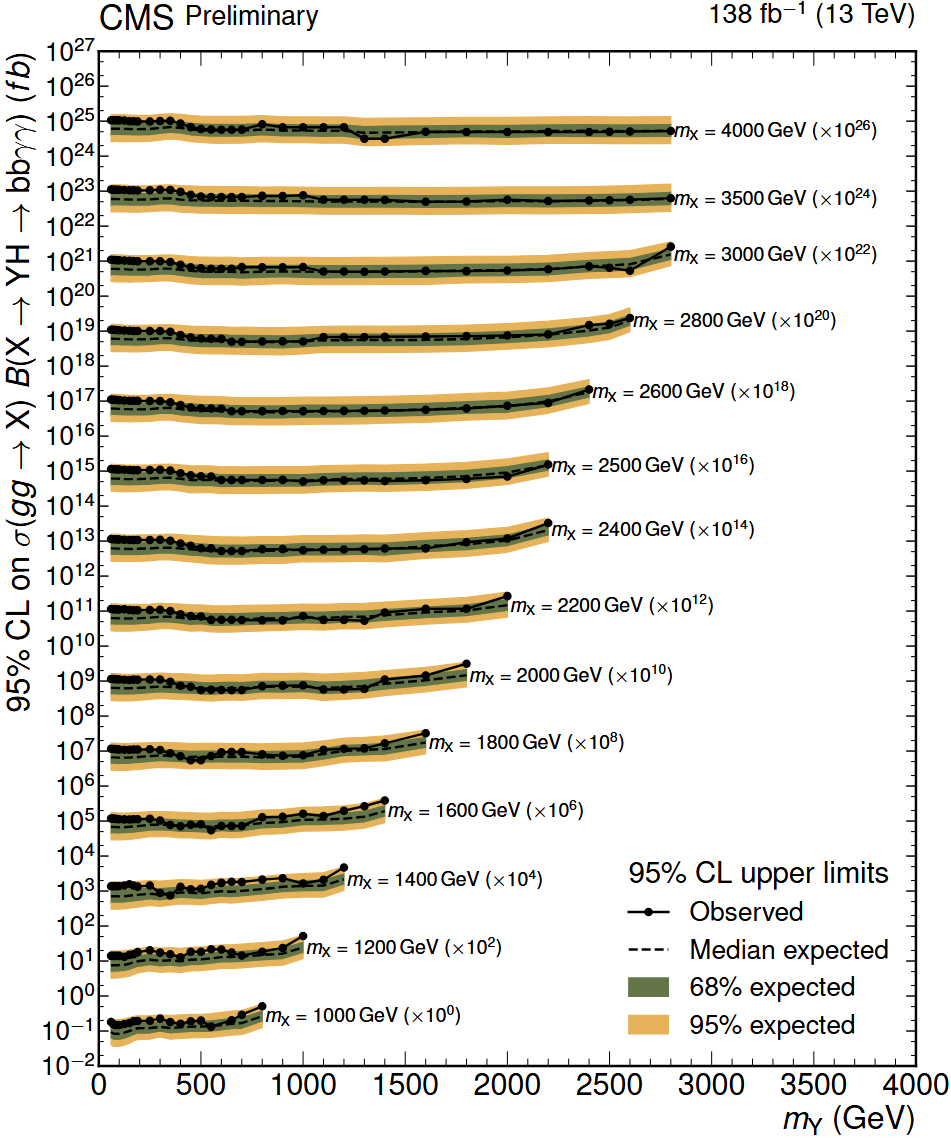
Figure 2: Limits for the new two-photon search across the tested masses of the Y scalar. The solid black points represent the observed 95% confidence-level limits; the dashed curves show the median expected limits if only known processes are present. The green and yellow bands show the expected statistical spread. Curves for different X masses are scaled by the labelled factors for visual separation.
The results were then combined with previous searches targeting the Higgs boson decays into bottom quarks or tau leptons. Including the two-photon channel improves the expected combined limits for heavier masses of Y. For a broad range of X masses, it provides the leading individual sensitivity (see Fig. 3).
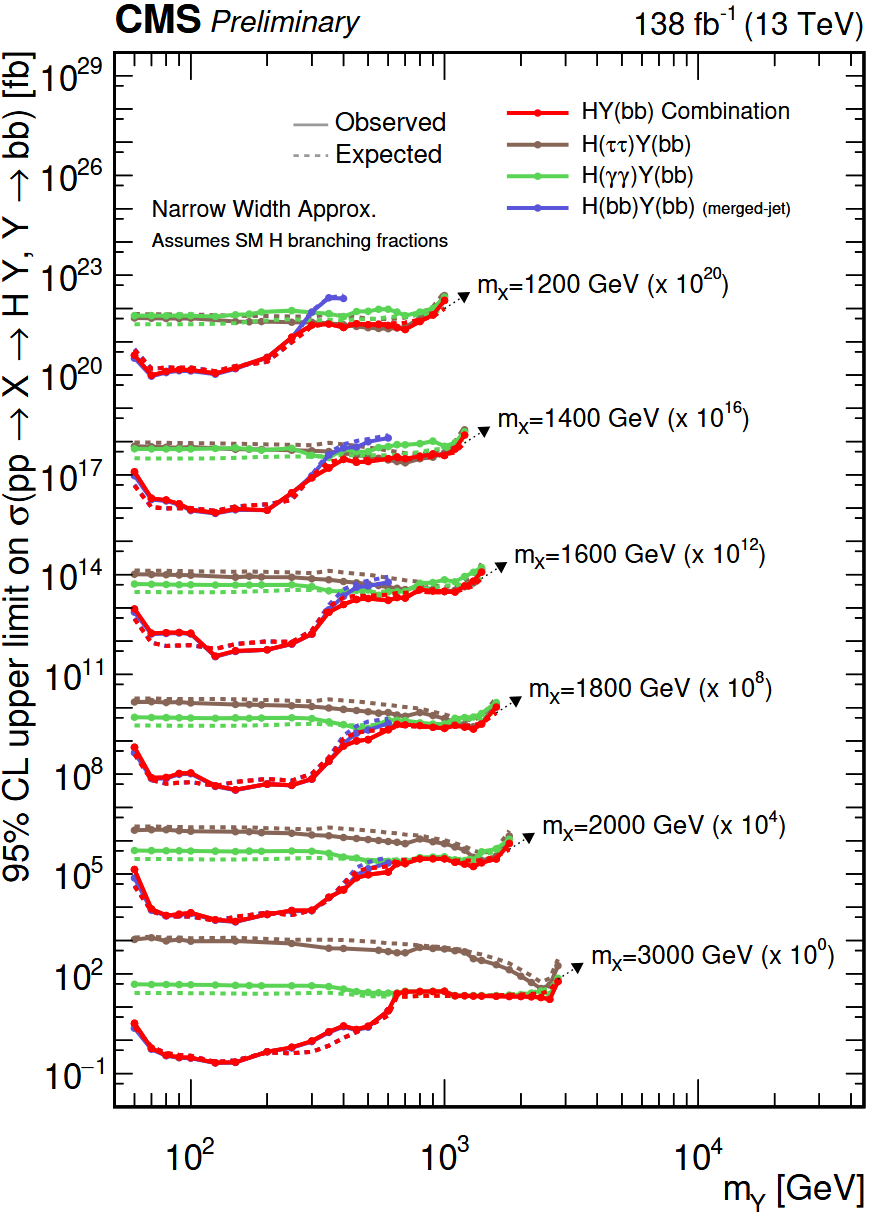
Figure 3: Three searches for the X→HY process are compared: two photons plus bottom-quark jets (new result being presented, green), four bottom-quark jets (blue), and tau leptons plus bottom-quark jets (brown). Their combination is shown in red. The solid lines represent observed limits and dashed lines the expected limits. Within each X-mass group, lower curves correspond to stronger constraints. Curves for different X masses are scaled by the labelled factors for visual separation.
The results do not rule out an extended Higgs sector. They establish the first constraints at high masses in this final state and identify where the precise photon channel adds most to other decay channels. The current search is primarily limited by the available data sample. Its two-topology strategy is ready for the larger Run 3 datasets, where more collisions will directly sharpen the search for these rare decays.
Written by: Jin Wang for the CMS Collaboration
Edited by: Andrés G. Delannoy
Read more about these results:
-
CMS Physics Analysis Summary (B2G-24-019): "Search for a heavy resonance decaying into a Higgs boson and a new scalar boson using the γγbb̄ final state in proton-proton collisions at √s = 13 TeV"
-
@CMSExperiment on social media: Bluesky - Facebook - Instagram - LinkedIn - TikTok - Twitter/X - YouTube