
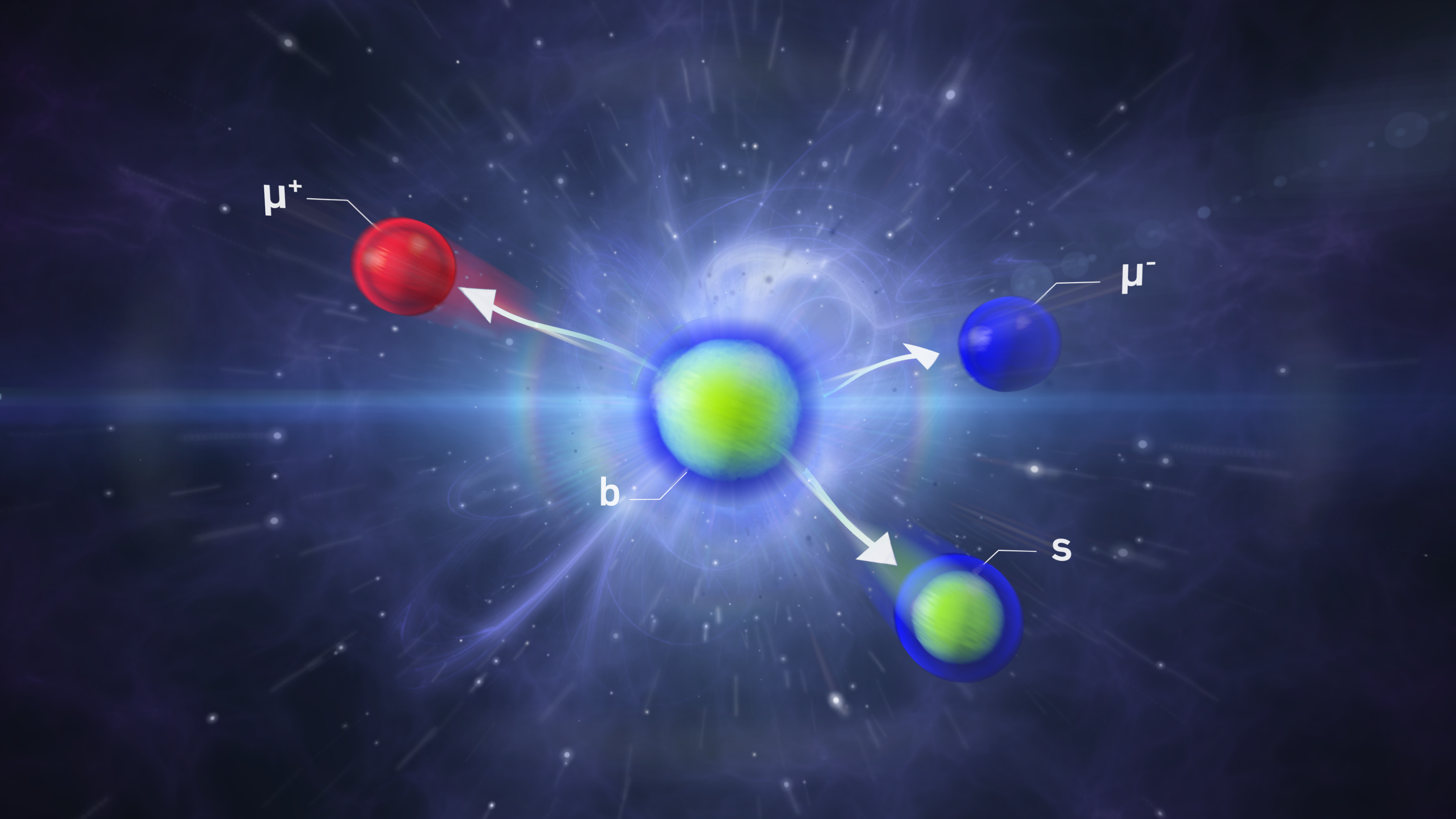
One of the unique features of the weak interaction is its ability to transform one quark flavor into another. However, not all flavor transitions are equally likely. Some occur relatively often, while others are extremely rare because the Standard Model suppresses them through quantum-mechanical processes, known as “loops”. A particularly striking example is the transition of a bottom quark into a strange quark accompanied by a pair of opposite-sign charged muons, denoted b→sμμ. These decays occur only about once in every ten million b-flavored hadron decays, making them significantly sensitive to tiny contributions from particles that may exist beyond the Standard Model. For this reason, flavor-changing transitions provide some of the most stringent tests of the Standard Model and deepen our understanding of particle physics.
Using data collected between 2022 and 2024, the CMS experiment has studied six rare b-flavored hadron channels, all proceeding through the same underlying b→sμμ transition. The channels involve different b-flavored hadrons and different s-flavored particles in the final state, allowing CMS to study the same rare process in complementary ways.
These measurements are intriguing because a persistent pattern has emerged over the past decade. For several rare b-flavored hadron decays involving the b→sμμ transition, experiments have measured branching fractions, the fractions of b-flavored hadrons that decay through a particular channel, that are lower than some Standard Model predictions. The challenge today is no longer simply to observe these decays; it is to measure them with sufficient precision to determine whether these differences point to new physics or to a deeper understanding of the Standard Model itself. CMS has advanced this precision programme through improved data collection and analysis techniques.
A first major advance came from collecting a much larger sample of these rare decays using improved trigger technique. For Run 3, CMS deployed an “inclusive dimuon” trigger, which recorded far more rare decay candidates than had previously been possible. This reduced the statistical uncertainties in the measurements to the percent level.
The second major advance was to study all six decay channels together rather than as independent measurements. These channels are B+→ K+μμ, B+→ K*+μμ, B0 → Ks0μμ, B0 → K*0μμ, Bs0 → μμ, and Λb0 → Λ0μμ. By analysing them simultaneously, CMS could treat related backgrounds and sources of uncertainty consistently across the different channels, leading to a more robust determination of the branching fractions. This unified approach provides the most comprehensive and precise CMS picture to date of rare b→sμμ decays.
As shown in Fig. 1, the differential branching fraction results, which tell how the decay probability varies with the squared mass of the muon pair, are consistent with previous measurements by CMS and LHCb. Most notably, all six rare decay channels continue to exhibit branching fractions that are systematically lower than several predictions. While the deviations remain individually modest, their consistency across multiple decay modes and successive generations of measurements continues to motivate both theoretical and experimental scrutiny.
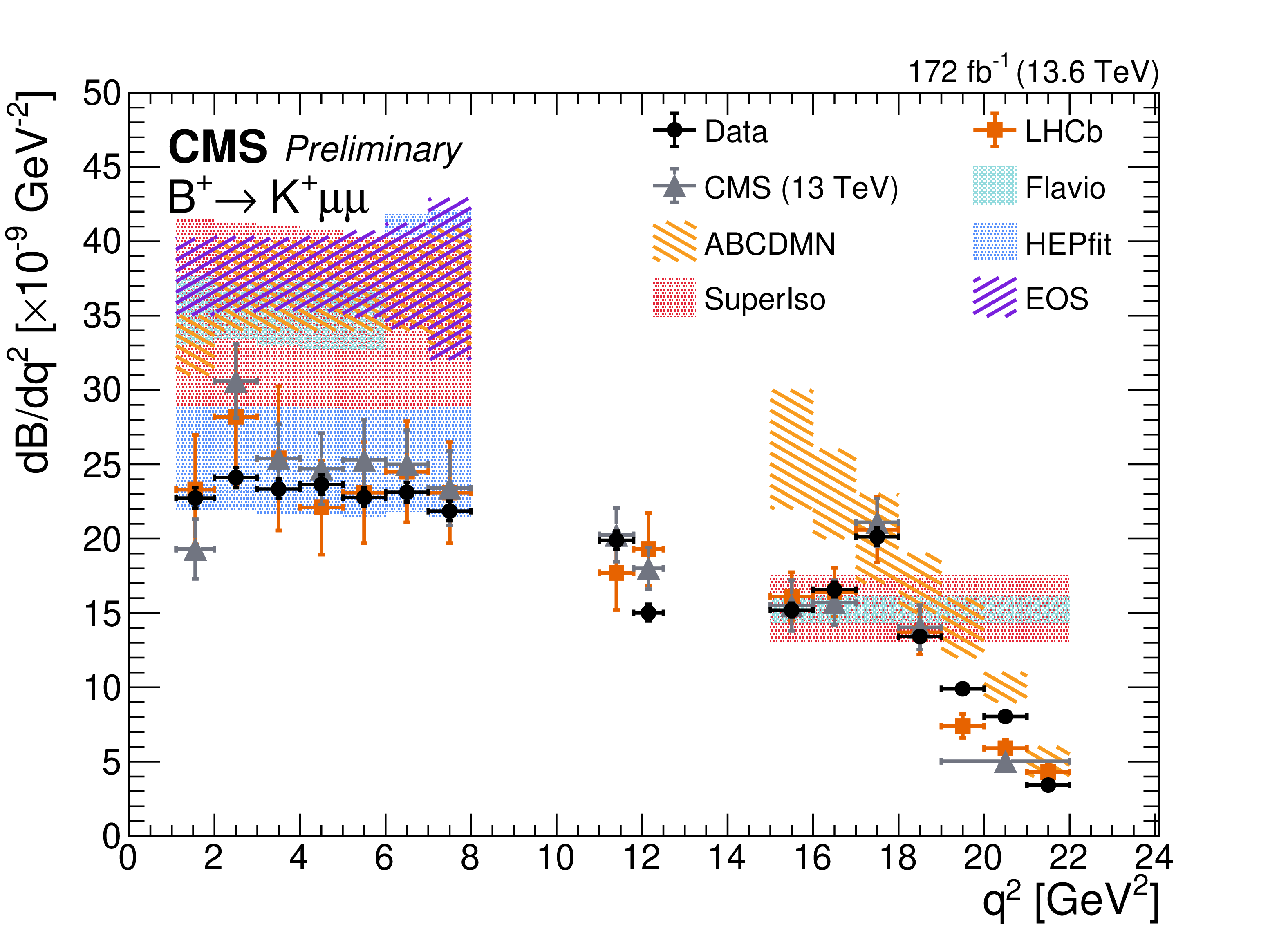
Fig. 1: Comparison of measured differential branching fraction for the pseudoscalar B+→K+μμ with the theory predictions from ABCDMN, SuperIso, Flavio, HEPfit, and EOS packages. The CMS results are in agreement with previous CMS & LHCb results and with significantly reduced uncertainty. For all the studied decay modes, a relative suppression with respect to theory is observed.
The analysis also compares closely related neutral and charged B-meson decays. These mesons differ mainly by whether they contain an up or down spectator quark. The relative differences in their decay rates, known as isospin asymmetries, are consistent with zero within the measured uncertainties and remain in agreement with the Standard Model expectations, as shown in Fig. 2.
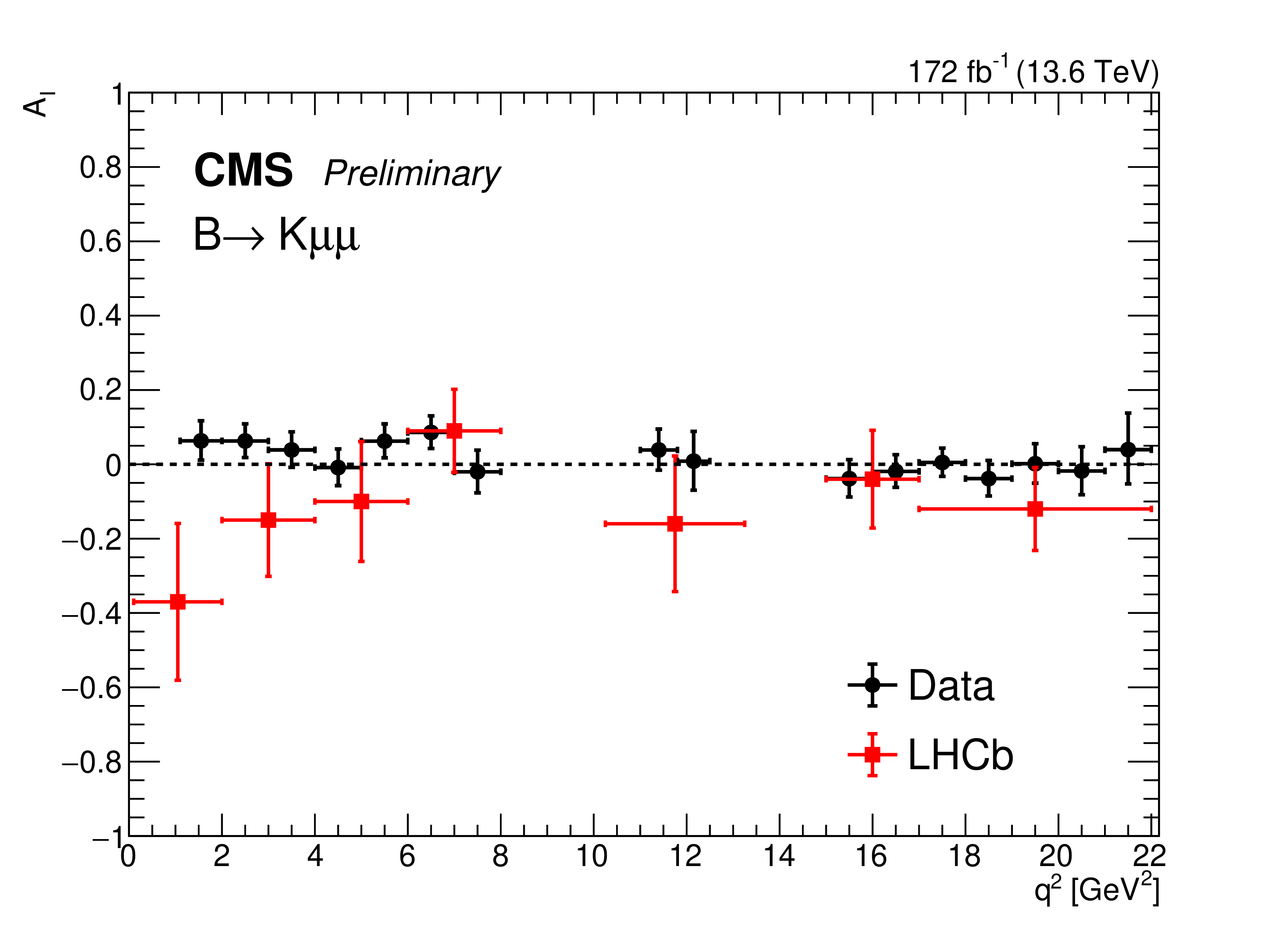
Fig. 2: Isospin asymmetry measurements for the pseudoscalar B→Kμμ decay modes. The CMS results are compatible with zero (as per the Standard Model prediction) and are measured with significantly reduced uncertainty. The LHCb measurements are superimposed.
CMS also measured ratios comparing decays through the ψ(2S) and J/ψ resonances. These ratios provide a stringent validation of the analysis and, thanks to the large data samples, are also precise measurements in their own right, as shown in Fig. 3.
As both experimental measurements and theoretical calculations continue to improve, these rare decays are becoming powerful laboratories for exploring physics beyond the Standard Model. Whether the observed pattern ultimately points to new fundamental particles or to a deeper understanding of the Standard Model itself, the era of precision measurements has clearly begun.
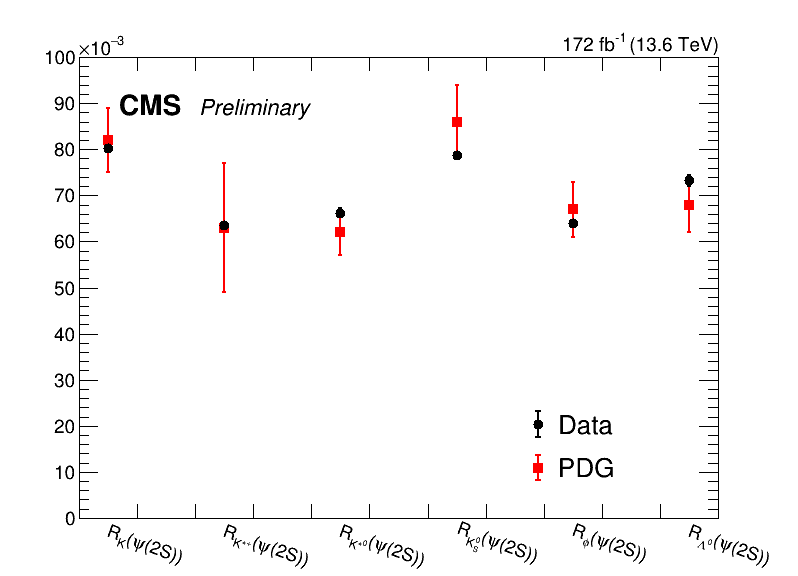
Fig. 3: Comparisons of the ψ(2S) branching fractions with respect to the corresponding J/ψ modes. The results are compared with the world’s average values from the Particle Data Group.
Written by: Georgios Melachroinos and Paris Sphicas, for the CMS Collaboration
Edited by: Haifa Rejeb Sfar
Read more about these results: